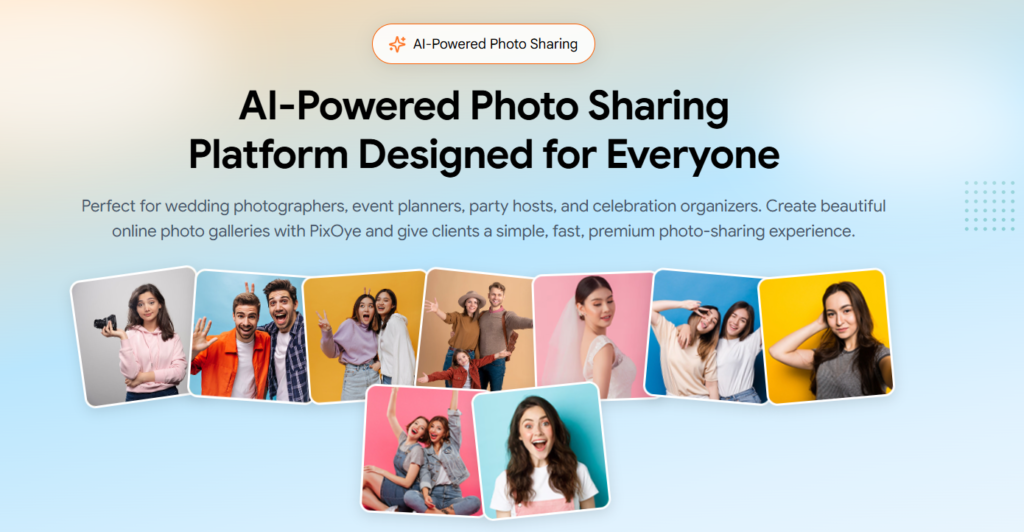
Think back to the last big event you went to. Maybe a wedding, maybe your kid’s school function. A photographer was there, camera clicking away, and somewhere in the few thousand shots they took, there’s a photo of you, laughing at something, mid-stride, stuck in an awkward group pose. Good luck finding it, though.
Most people don’t bother, honestly. A Google Drive link shows up, they scroll for a bit, get to photo 300-something, lose patience and just text a friend asking if they got anything decent. It’s a weirdly analog problem for how digital everything else has become. The photo exists, it’s sitting on a server somewhere, and nobody can be bothered to dig it out.
Pixoye was built around a pretty simple idea that somehow nobody solved properly until recently: if a computer can recognize your face, it should be able to hand you your own photos. You shouldn’t have to go looking.
Why this became a problem in the first place
Cameras got better, events got bigger and somewhere along the way delivery stopped keeping up. A wedding photographer these days might walk away from a two-day shoot with 4,000-plus frames. Marathon photographers can end up with tens of thousands of finish-line shots. None of that is hard for the camera. It’s hard for whoever has to make sense of it afterward.
For years the fix was just… a shared folder. Everyone scrolls, most people give up early and the photographer spends the next two weeks answering “can you send me the one where I’m by the cake” messages one at a time.
Pixoye flips that around. Instead of you hunting through the album, the album goes and finds you.
How the matching actually works
The setup itself doesn’t ask much of anyone. A host uploads the gallery, the whole thing, thousands of photos if needed, and shares one link. That link can go out over WhatsApp, email or whatever’s easiest.
From there, a guest has two options. Browse everything, or run a quick face scan and only see the shots they’re actually in. No one’s sitting there tagging faces at midnight. No one’s scrolling through four thousand pictures hoping to spot themselves in the background of someone else’s photo.
The part doing the real work is the facial recognition underneath it, which has to deal with the stuff that makes this genuinely hard: bad lighting, weird angles, half a face turned away from the camera, someone buried three rows back in a crowd shot. That used to be a job for a human with way too much patience.
Speed isn’t really the whole story
Getting photos faster is the obvious selling point, but there’s something else going on too and it matters more than people give it credit for: who gets to see what.
A match-only link means guests only unlock their own photos and only after the app confirms it’s actually them. Everything else in the gallery stays closed off. Which is kind of a relief when you think about it. Nobody signed up for five hundred near-strangers casually browsing every candid from their wedding reception. Pixoye lets a host share plenty without throwing the whole album open to everyone at once.
On the photographer’s side, this solves a different headache. Rather than manually pulling and sending individual photos to dozens of guests one by one, they upload once and let the matching do the routing. A job that used to eat a week can get done in an afternoon.
Built to actually handle scale
This is where Pixoye separates itself from a basic shared folder. It’s already processed hundreds of millions of photos across hundreds of thousands of events, which means the matching has been stress-tested in exactly the chaotic conditions where manual sorting falls apart: packed stadiums, dance floors at 11 p.m., a school sports day with forty teams all running around in identical uniforms.
There’s a working-photographer layer to it too. Bulk uploads for after a full shoot day. In-camera delivery over secure SFTP so photos can start reaching people while the event’s still going. And if your archive already lives in Google Drive, you can just connect the folder instead of uploading everything twice.
None of it requires a guest to learn anything new. Open a link, scan your face if you want to, get your photos. That’s the entire experience on their end, which is really the whole point.
The bigger shift here
What Pixoye is really doing is changing a fairly old assumption about event photography. For a long time, photos were something you took and then just hoped people would eventually stumble across. Now they can go the other direction and find the person instead of waiting to be found.
It’s a small reversal on paper. But if you’ve ever given up halfway through a shared album, tired of scrolling for a version of yourself that might not even be in there, you already know how much that shift actually matters.