If you use an impact wrench, the socket on the end matters as much as the tool. A normal hand socket isn’t made for that kind of force. Over time, it can crack or even break while you’re using it.
Impact sockets are made for this job. They can take the hard, fast hits of an impact wrench, day after day.
What Are Impact Sockets?
You attach an impact socket to an impact wrench the same way you’d put a normal socket on a ratchet. From the outside, they look quite alike. What makes them different is the material and how they’re built.
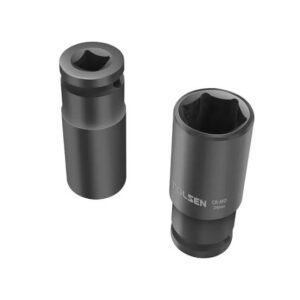
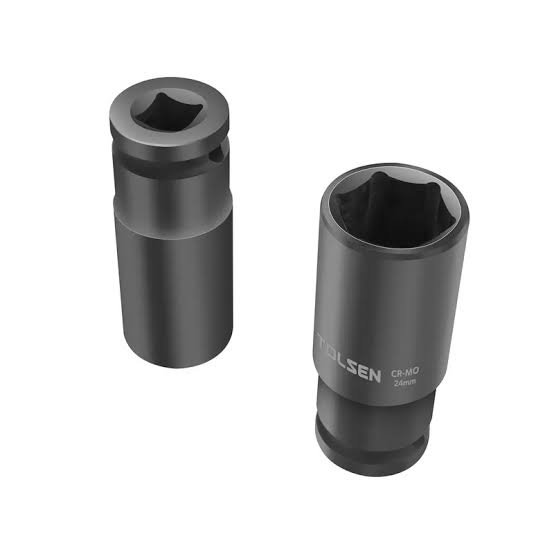
Impact sockets have thicker walls and are made from tougher alloy steel. They’re heat treated so they can bend a tiny bit under a hit instead of cracking. Most are black, because of a black oxide coating that helps stop rust. Normal hand sockets are usually shiny chrome, and they’re harder but more brittle.
Think of it like a glass and a plastic cup. Both hold water, but only one survives being dropped again and again.
Why not use a normal socket on an impact wrench?
People do it all the time, mostly because the chrome socket is already in the toolbox. Honestly, it might work for a while. But chrome sockets aren’t built for repeated hammering. They can split, and a broken piece can fly off at high speed. That’s a real risk to your eyes and hands.
Which one should you select: square drive or spline drive?
Most of these sockets have a square drive, like 1/2 inch or 3/4 inch. This is the hole that fits onto the wrench. Bigger drives are used for bigger bolts.
On heavy steel work, you’ll also see spline drive sockets, such as #5 spline. These have a ring of small teeth inside instead of a square. They spread the load better, so they’re common on large impact wrenches used for structural bolts.
Where structural wrenches come in?
On steel building sites, workers use impact sockets alongside structural wrenches. A structural wrench has an open or ring end for the nut and a long, pointed handle. The pointed end is pushed through bolt holes to line up steel beams before the bolts go in.
So the structural wrench lines things up, and the impact wrench with the right socket does the tightening.
What to check before you buy
Start with the drive size and the nut size you use most. Check that the socket is clearly marked for impact use. Look for a ring and pin to hold it firmly on the wrench, because a loose socket can fly off. If you’re also buying from a structural wrenches manufacturer, ask whether they make matching impact sockets, so your sizes stay the same across both tools.
Conclusion
On an impact wrench, impact sockets are the safer choice, and they don’t wear out as fast as normal sockets. Make sure the drive and size match your bolts. Wear safety glasses whenever you use one. A good structural wrenches manufacturer can help you match both tools to your job.
Impact Socket offers square drive and #5 spline impact sockets made from heat-treated alloy steel, along with structural and slugging wrenches, and ships to over 140 countries.