Forklifts play an important role in warehouses, distribution centers, manufacturing plants, and other industrial environments. When a forklift depends on a battery for power, battery condition can directly affect how reliably the equipment performs throughout the workday. Over time, even a well-maintained forklift battery can lose its ability to hold a charge, deliver consistent power, or operate for an entire shift. When that happens, replacing the entire battery is not always the only option. Industrial battery service can sometimes restore a worn battery through a process known as rebuilding.
Forklift battery rebuilding is more than simply replacing a few damaged parts. It involves inspecting the battery, identifying failed components, replacing or repairing suitable parts, and testing the finished unit to determine whether it can safely return to service. When performed correctly, rebuilding can give a suitable battery a new lease on life while reducing waste and helping businesses manage equipment costs.
What Is a Forklift Battery?
Most traditional electric forklifts use lead-acid batteries designed to provide substantial amounts of power over extended operating periods. These batteries contain multiple cells connected together to produce the voltage required by the forklift.
A typical forklift battery includes:
- Individual battery cells
- Positive and negative plates
- Electrolyte
- Separators
- Cell connectors
- Battery cables and terminals
- A protective steel case
- Vent caps or watering components
Each part has an important role. If one or more cells become weak or damaged, the battery may no longer perform as expected. Operators may notice shorter run times, slower lifting performance, reduced acceleration, or unexpected voltage drops.
Because forklift batteries are large, heavy, and expensive, rebuilding may be worth considering when the underlying battery structure is still in usable condition.
Why Do Forklift Batteries Need Rebuilding?
Forklift batteries experience demanding operating conditions. They may be charged and discharged frequently, exposed to heat, subjected to vibration, and required to deliver high amounts of energy during every shift.
Several issues can gradually reduce battery performance.
Normal Wear and Aging
Rechargeable batteries naturally lose capacity as they go through repeated charge and discharge cycles. The plates inside lead-acid cells gradually deteriorate, reducing the amount of energy the battery can store and deliver.
Weak or Failed Cells
A forklift battery is made up of multiple cells. If one or more cells become significantly weaker than the others, the entire battery’s performance can suffer. Depending on the condition of the battery, replacing individual cells may be part of the rebuilding process.
Sulfation
Sulfation occurs when lead sulfate crystals accumulate on battery plates, particularly when a lead-acid battery is repeatedly undercharged or left in a discharged state. Excessive sulfation can reduce charging efficiency and available capacity.
Poor Maintenance
Incorrect watering, inadequate charging practices, contamination, and neglect can accelerate battery deterioration. A rebuilding assessment can help determine whether the battery is still a practical candidate for restoration.
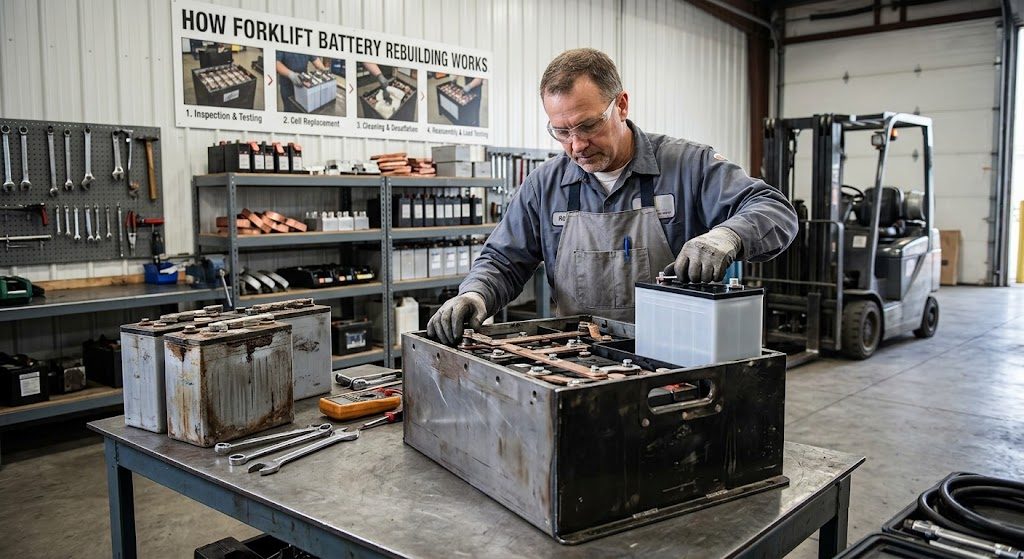
How the Forklift Battery Rebuilding Process Works
The rebuilding process varies depending on the battery’s design and condition, but professional rebuilding generally follows several important stages.
1. Initial Battery Inspection
The first step is a detailed inspection. A technician examines the battery’s overall physical condition and looks for signs of damage, corrosion, leakage, cracked components, or other problems.
The technician may also review information such as:
- Battery age
- Voltage rating
- Previous maintenance history
- Charging behavior
- Operating symptoms
- Visible cell condition
This assessment helps determine whether rebuilding makes sense.
Not every battery should be rebuilt. If the case is severely damaged, the internal components are extensively deteriorated, or the repair cost would approach the price of a suitable replacement, replacement may be more practical.
2. Electrical Testing
Physical inspection alone does not provide the complete picture. The battery must also be electrically tested.
Technicians can measure the battery’s voltage and evaluate individual cells. Differences between cells can reveal weak or failing components.
Capacity testing may also be performed to determine how much usable energy the battery can provide under controlled conditions. This is especially important because a battery can show an acceptable voltage reading while still having significantly reduced capacity.
3. Opening and Inspecting the Battery
If the battery is considered a suitable rebuilding candidate, technicians may access its internal components.
This stage requires appropriate safety procedures because forklift batteries contain corrosive electrolyte and can produce hazardous gases during charging. Trained technicians use suitable protective equipment and follow established battery-handling procedures.
Once accessible, the internal components can be inspected for corrosion, damaged plates, sediment buildup, or other signs of deterioration.
4. Identifying Components That Need Replacement
One of the main goals of rebuilding is to determine which components can remain in service and which need replacement.
Depending on the battery’s condition, rebuilding may involve replacing selected cells or other damaged components. Cell replacement can be particularly useful when a battery has one or several failed cells while the remaining components remain serviceable.
The objective is not to replace parts unnecessarily. A good rebuilding process focuses on restoring reliable performance while maintaining compatibility among the battery’s components.
5. Cleaning and Repairing Connections
Corroded or damaged connections can create resistance and interfere with current flow. During rebuilding, technicians can inspect and address battery connections, terminals, and related components.
Cleaning and repairing appropriate connections can help improve electrical performance and reduce problems caused by poor contact.
6. Reassembly
After necessary repairs and component replacements are completed, the battery is carefully reassembled.
The technician ensures that components are properly positioned and connected. The battery case, connectors, cables, and other relevant parts are checked before the unit moves to the testing stage.
Correct assembly is critical because a forklift battery operates under substantial electrical and mechanical demands.
7. Charging and Testing
A rebuilt battery should not simply be returned to a forklift immediately after reassembly. Testing is an essential part of the process.
The battery may be charged under controlled conditions and then tested to evaluate its performance. Depending on the service process, technicians may check:
- Overall voltage
- Individual cell performance
- Charging behavior
- Capacity
- Temperature during operation
- Voltage stability
- Signs of abnormal discharge
These tests help determine whether the rebuilt battery is performing as expected.
How Do You Know if a Forklift Battery Can Be Rebuilt?
Not every aging forklift battery is a good candidate for rebuilding. Several factors should be considered before making a decision.
Battery Age
Older batteries may have experienced significant internal deterioration. Age alone does not automatically rule out rebuilding, but it should be considered alongside capacity and physical condition.
Overall Physical Condition
A battery with a structurally sound case and serviceable internal components may be a better rebuilding candidate than one with severe physical damage.
Number of Failed Cells
A battery with a limited number of failed cells may be repairable, while extensive cell deterioration can make rebuilding less practical.
Remaining Capacity
Capacity is one of the most useful indicators of battery health. If the battery can still retain a meaningful amount of usable capacity after appropriate repairs, rebuilding may be worth considering.
Cost Comparison
Businesses should compare the expected rebuilding cost with the price of a suitable replacement battery. The decision should also account for downtime, expected service life, warranty coverage, and operating requirements.
Benefits of Rebuilding a Forklift Battery
When a battery is a suitable candidate, rebuilding can offer several practical benefits.
Lower Replacement Costs
A complete forklift battery replacement can represent a significant expense. Rebuilding selected components may provide a more economical alternative in certain situations.
Reduced Downtime
Depending on the service provider and battery condition, rebuilding can help businesses restore an existing battery instead of starting the replacement process from scratch.
Less Material Waste
Rebuilding can extend the useful life of existing battery components. Keeping suitable components in service can reduce the amount of material sent for recycling or disposal.
Better Resource Utilization
Industrial batteries contain valuable materials. Extending the service life of a suitable battery can make better use of the resources already invested in its manufacture.
What Causes a Rebuilt Battery to Fail Again?
Rebuilding addresses existing battery problems, but it cannot eliminate future wear. How the battery is treated after rebuilding plays an important role in its service life.
Common causes of premature deterioration include:
- Repeated undercharging
- Overcharging
- Incorrect watering
- Allowing the battery to remain deeply discharged
- Operating in excessive heat
- Poor charging practices
- Lack of regular inspection
- Using an incompatible charger
Following the battery manufacturer’s charging and maintenance recommendations is therefore just as important after rebuilding as it was before the service.
How to Maintain a Rebuilt Forklift Battery
Proper maintenance can help protect the investment made in rebuilding.
Follow the Correct Charging Routine
Use a charger that matches the battery’s specifications. Avoid routinely interrupting charging cycles unless the manufacturer’s operating instructions allow it.
Check Electrolyte Levels
For applicable flooded lead-acid batteries, electrolyte levels should be checked and maintained according to manufacturer recommendations. Watering should be done correctly and at the appropriate time.
Keep the Battery Clean
Dirt, corrosion, and electrolyte residue can contribute to electrical problems and accelerate deterioration. Regular cleaning and inspection can help identify issues early.
Monitor Performance
Operators should pay attention to changes in operating time, charging behavior, lifting performance, and other signs of declining battery performance. A sudden change can indicate a developing problem.
Schedule Professional Inspections
Periodic professional testing can identify weak cells or capacity problems before they cause unexpected interruptions during operations.
Rebuilding vs. Replacing: What Should You Choose?
The right decision depends on the individual battery and the operational requirements of the business.
Rebuilding may make sense when the battery has a sound structure, limited component failures, and enough remaining life to justify the repair. Replacement may be more appropriate when the battery has extensive damage, severe deterioration, or insufficient remaining capacity.
Rather than making the decision based solely on age, businesses should consider the battery’s test results, physical condition, expected future workload, repair cost, replacement cost, and required reliability.
Conclusion
Forklift battery rebuilding is a structured process that combines inspection, electrical testing, component replacement, repair, reassembly, and performance testing. When a battery has suitable underlying components, rebuilding can be a practical way to restore performance without immediately purchasing a completely new unit.
The key is to have the battery properly evaluated rather than assuming every weak battery can or should be rebuilt. Professional assessment can help identify the actual cause of poor performance and determine whether rebuilding is technically and economically sensible. Businesses looking for experienced battery support can work with Battery Rescue LLC to explore suitable rebuilding and battery service options for their equipment.
With proper rebuilding, charging, maintenance, and regular testing, a forklift battery may continue supporting demanding operations for considerably longer. The result is not simply a repaired battery it is a more informed approach to equipment maintenance, operating costs, and battery life.