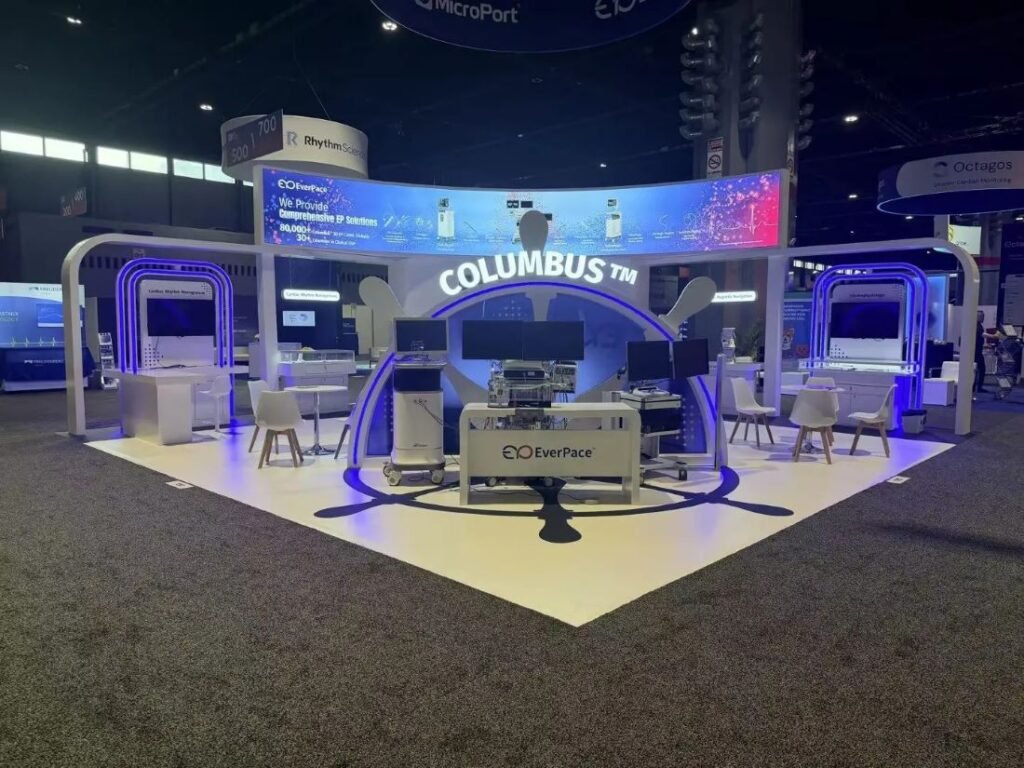
A polished trade show booth can look impressive in photographs and 3D renderings. Clean graphics, attractive lighting, modern structures, and carefully selected furniture can create a strong first impression.
But a beautiful booth is not automatically a successful booth.
Once the exhibition opens, the environment changes. Visitors are moving in different directions, staff are having conversations, neighboring exhibitors are competing for attention, and the booth has to communicate its purpose within seconds.
For Minneapolis exhibitors, this is where good exhibit design Minneapolis needs to go beyond appearance and focus on how the space actually works.
- Visitors Don’t Experience the Booth Like a Designer Does
A designer may view a booth from a carefully selected angle. Visitors experience it while walking through a busy aisle.
They may see it from:
- Across the aisle
- From the side
- Behind other visitors
- While moving quickly
- While focused on another exhibitor
If the main branding or message is only visible from one angle, the booth may lose opportunities to attract attention.
Ask a Simple Question
Can someone understand who you are and what you offer before entering the booth?
If the answer is unclear, the design may need stronger visual hierarchy.
- Too Much Information Can Become a Barrier
Exhibitors often want to communicate everything: company history, product features, services, benefits, statistics, customer logos, and technical details.
The problem is that visitors usually don’t have time to read everything.
A booth packed with text can become visually overwhelming even when the design itself is attractive.
Effective exhibit design in Minneapolis should establish a clear information hierarchy:
Primary message → Key offering → Supporting information → Conversation or demonstration
Visitors should be able to understand the main point first and explore details afterward.
- The Booth Doesn’t Guide Visitor Movement
A beautiful booth can still feel awkward if visitors don’t know where to go.
For example, a large counter positioned near the entrance may unintentionally create a barrier. Meeting tables might block product displays, while demonstrations could attract crowds in areas that weren’t designed for standing visitors.
Before approving a layout, consider:
- Where do visitors enter?
- Where do they naturally stop?
- Can several people move through comfortably?
- Where will demonstrations happen?
- Where can staff have conversations?
- Is there enough space around meeting areas?
Good design should support movement rather than force visitors to navigate around obstacles.
- The Booth Looks Great-But Staff Can’t Work in It
The visitor experience is only half the equation.
Your team may spend eight or more hours inside the booth. They need places to store personal items, access marketing materials, charge devices, conduct meetings, and manage demonstrations.
A rendering can hide these practical requirements.
A useful booth should provide enough:
- Storage
- Seating
- Work surfaces
- Product access
- Technology access
- Staff circulation space
If the team becomes crowded or disorganized during busy periods, the booth’s visual appeal won’t solve the problem.
- Lighting Looks Good but Doesn’t Support the Message
Lighting is often treated as decoration, but it can influence what visitors notice first.
Poorly positioned lighting can create glare on screens, leave products in shadow, or make important graphics difficult to read.
Consider whether the lighting highlights:
- Key products
- Brand signage
- Demonstration areas
- Meeting spaces
- Important graphics
The goal isn’t simply to make the booth brighter. It is to make important elements easier to notice.
- The Design Ignores the Surrounding Environment
Your booth doesn’t exist in isolation.
On the show floor, it may be surrounded by dozens or hundreds of other exhibitors. Nearby structures, hanging signs, large screens, lighting, and crowds can change how your booth is perceived.
A design that looks distinctive against a blank background may become less noticeable when surrounded by competing displays.
This is why reviewing the booth from realistic aisle perspectives can be valuable before production begins.
- The Design Is Difficult to Build or Install
Another potential problem appears when an ambitious concept meets real-world fabrication.
Unusual structures, complex materials, oversized graphics, heavy components, or intricate technology setups may introduce additional production and installation requirements.
The question isn’t whether a feature looks impressive.
It is:
Can it be produced, transported, installed, tested, and maintained within the show’s requirements and timeline?
This is where technical planning becomes an important part of exhibit design Minneapolis.
- There Is No Clear Reason for Visitors to Engage
A booth can attract attention without creating meaningful interaction.
Visitors need a reason to stop.
That reason could be:
- A product demonstration
- A hands-on experience
- A relevant question
- A useful takeaway
- A scheduled consultation
- An interactive presentation
The feature should connect to the exhibitor’s actual objective rather than being included simply because it looks impressive.
A Practical Pre-Show Reality Check
Before finalizing your booth, walk through these questions:
Visibility
Can visitors recognize the brand from multiple directions?
Message
Can they understand the main offering quickly?
Movement
Can people enter, stop, and leave without creating congestion?
Function
Can staff comfortably work throughout the day?
Engagement
Is there a clear reason for visitors to stop?
Buildability
Can every element realistically be fabricated and installed?
Show Rules
Does the design meet the specific venue and event requirements?
If several answers are uncertain, the booth may need another design review before production.
Final Takeaway
A beautiful booth can attract attention, but attention alone doesn’t guarantee engagement.
Successful exhibition spaces need to balance visual appeal with visibility, communication, visitor movement, staff functionality, technical feasibility, and real-world show-floor conditions.
For Minneapolis exhibitors, the most effective approach to exhibit design in Minneapolis is therefore not simply asking, “Does this booth look good?”
Ask the more useful question:
“Will this booth help visitors notice us, understand us, and engage with us when the show is busy?”
That is the difference between designing a booth for a presentation and designing one for the real exhibition floor.