Most businesses know they need SEO. Fewer know what they’re actually paying for. If you’ve ever looked at an SEO proposal and wondered what “on-page optimisation” or “link equity” really means in practice, you’re not alone. Hiring an SEO company is a significant investment, and it pays to understand exactly what that investment covers before you sign anything.
This guide breaks down what SEO companies do, how they price their services, and how to tell a credible agency from one that will waste your budget.
What SEO Companies Actually Do
An SEO company helps your website rank higher in search engine results pages (SERPs). But that’s only the surface-level answer. The real work spans technical, creative, and strategic disciplines—often running simultaneously.
Keyword Research and Strategy Development
Every effective SEO campaign starts with understanding what your target audience is searching for. SEO companies use tools like Ahrefs, SEMrush, and Google Search Console to identify high-value keywords, assess their difficulty, and map them to specific pages on your site. This isn’t just about volume—it’s about intent. A keyword that brings in 500 highly motivated buyers is far more valuable than one that drives 5,000 casual browsers.
On-Page Optimisation
Once target keywords are identified, SEO companies optimise your existing content and page structures. This includes refining meta titles and descriptions, improving heading hierarchies, adding internal links, and ensuring each page clearly signals its topic to search engines. It’s methodical work, but it directly affects how well your pages perform.
Technical SEO Audits and Improvements
Technical SEO addresses what happens behind the scenes. Crawlability, site speed, structured data, duplicate content, broken links, and XML sitemaps all fall under this umbrella. A technical audit often uncovers issues that have been quietly suppressing your rankings for months—or years.
Link Building and Authority Development
Search engines treat backlinks as votes of confidence. The more authoritative sites that link to yours, the more credible your site appears. SEO companies develop link-building strategies through tactics like digital PR, guest posting, and outreach—always with an eye on quality over quantity.
Performance Tracking and Reporting
A good SEO company doesn’t just do the work; it shows you the results. Monthly reporting should cover organic traffic trends, keyword ranking changes, conversion data, and a clear explanation of what was done and why.
Common SEO Services: What’s Usually Included
Different agencies package their services differently, but most reputable SEO companies offer some combination of the following:
- SEO audits and competitive analysis – A deep dive into your site’s current performance and how you stack up against competitors
- Content creation and optimisation – Writing or improving pages, blog posts, and landing pages to target specific search queries
- Local SEO – Optimising your Google Business Profile and local citations to improve visibility in location-based searches
- Mobile optimisation and Core Web Vitals – Ensuring your site loads fast and functions well on mobile devices, both ranking factors in Google’s algorithm
- Analytics setup and monitoring – Configuring Google Analytics and Search Console to accurately track what matters
Not every business needs all of these. A local tradesperson has very different SEO needs from a national e-commerce retailer. The best agencies tailor their approach rather than offering a one-size-fits-all package.
Pricing Models and What You Should Expect to Pay
SEO pricing varies considerably, and that’s partly because the work itself varies. Here’s a breakdown of the most common models.
Monthly Retainers
The most common arrangement. You pay a fixed monthly fee in exchange for ongoing SEO work. Retainers typically range from £500–£2,000 per month for small businesses, and £2,000–£10,000+ per month for more competitive industries or larger sites. What you get for that fee should be clearly defined in a scope of work.
Project-Based Pricing
Suited to specific, time-limited initiatives—like a site migration, an SEO audit, or a content overhaul. Project fees can range from £500 for a basic audit to £10,000+ for a comprehensive content and technical project.
Hourly Consulting
Some SEO professionals charge by the hour for advisory work, strategy sessions, or training. Rates typically fall between £75 and £200 per hour, depending on experience and specialism.
What Influences the Price?
- Industry competition – Ranking in legal, finance, or property requires far more effort than ranking in a niche with few competitors
- Current site health – A site riddled with technical issues requires more upfront work
- Scope of services – Whether you need content creation, link building, technical SEO, or all three
- Agency size and reputation – Boutique agencies and freelancers may offer better value for smaller businesses; larger agencies bring more resource but at a higher price
Red Flags to Watch For
Be cautious of any SEO company that guarantees a first-page ranking within 30 days. No legitimate agency can guarantee specific rankings—search engines don’t work that way. Similarly, very low prices (think £99/month packages) rarely deliver meaningful results and sometimes cause more harm than good through spammy link-building tactics.
How to Choose the Right SEO Company
The SEO industry isn’t regulated, which means standards vary wildly. Here’s how to filter out the noise.
Review their case studies. A credible agency will have documented examples of results achieved for clients in comparable industries. Look for specifics—traffic growth percentages, ranking improvements, conversion lifts—rather than vague success stories.
Check independent reviews. Google Reviews, Clutch, and Trustpilot are useful starting points. Look for patterns in how they handle communication, reporting, and problem-solving.
Ask about their methodology. A trustworthy SEO company will happily explain what they’re doing and why. If an agency is vague about its approach or reluctant to share details, that’s a concern.
Insist on ethical, white-hat practices. Black-hat tactics—like buying links in bulk or keyword stuffing—can produce short-term gains but often result in Google penalties that are difficult to recover from. Confirm that any agency you work with follows Google’s Webmaster Guidelines.
Prioritise transparency and communication. Regular, jargon-free reporting is non-negotiable. You should always know what’s being worked on, what’s been achieved, and what’s planned next.
Finding the Right SEO Partner for Your Business
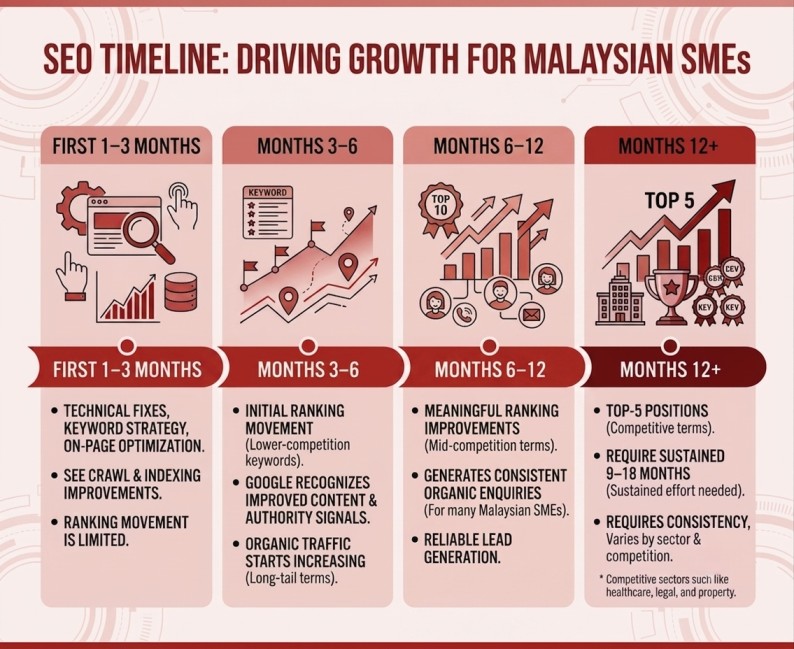
Working with an SEO company can significantly accelerate your online growth—but only if you choose the right one and set realistic expectations. SEO is not a quick fix. Most campaigns take three to six months to show meaningful movement, and the real compounding benefits tend to emerge over twelve months or more.
The businesses that get the most from SEO are those that treat it as a long-term channel, not a one-off project. That means finding a partner who understands your industry, communicates clearly, and measures success by your business outcomes—not just by rankings.
Before you start reaching out to agencies, take stock of where you currently stand. What are your organic traffic levels? Which pages are underperforming? Do you have any existing technical issues? The clearer your baseline, the easier it will be to evaluate proposals and hold any agency you hire to account.