Key Takeaways
- Speed wins bookings. Dubai welcomed 19.59 million international overnight visitors in 2025. Agencies that respond, quote and confirm faster than competitors capture that demand.
- A website is one channel, not a system. Connected travel software links enquiries, suppliers, payments and reporting in a single workflow.
- Automation improves efficiency. Removing manual re-entry between WhatsApp, spreadsheets and supplier portals cuts errors and frees agents to sell.
- AI assists, humans decide. Use AI for itinerary drafts and lead qualification, but take pricing and availability from live supplier data.
- Design for the UAE from day one. AED and multi-currency pricing, 5% VAT invoicing, e-invoicing from 2027 and PDPL data protection shape the architecture.
- Stay competitive with smart choices. Pick custom, ready-made or hybrid software based on your workflows and supplier network, not on feature count.
- Budget in phases. Indicative ranges run from AED 110,000 for an MVP to AED 1,285,000+ for AI-enabled platforms.
Dubai welcomed 19.59 million international overnight visitors in 2025, up 5% from 18.72 million the year before, according to the Dubai Department of Economy and Tourism (DET). Hotels averaged 80.7% occupancy. For anyone selling trips, tours and transfers, that’s good news. It’s also a stress test.
Walk into a mid-sized Dubai travel agency on a busy afternoon and the problem is easy to spot. One enquiry lands on WhatsApp. Another arrives through the website form. A third comes from Instagram, and a corporate client phones to amend a booking. Quotes live in spreadsheets, supplier confirmations sit in email threads, and nobody can say within ten seconds who still owes what.
A booking website doesn’t fix that. It adds one more channel to the pile.
Travel software development is the work of connecting those pieces: customer enquiries, booking workflows, supplier inventory, payments, finance and reporting, so data moves once instead of being retyped five times. This guide covers the modules that matter, where AI helps (and where it doesn’t), UAE-specific requirements, build-versus-buy decisions, realistic budgets and a phased route to launch.
Why Dubai Travel Businesses Need More Than a Booking Website
Rising travel demand creates operational pressure
Every extra visitor creates work behind the scenes: enquiries to answer, quotes to build, amendments to process, cancellations to refund. With hotels running at 80.7% average occupancy in 2025, rooms, transfers and activities are often tight, and the agency that confirms first usually keeps the customer.
Buyers are also moving online. VIDEC’s GCC & Egypt Travel Market Sizing & OTA Benchmarking Study, presented at Arabian Travel Market 2026, puts UAE online air-booking penetration at 42% in 2025, 46% in 2026 and a forecast 52% by 2030. The same research estimates that Booking.com and Agoda together hold around 70% of the hotel OTA market. Independent agencies, DMCs and tour operators compete against those platforms on service quality and speed. A shared spreadsheet won’t get them there.
Disconnected workflows create avoidable revenue leakage
Here’s an illustrative scenario. A family messages an agency on WhatsApp asking for a five-night Dubai stay with desert safari and airport transfers. Agent A answers after lunch and copies the details into a spreadsheet. A hotel rate is requested by email. The customer, meanwhile, has messaged two other agencies.
By the time the quote goes out, the net rate has changed. The follow-up reminder lives in someone’s head. When the supplier finally confirms, the email lands in the inbox of an agent who’s on leave. Nobody knows whether the deposit arrived.
None of these failures is dramatic. Together they cost real money: slower responses lower conversion, duplicate customer records waste follow-up effort, stale rates erode margins, and unclear balances delay collections. Manual coordination also caps growth, because every new booking needs the same human attention as the last one.
From digital presence to connected travel operations
A basic booking website shows products and takes orders. A connected travel platform runs the business behind the order. It ties the CRM, booking engine, supplier connections, payments, finance and reporting into one record of each customer and trip.
That difference matters when something changes. If a supplier amends a flight time, the platform updates the booking, flags the affected customer and adjusts the invoice, instead of waiting for someone to notice. The next section covers the capabilities worth prioritising.
What Modern Travel Software Should Include in Dubai
Booking engine and travel package management
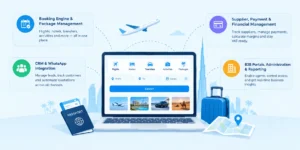
The booking engine is the transaction core. For most Dubai businesses it needs to handle flights, hotels, airport transfers, activities and holiday packages, and, depending on the business, visa services or Umrah-related itineraries.
Search, availability, quotation, confirmation, amendment and cancellation should run as one workflow, not as separate tools. Real-time pricing and inventory come from supplier APIs, so the price a customer sees matches what the supplier will actually honour. Package builders matter just as much to DMCs, who combine hotel, transport and experiences into branded itineraries and need margins calculated automatically.
This is where travel application development stops being a technical exercise and becomes a design question: how do search, quoting and confirmation share one data model so nothing is typed twice?
CRM, WhatsApp integration and quotation automation
Customers don’t care which channel they use. Your system shouldn’t either. Website forms, WhatsApp messages, social enquiries and phone calls should create or update one customer record, assign a lead to the right agent and start a follow-up timer.
From there, the CRM tracks history: past trips, preferences, quotations sent, quotations accepted. Agents can generate branded itineraries and proposals from templates and supplier data, then see at a glance which quotes are waiting on a reply. For agencies running on WhatsApp, this is usually the first module that pays back, because it removes the copy-and-paste step between chat and spreadsheet.
Connecting a CRM to a booking engine, an accounting package and a messaging API is a systems problem as much as a coding one. Many agencies bring in experienced system integrators Dubai to map the data flow between tools before any new code is written.
Supplier, payment and financial management
Margins are made or lost here. The platform should store supplier contracts, negotiated rates, commissions and service fees, then calculate profit per booking at the moment of quotation, not at month-end.
On the payment side, look for gateway integration, deposits and instalments, refunds, reconciliation and multi-currency support, with VAT-ready invoicing (more on that below). The aim is simple: when a booking changes, finance sees it automatically.
B2B portals, administration and reporting
Wholesalers and DMCs selling to other agents need an agent portal with role-based access, customer-specific rates, booking approvals and credit limits. Administrators need one place to manage users, products and permissions.
Reporting should answer practical questions: What’s in the sales pipeline? Which agents convert best? Where are cancellations rising? Which payments are overdue? Which bookings actually earn money? Add modules because the business model demands them, not because a feature list looks impressive.
Quick Question: “What’s the difference between a booking engine and a travel CRM?”— A booking engine handles search, availability, pricing and confirmation of travel products. A travel CRM manages the relationship: leads, customer history, follow-ups and quotations. Agencies need both, working from the same customer and booking data.
How Travel Booking Automation Improves Agency Operations
Automate the booking journey from enquiry to confirmation
Automation only becomes tangible when you follow one booking end to end:
- A customer submits a website enquiry or sends a WhatsApp message.
- The system creates a CRM lead and assigns it to the right agent.
- An automated or AI-assisted reply collects travel dates, destination, budget and passenger details.
- The agent builds an itinerary and quotation from current supplier information.
- The customer approves the proposal and receives a payment link.
- Booking, supplier confirmation and payment status update on one shared timeline.
Nobody retypes anything. Nothing waits in a personal inbox. And a manager can open the timeline and see exactly where a booking stands.
Reduce manual work across documents and payments
Paperwork is where bookings quietly stall. The platform can run document checklists, track visa-related status, route approvals and accept secure uploads of passport copies instead of emailing them around.
Payments get the same treatment: automated reminders before balances fall due, notifications when deposits arrive, and follow-ups to suppliers who haven’t confirmed. After the trip, the system can request a review and, for repeat travellers, trigger a tailored offer. That last step is small, but it’s how a one-off customer becomes a regular.
Measure the operational results
Automation should be judged on numbers. Track enquiry response time, quotation-to-booking conversion, manual processing time per booking, payment delays, cancellation rates and gross margin per booking.
Capture a baseline before launch. Without it, you can’t tell whether the new system is working or simply feels busier. And be wary of any vendor promising a specific percentage improvement without a documented case study behind it. Your own before-and-after data is the only evidence that counts.
How AI Is Changing Travel Software Development in Dubai
AI itinerary planning and personalised recommendations
AI can turn a loose brief (“four nights, two kids, mid-range budget, something outdoors”) into a first-draft itinerary in seconds. It can suggest activities based on interests, season and past bookings.
The catch: language models don’t know today’s availability or net rate. Every price and room count in an AI-drafted itinerary should be validated against live supplier data before it reaches a customer.
AI-assisted sales and customer support
The practical gains are in the front office. AI can qualify leads by asking the right questions, suggest replies for agents, answer booking-status enquiries and support conversations in Arabic, English and other languages common among Dubai’s visitors, such as Russian, Hindi and German.
Keep a human in the loop for complex itineraries, group bookings and high-value clients. The best results come when AI handles the routine and agents handle the relationship.
Demand forecasting and operational intelligence
With clean historical data, AI-supported analytics can highlight seasonal demand patterns, flag capacity pinch points and help sales teams prioritise leads most likely to book. That only works if the underlying data is reliable, integrations are sound and privacy safeguards are in place.
It’s worth separating workflow automation from hype. Fully autonomous travel booking, where software negotiates, books and pays without oversight, remains speculative. Assistive AI is delivering value today, and it’s the sensible place to start for any Travel App Development Dubai project that includes mobile booking and AI-enabled customer support.
UAE-Specific Requirements for a Travel Booking Platform
Arabic, English, AED and multi-currency support
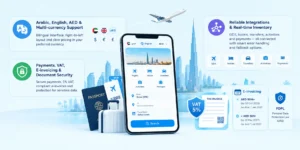
A platform serving Dubai needs bilingual Arabic and English interfaces (including right-to-left layouts), localised content, and sensible exchange-rate handling. Show fees and the final price clearly before payment. Surprises at checkout kill conversions and invite disputes.
Mobile matters too. Travellers browse and pay on phones, and agents often work from airports, hotel lobbies and client offices.
Payments, VAT, e-invoicing and document security
The UAE’s standard VAT rate is 5%. Under Federal Tax Authority rules, VAT-registered businesses must issue a compliant tax invoice, generally within 14 days of the supply, and invoices in foreign currencies must show the VAT amount in AED. Your platform should generate these automatically and reconcile them against payments.
E-invoicing is the next shift. Under the Ministry of Finance’s phased timeline, businesses with annual revenue of AED 50 million or more must appoint an Accredited Service Provider by 30 October 2026 and go live on 1 January 2027. Businesses below that threshold follow with an appointment deadline of 31 March 2027 and go-live on 1 July 2027. The mandate covers B2B and B2G transactions, with B2C supplies excluded, and invoices travel through accredited providers on the Peppol network. If you sell to other agents or corporate clients, build invoicing with this in mind now rather than retrofitting later.
Then there’s personal data. Passports, visa documents and payment details are sensitive. The UAE’s Federal Decree-Law No. 45 of 2021 (the PDPL), in force since 2 January 2022, makes consent the primary basis for processing personal data and gives individuals rights of access, correction and erasure. DIFC and ADGM operate their own regimes. Confirm which applies to your entity, and have qualified legal and tax advisers review your setup. This article is guidance, not legal advice.
Reliable integrations and real-time inventory
Travel software lives or dies by its connections: GDS content, hotel wholesalers, transfer providers, activity suppliers and payment gateways. Good API integration Dubai projects plan for failure from the start, with error handling, retry logic, monitoring and fallback procedures for when a supplier’s system goes down mid-booking. A platform that can’t degrade gracefully will fail on your busiest day.
Quick Question: “Does a UAE travel platform need to support e-invoicing?”— If your business issues B2B or B2G invoices, yes. The Ministry of Finance’s rollout starts on 1 January 2027 for larger businesses and 1 July 2027 for the rest, with B2C sales excluded. Confirm your exact phase and obligations with a tax adviser.
Custom Travel Software vs Ready-Made Platforms
When ready-made travel software is the better option
Off-the-shelf platforms suit businesses with standard booking needs, tight timelines and limited upfront budgets. You get a working system quickly. The trade-offs are subscription costs that grow with usage, limits on integrations, and a roadmap set by the vendor, not by you.
When custom travel application development makes sense
Custom builds earn their cost when your business is genuinely different: complex supplier networks, proprietary packages, multi-level approval workflows, multi-brand operations or a differentiated B2B model. Here, Custom Travel App Development Dubai projects let you shape the platform around the way your team already sells, and you own the roadmap as the business expands. Choosing the right software development company Dubai teams can rely on means looking past portfolios and testing how well they understand your workflow.
Choose based on business requirements, not feature count
| Decision factor | Ready-made platform | Custom platform |
|---|---|---|
| Initial deployment | Generally faster | Requires discovery and development |
| Upfront investment | Usually lower | Usually higher |
| Workflow flexibility | Depends on vendor | Can be designed around business needs |
| Integrations | Available connectors and vendor limits | Tailored integration options |
| Ongoing responsibility | Depends on service agreement | Depends on ownership and support model |
A hybrid route is often the smartest. Use an established booking engine for inventory and checkout, then build the CRM, automation layer or customer-facing experience that sets you apart.
Travel Software Development Cost in Dubai in 2026
Indicative development budgets
Treat these as preliminary planning ranges, not quotations or verified market averages. Real figures depend on scope, integrations and the team you choose.
| Solution type | Indicative budget |
|---|---|
| Basic booking website or MVP | AED 110,000–220,000 |
| Standard booking platform | AED 220,000–440,000 |
| Advanced marketplace | AED 440,000–735,000+ |
| AI-enabled travel platform | AED 660,000–1,285,000+ |
What determines the final cost?
- The number of booking modules and user roles
- Integrations with GDS, suppliers, CRM, payment gateways and accounting systems
- AI features, data migration, security and reporting requirements
- Mobile app requirements, hosting, maintenance and third-party licences
A reliable estimate needs a defined scope, an integration assessment and a phased delivery plan. If a quote arrives without those three things, ask why. Always compare proposals against current written quotations before you commit.
How to Implement a Travel Platform Without Disrupting Operations
Follow a phased implementation roadmap
- Discovery: Map current booking, sales, supplier, payment and reporting workflows.
- MVP: Prioritise booking, quotation, CRM, payments and administration.
- Integration: Connect suppliers, GDS, WhatsApp, accounting and payment services.
- Automation: Introduce notifications, document workflows, reminders and approvals.
- AI and scaling: Add itinerary assistance, lead scoring, forecasting, B2B portals and analytics as the business case justifies.
Phasing keeps the agency selling while the system is built. It also gives you evidence at each stage. Teams that treat the platform as a long-term product, with a roadmap, owners and measured outcomes, tend to get more from partners offering product engineering solutions Dubai businesses can scale with.
Establish measurable success criteria
Set baseline KPIs before launch. Test integrations, security, booking accuracy and payment reconciliation before going live. Then train staff, name a system owner and review performance 60 to 90 days after deployment. Adoption decides outcomes as much as functionality does: the best platform fails if agents quietly return to their spreadsheets.
Travel Software Development by SISGAIN Technologies
Building travel platforms around business workflows
SISGAIN Technologies is an IT software development company founded in 2009. Its core work (custom software development, API integrations, CRM connectivity, workflow automation and booking-system logic) maps directly onto the problems travel businesses face: fragmented enquiries, supplier coordination, limited booking visibility and systems that can’t scale.
The approach is requirement-led. A boutique DMC with a handful of suppliers and a wholesaler running agent portals across several markets don’t need the same architecture, and SISGAIN doesn’t recommend one. For businesses looking for a travel software provider Dubai teams can brief on their real workflows, that starting point matters more than a feature checklist.
Plan the right platform for your travel business
Before choosing a solution, define your booking model, supplier ecosystem, customer journey, integration needs and growth targets. Scope, timeline and budget should follow a discovery and technical assessment, not precede it.
Planning to modernise your travel operations? Discuss your booking workflows, integration requirements and platform goals with SISGAIN Technologies to develop a practical roadmap for your business.

Conclusion: Building a Scalable Digital Travel Business in Dubai
Dubai’s travel businesses need more than a website. They need connected booking, customer, supplier and financial workflows that hold up when demand spikes. Travel software development gives you that: automation that removes rework, UAE-ready invoicing and data handling, reliable integrations and a budget planned in phases.
The right platform depends on your size, booking complexity, supplier relationships and growth plans. Start by mapping how a booking actually moves through your business today. Then decide what to build, buy or combine for the next phase.
Frequently Asked Questions
1. What is travel software development?
Travel software development is the process of building custom platforms that connect booking engines, CRM, supplier APIs, payments, finance and reporting. It replaces scattered spreadsheets and chats with one workflow, helping agencies quote faster, reduce errors and scale operations.
2. Why does a Dubai travel business need more than a booking website?
A website only takes orders. Enquiries from WhatsApp, calls and social media, plus supplier confirmations and payments, still need manual handling. Connected software unifies them, so agents respond faster, protect margins and always know each booking’s status.
3. Which modules should a travel booking platform include?
Core modules include a booking engine, CRM with WhatsApp integration, quotation and itinerary tools, supplier and commission management, payments, VAT-ready invoicing, a B2B agent portal, and reporting. Choose modules your business model actually needs, not every available feature.
4. How does travel booking automation help agencies?
Automation turns an enquiry into a CRM lead, assigns it to an agent, generates a quotation, sends a payment link and updates supplier confirmation on one timeline. It cuts retyping, missed follow-ups and payment delays, freeing agents to sell.
5. Can AI replace travel agents?
No. AI is useful for drafting itineraries, qualifying leads, suggesting replies and multilingual support. Prices and availability must still come from live supplier data, and humans should review complex or high-value bookings. Fully autonomous booking remains speculative today.
6. What UAE requirements should a travel platform meet?
It should support Arabic and English, AED and multi-currency pricing, 5% VAT-compliant invoicing, and upcoming e-invoicing for B2B transactions. It must also protect passport and payment data under the PDPL. Confirm obligations with qualified legal and tax advisers.
7. Should I choose custom or ready-made travel software?
Ready-made suits standard needs, quick launches and smaller budgets. Custom fits complex supplier networks, proprietary packages or unique approval workflows. Many agencies choose a hybrid: an established booking engine combined with custom CRM, automation or customer-facing features.
8. How much does travel software development cost in Dubai?
Indicative planning ranges run from AED 110,000–220,000 for an MVP to AED 660,000–1,285,000+ for AI-enabled platforms. Final cost depends on modules, integrations, security and mobile needs. Request quotations after a defined scope and discovery.
9. How long does it take to implement a travel platform?
Timelines depend on scope and integrations. A phased approach (discovery, MVP, integrations, automation, then AI and scaling) lets you launch core features first. Your agency keeps selling while the platform grows, and you refine it using measured results.
10. How do I measure whether the new platform is working?
Capture baselines before launch, then track enquiry response time, quotation-to-booking conversion, manual processing time, payment delays, cancellation rates and gross margin per booking. Compare results after 60–90 days to judge whether automation delivers real value.