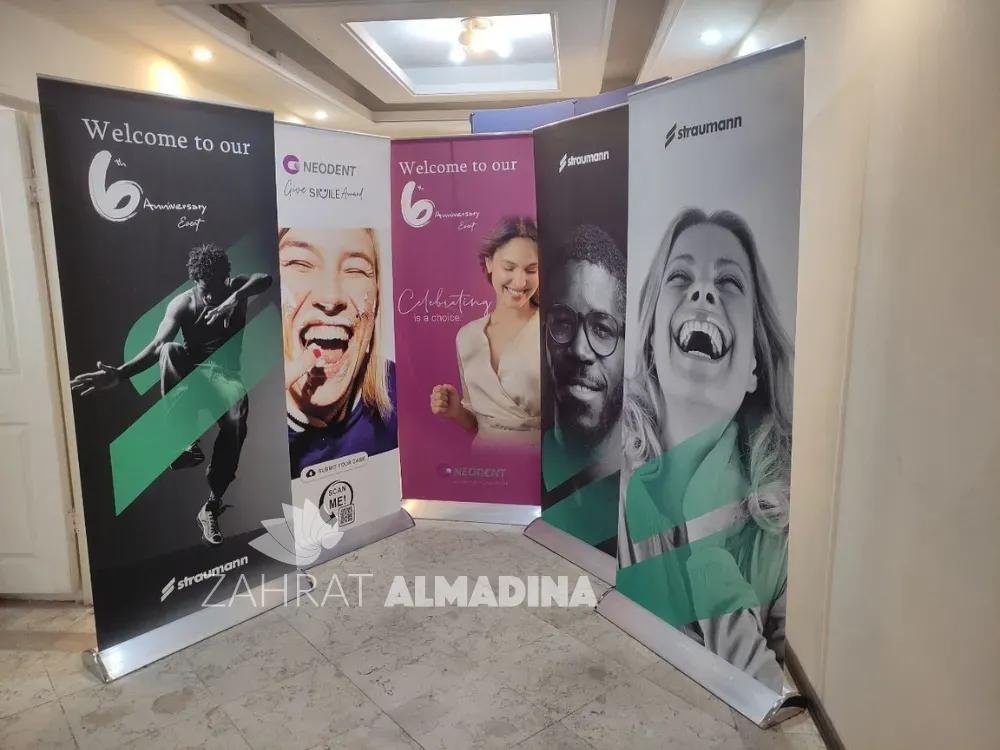
Roll-up banners are widely used for exhibitions, conferences, retail promotions, presentations, reception areas, and business events. Their main advantage is portability: the printed graphic rolls into a base, making the display relatively easy to transport, store, and set up.
However, choosing a roll-up banner is not simply about selecting the largest available size. Businesses also need to consider the display location, viewing distance, stand construction, artwork, printing material, and how frequently the banner will be moved.
For businesses comparing roll-up banner printing in Dubai, understanding these factors before ordering can help avoid common problems and produce a display that works well for its intended purpose.
What Is a Roll-Up Banner?
A roll-up banner consists of a printed graphic attached to a retractable mechanism inside a base. When needed, the graphic is pulled upward and secured to a support pole. After use, it can be lowered back into the base.
This format is particularly useful for businesses that need temporary displays at different locations. Unlike a fixed sign, a roll-up banner can usually be packed away after an event and transported to another venue.
Common applications include:
- Trade shows and exhibitions
- Corporate presentations
- Retail promotions
- Conferences
- Hotel events
- Reception areas
- Product launches
- Training sessions
- Promotional campaigns
Choosing the Right Banner Size
Size should be determined by the available space and the distance from which visitors will view the display.
Standard Sizes
A narrower roll-up banner can work well in reception areas, entrances, corridors, and spaces where floor area is limited. Wider formats may be more suitable for exhibitions or areas where the banner needs greater visual presence.
Before ordering, measure the intended location. Consider not only the width of the banner but also the height of the ceiling and surrounding furniture.
Viewing Distance Matters
Text and graphics should be designed according to viewing distance. A headline that looks clear on a computer monitor may become difficult to read when visitors are several metres away.
For most business displays, a simple hierarchy works well:
- Main message or headline
- Logo or business name
- Supporting information
- Contact details or call to action
Trying to fit an entire brochure onto a roll-up banner usually makes the design harder to read.
Understanding Stand Types
The stand is an important part of the display because it supports the printed graphic and affects portability.
Some systems are designed for occasional indoor use, while others are built for businesses that need to transport and assemble displays regularly.
A business that attends frequent exhibitions may prioritize a lightweight system that is easy to carry. A permanent reception display may place more emphasis on appearance and stability.
The base should also be considered. A wider or heavier base can provide greater stability, while a compact base may be easier to transport.
Roll-Up Banners vs. Traditional Banners
A traditional banner printing solution can provide more flexibility in terms of size, installation method, and display configuration. It may be suitable when the graphic needs to cover a wall, fence, stage area, or larger promotional surface.
Roll-up banners, on the other hand, are designed around portability and quick setup.
The choice depends on the application. A roll-up system can be convenient for a single standing display, while a larger printed banner may be more appropriate for a wide background or fixed installation.
Where Should a Roll-Up Banner Be Placed?
Placement can significantly affect how well a banner communicates its message.
Exhibition Stands
At an exhibition, the banner should be positioned where visitors can see it without blocking staff or product displays. It can be placed near an entrance, beside a counter, or toward the back of the stand.
The design should communicate the business or campaign quickly because exhibition visitors often pass several displays within a short period.
Reception Areas
A roll-up banner can provide information about a business, campaign, service, or event near a reception desk.
Because reception areas are often relatively compact, a narrower display may be more practical than a large format.
Events and Presentations
For conferences, workshops, and corporate events, banners can be placed near stages, registration desks, presentation areas, or photography spaces.
The display should complement the event rather than compete with the main stage or speaker.
Artwork and Printing Requirements
The quality of the final display depends heavily on the artwork supplied for production.
Images should have sufficient resolution for the final print size. Logos should preferably be supplied in a suitable high-quality format so they remain sharp.
Important information should not be positioned too close to the edges. The design should also account for the section of the graphic that enters the base, since that area may not be visible when the banner is fully displayed.
Color choices should be checked before production, particularly when brand colors need to remain consistent across different marketing materials.
Choosing Materials
The printed graphic needs to be compatible with the roll-up mechanism and intended usage.
A banner that will be used repeatedly at exhibitions may require different considerations from one intended for a short indoor event. Businesses should discuss expected usage, storage, transportation, and installation conditions before selecting the printing material.
The display should also be stored properly between events. Keeping the graphic protected from excessive moisture, dust, folding, and unnecessary pressure can help maintain its appearance.
Roll-Up Banners for Dubai Events
Dubai hosts exhibitions, conferences, corporate events, retail activations, and promotional activities throughout the year. Businesses using roll-up displays should consider the specific requirements of the venue before production.
For example, an exhibition hall may provide more space than a hotel meeting room or retail entrance. Some venues may also have rules regarding display dimensions, placement, or access.
The transportation route should also be considered. A display that needs to be carried between venues should be easy to pack and handle.
Common Mistakes to Avoid
Several simple mistakes can reduce the effectiveness of a roll-up banner.
Using too much text: Visitors should understand the main message quickly.
Choosing the wrong size: A display that is too small may disappear in a large exhibition area, while an oversized banner can restrict movement in a small room.
Ignoring the base area: Artwork should account for the section that retracts into the stand.
Using low-resolution images: Poor-quality images become more noticeable when printed at a large size.
Placing the banner poorly: Even a well-designed display can be ineffective if it is hidden behind furniture or positioned where people cannot easily see it.
Forgetting transportation: Businesses attending multiple events should consider the packed dimensions and carrying requirements before selecting a system.
Comparing Roll-Up Banner Options
Before placing an order, it helps to create a simple checklist:
- Where will the banner be displayed?
- How much floor space is available?
- What viewing distance should the design accommodate?
- How often will the banner be transported?
- What size is appropriate?
- What information must appear on the graphic?
- Does the artwork meet the printer’s specifications?
- How will the banner be stored after the event?
For businesses that need a broader display setup, backdrop stands supplier may be worth considering instead of a single roll-up banner. A backdrop can provide a larger branded surface when the available space and event format justify it.
Conclusion
Choosing a roll-up banner requires more thought than simply selecting a printed graphic. Size, stand construction, material, artwork, placement, portability, and storage all affect how useful the final display will be.
The best starting point is the intended environment. Measure the space, identify the viewing distance, decide what information visitors need to see, and consider how often the display will be transported. With these factors established in advance, it becomes easier to choose a roll-up banner that fits the event and communicates its message clearly.