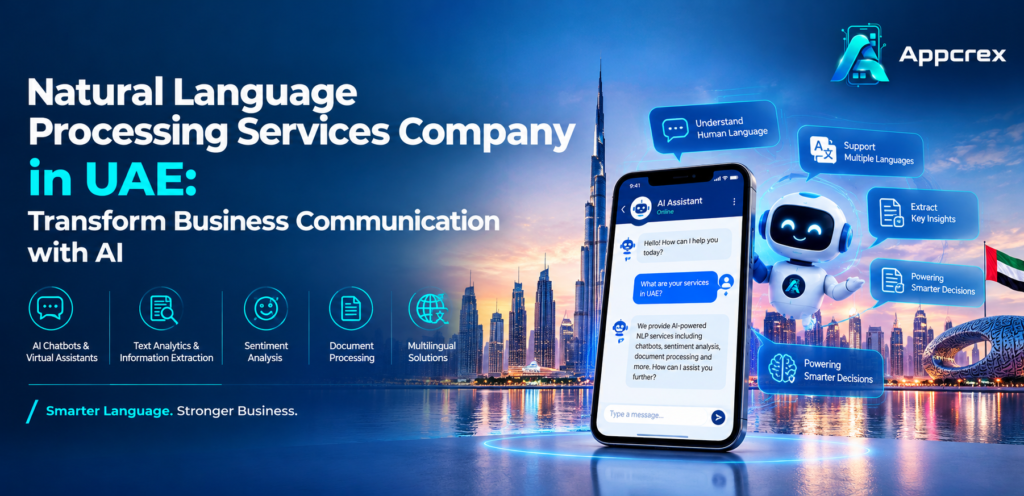
Businesses in the United Arab Emirates (UAE) are increasingly adopting artificial intelligence to improve communication, automate operations, and deliver better customer experiences. From retail and healthcare to banking, logistics, and education, organizations are exploring smarter ways to manage information and understand customer needs.
One technology supporting this transformation is Natural Language Processing (NLP). It enables computers to understand, analyze, interpret, and generate human language. By combining NLP with machine learning and artificial intelligence, businesses can automate communication, analyze customer feedback, and process large volumes of text data.
Working with a reliable Natural Language Processing Services Company in UAE can help organizations implement intelligent solutions that address their business challenges.
Appcrex helps businesses explore AI-powered software solutions, including intelligent applications and customized digital systems. In this blog, we will discuss NLP services, their benefits, industry applications, development processes, and how businesses can select the right NLP development partner in the UAE.
What Is Natural Language Processing (NLP)?
Natural Language Processing is a branch of artificial intelligence that enables computers to understand and process human language in written or spoken form.
NLP technologies help software identify patterns, understand context, classify text, extract information, and generate responses.
For example, an eCommerce business can use NLP to analyze customer reviews and identify common complaints. Similarly, a financial organization can automate the extraction of important information from reports and business documents.
Therefore, NLP helps businesses convert unstructured language data into useful insights that support better decision-making.
What Services Does a Natural Language Processing Services Company in UAE Provide?
A professional NLP development company offers different services depending on business requirements, available data, and project objectives.
- NLP Consulting and Strategy
NLP consulting helps organizations identify opportunities to use artificial intelligence in their existing workflows.
The process includes understanding business requirements, evaluating available data, identifying automation opportunities, and selecting suitable NLP technologies.
Furthermore, a clear implementation strategy helps businesses focus on practical applications and avoid unnecessary development expenses.
- AI Chatbot and Virtual Assistant Development
AI-powered chatbots allow businesses to communicate with customers through websites, mobile applications, and other digital platforms.
These solutions can answer common questions, provide product information, assist with bookings, and guide customers through different services.
For example, a UAE-based retail business can use a chatbot to help customers check product availability, understand delivery options, and receive order updates.
As a result, businesses can improve customer support and reduce repetitive manual tasks.
- Sentiment Analysis Services
Sentiment analysis uses NLP to identify opinions and emotional signals in written content.
Businesses can analyze customer reviews, surveys, social media comments, and support conversations to understand customer satisfaction.
For instance, a company can identify recurring complaints about product quality or service delivery.
Consequently, organizations can use these insights to improve their products, services, and customer engagement strategies.
- Text Classification and Categorization
Text classification automatically organizes written information into predefined categories.
For example, a customer support application can classify messages into billing questions, technical problems, refund requests, and general inquiries.
Similarly, businesses can categorize documents, emails, and customer feedback.
Therefore, automated text classification can improve information management and reduce repetitive administrative work.
- Named Entity Recognition (NER)
Named Entity Recognition identifies important information within text, including names, organizations, dates, locations, and product references.
Businesses can use NER to extract relevant details from contracts, invoices, reports, and customer communications.
For example, an NLP application can identify company names, dates, and financial information within business documents.
This makes information easier to organize, search, and retrieve.
Just read:
Arabic NLP Solutions UAE: Services, Use Cases, Cost & Development Process
- Intelligent Document Processing
Businesses often manage large volumes of invoices, applications, contracts, reports, and other documents.
NLP-powered document processing helps extract information, classify files, summarize content, and automate document-related workflows.
Additionally, combining NLP with Optical Character Recognition (OCR) allows applications to process text from scanned documents and images.
As a result, organizations can reduce manual data entry and improve document management.
- Text Summarization
Text summarization uses AI to convert lengthy content into shorter versions while retaining important information.
Businesses can use this technology to summarize reports, meeting notes, research documents, customer conversations, and internal communications.
Consequently, employees can review important information more quickly and improve productivity.
- Multilingual NLP Solutions
The UAE has a diverse business environment, where organizations may communicate with customers in Arabic, English, and other languages.
Multilingual NLP solutions can support language detection, translation, text analysis, and multilingual customer communication.
For Arabic applications, businesses should also consider right-to-left (RTL) layouts, regional language variations, and context-specific terminology.
Therefore, multilingual NLP can help businesses create more accessible digital experiences for different customer groups.
- Semantic Search and Information Retrieval
Semantic search helps applications understand the meaning behind a user’s query rather than depending only on exact keyword matches.
For example, employees can search company policies, product information, or internal documents using natural language questions.
The system can identify relevant information from available knowledge bases and business documents.
As a result, semantic search can improve information accessibility and reduce the time spent searching through large collections of files.
- Generative AI and NLP Integration
Natural Language Processing can work alongside generative AI and large language models (LLMs) to create advanced business applications.
These solutions may include conversational AI assistants, intelligent document search, automated content analysis, and customer support applications.
For example, a company can develop an AI assistant that retrieves information from approved business documents and responds to employee questions.
However, organizations should evaluate response accuracy, privacy, security, and access permissions before deploying such applications.
Benefits of Natural Language Processing for Businesses in UAE
NLP offers several advantages for organizations looking to improve communication, automate operations, and support digital growth.
Improve Customer Communication
Customers expect quick and relevant responses when interacting with businesses.
NLP-powered chatbots and virtual assistants can help answer common questions, provide service information, and guide users through digital processes.
Moreover, multilingual NLP can support communication with customers who prefer different languages.
Automate Repetitive Business Tasks
NLP can automate activities such as email classification, document processing, information extraction, and customer inquiry management.
As a result, employees can spend less time on routine tasks and focus on responsibilities that require human judgment.
Understand Customer Feedback
Customer reviews, surveys, and online conversations contain valuable business information.
Sentiment analysis can help organizations identify recurring opinions, customer concerns, and service improvement opportunities.
Consequently, businesses can make more informed decisions based on customer feedback.
Improve Business Productivity
NLP-powered applications can simplify information retrieval, summarize documents, and organize large amounts of text.
Therefore, employees can access relevant information more efficiently and complete language-based tasks with less manual effort.
Support Multilingual Audiences
Businesses in the UAE often serve customers with different language preferences.
NLP solutions supporting Arabic and English can improve accessibility and help organizations deliver more convenient digital experiences.
Support Business Growth
As organizations expand, communication and information-processing requirements may increase.
NLP applications can help businesses manage larger volumes of customer interactions and automate repetitive workflows.
However, systems should be monitored and improved as business requirements change.
Industries That Can Benefit from NLP Services in UAE
Natural Language Processing can support businesses across several industries in the UAE.
Healthcare
Healthcare organizations can explore NLP for clinical document organization, medical text analysis, information retrieval, and administrative workflow support.
However, healthcare applications must carefully address patient privacy, information security, accuracy, and applicable regulatory requirements.
Banking and Financial Services
Financial organizations can use NLP to classify documents, analyze customer feedback, extract information from reports, and improve internal knowledge management.
Additionally, sentiment analysis can help organizations study opinions expressed in financial news and public discussions.
Retail and eCommerce
Retail and eCommerce businesses can use NLP to analyze product reviews, improve product search, classify customer inquiries, and develop AI-powered shopping assistants.
As a result, organizations can understand customer preferences and create more convenient shopping experiences.
Education
Educational institutions can use NLP for learning assistance, document summarization, content search, and student feedback analysis.
For example, an educational platform can help students find relevant learning materials through natural language search.
Legal Services
Legal organizations manage large volumes of contracts, case documents, policies, and reports.
NLP can support document classification, clause identification, information extraction, and legal document search.
Nevertheless, qualified professionals should review important legal interpretations and decisions.
Tourism and Hospitality
The UAE tourism and hospitality sector can benefit from NLP-powered customer support, multilingual chatbots, booking assistance, and review analysis.
For example, hotels can use conversational applications to answer guest questions about facilities, reservations, and available services.
Logistics and Transportation
Logistics companies can use NLP to classify support requests, organize delivery reports, extract information from documents, and improve access to operational knowledge.
Consequently, language-based automation can complement existing business systems.
How Does NLP Development Work?
Developing an NLP solution requires a structured process to ensure that the application meets business objectives.
Step 1: Identify Business Requirements
First, define the specific problem the NLP application should solve.
For example, a business may want to automate customer inquiries, analyze reviews, classify documents, or build an intelligent search system.
Clear objectives help determine the right development approach.
Step 2: Collect and Prepare Data
Next, identify the text and language data required for the project.
Data preparation may include cleaning, formatting, labeling, removing duplicates, and protecting sensitive information.
Furthermore, businesses should ensure that they have appropriate permission to use the selected data.
Step 3: Select Suitable NLP Technology
The technology depends on the project’s requirements.
Traditional machine learning may be suitable for basic classification tasks, while transformer-based models and large language models can support more advanced language applications.
However, businesses should also consider accuracy, privacy, processing speed, cost, and scalability before selecting a model.
Step 4: Develop and Integrate the Application
Developers build the NLP solution and connect it with the required business systems.
For example, an NLP application may integrate with a website, mobile app, customer relationship management system, or document management platform.
Step 5: Test Accuracy and Performance
Before deployment, the application should be tested using relevant examples and real-world scenarios.
Testing may evaluate classification accuracy, response quality, processing speed, and system reliability.
Additionally, businesses should check how the application handles incorrect inputs and sensitive requests.
Step 6: Deployment and Maintenance
After successful testing, the application can be deployed in the intended environment.
Regular monitoring, security updates, performance evaluation, and model improvements help maintain reliability over time.
How Much Do NLP Services Cost in UAE?
The cost of developing an NLP application in the UAE depends on project complexity, data requirements, technology selection, integrations, infrastructure, and maintenance.
A basic text classification application may require less development effort than an advanced multilingual chatbot connected to several business systems.
The main factors affecting NLP development costs include:
- Project complexity: Advanced features require additional development and testing.
- Data preparation: Cleaning and labeling data can increase project effort.
- Technology selection: Traditional machine learning, hosted AI services, and custom models have different costs.
- Integration requirements: Connecting NLP applications with existing business systems can increase complexity.
- Security requirements: Sensitive business information may require additional protection.
- Infrastructure: Hosting, storage, API usage, and processing costs affect the overall investment.
- Maintenance: Regular updates, monitoring, and improvements contribute to ongoing expenses.
Therefore, businesses should define their requirements and request a project-specific estimate.
One practical approach is to begin with a Proof of Concept (PoC) or Minimum Viable Product (MVP). This allows organizations to test the solution, evaluate its performance, and understand its business value before expanding the project.
How to Choose the Right Natural Language Processing Services Company in UAE?
Selecting the right NLP development partner is important for building a reliable AI solution.
Review Technical Expertise
Check the company’s experience with NLP, artificial intelligence, machine learning, text analytics, and language models.
The development partner should understand your requirements and recommend suitable technologies.
Evaluate Previous Projects
Review the company’s portfolio, relevant case studies, and examples of similar applications.
This can help you understand its development capabilities and approach to solving business problems.
Check Data Security Practices
Data security is important when an NLP application processes customer information, financial documents, or internal business records.
Ask about encryption, access controls, data storage, retention policies, and third-party AI services.
Businesses should also consider applicable UAE data protection requirements.
Understand the Development Process
A reliable development partner should explain the complete process, including planning, design, development, testing, deployment, and maintenance.
Clear communication helps businesses understand project responsibilities and expected deliverables.
Consider Scalability and Maintenance
Your NLP application should be capable of supporting future business requirements.
Therefore, discuss ongoing support, performance monitoring, technology updates, and the possibility of adding new features.
Compare Overall Value
Do not select a development company based only on the lowest quotation.
Instead, compare technical capabilities, project scope, development quality, communication, security practices, and long-term maintenance support.
Why Choose Appcrex for NLP and AI Development?
Appcrex helps businesses explore software development and AI-powered digital solutions designed around their objectives.
For organizations interested in Natural Language Processing, identifying the right business use case is an important first step.
Depending on project requirements, NLP solutions may include AI chatbots, sentiment analysis, document processing, text analytics, semantic search, and generative AI integration.
A successful implementation also requires attention to data quality, application performance, security, and future scalability.
Appcrex focuses on understanding business requirements and exploring suitable technology solutions that support digital growth.
Whether your organization wants to improve customer communication, automate document workflows, or develop an intelligent application, the right NLP strategy can help turn business challenges into practical digital solutions.
Visit Appcrex to explore its software development and AI solution offerings.
Future Trends in Natural Language Processing
NLP technology continues to evolve as artificial intelligence and language models become more capable.
Here are some important trends businesses should understand.
Large Language Models
Large Language Models are expanding the capabilities of NLP applications.
Businesses can use them for conversational assistants, document summarization, information extraction, and automated content analysis.
Retrieval-Augmented Generation
Retrieval-Augmented Generation (RAG) connects AI models with relevant external information, such as company documents and knowledge bases.
This approach can help applications provide responses based on business-specific information.
Multilingual AI Applications
Multilingual NLP is becoming increasingly useful for organizations serving customers with different language preferences.
In the UAE, support for Arabic and English can help businesses create more accessible digital experiences.
Voice-Based AI Solutions
Voice recognition and language processing can support voice assistants, automated call handling, and speech-to-text applications.
Consequently, businesses can explore additional ways to improve customer communication.
Responsible and Secure AI
Organizations are paying greater attention to data privacy, transparency, bias, and AI-generated errors.
Therefore, human oversight, security controls, and continuous evaluation are important parts of responsible NLP development.
Frequently Asked Questions (FAQs)
- What is a Natural Language Processing Services Company?
A Natural Language Processing services company develops or integrates AI solutions that help computers understand, analyze, and generate human language. Services may include chatbots, sentiment analysis, text classification, document processing, and semantic search.
- What are the benefits of NLP for businesses in UAE?
NLP can help UAE businesses automate repetitive tasks, improve customer support, analyze feedback, organize documents, and extract useful insights from unstructured data.
- Which industries in the UAE can benefit from NLP?
Healthcare, banking, retail, eCommerce, education, legal services, tourism, hospitality, manufacturing, and logistics can benefit from NLP applications.
- Can NLP applications support Arabic and English?
Yes. NLP applications can be designed to process Arabic and English content. Arabic applications should also consider right-to-left layouts, regional language variations, and translation accuracy.
- How much does NLP development cost in UAE?
NLP development costs depend on application complexity, data preparation, model selection, integrations, infrastructure, security, and maintenance. A project-specific estimate is required for accurate budgeting.
- Can NLP improve customer support?
Yes. NLP-powered chatbots and virtual assistants can answer common questions, classify inquiries, and provide relevant information. Complex issues can be transferred to human support teams.
- Is NLP suitable for small and medium-sized businesses in UAE?
Yes. SMEs can use NLP for customer feedback analysis, email classification, document search, and basic chatbot development. Starting with a focused solution can help control initial investment.
- Is Natural Language Processing part of Artificial Intelligence?
Yes. NLP is a branch of artificial intelligence that focuses on enabling computers to process, understand, and generate human language.
- Is NLP secure for business data?
NLP applications can be designed with security controls such as encryption, access management, and data retention policies. Businesses should also review third-party AI provider practices and applicable UAE data protection requirements.
- How do I choose an NLP development company in UAE?
Evaluate technical expertise, project experience, data security, integration capabilities, testing practices, scalability, and maintenance support before selecting a development partner.
Conclusion
Natural Language Processing is helping businesses in the UAE improve communication, automate repetitive tasks, and extract meaningful insights from large volumes of language data.
From AI chatbots and sentiment analysis to document processing and multilingual applications, NLP offers practical solutions for organizations across different industries.
However, successful implementation requires clear business objectives, reliable data, suitable technology, strong security practices, and continuous monitoring.
If your business is planning to adopt AI-powered language solutions, choosing the right development approach can make a significant difference. Appcrex can help you explore customized software and AI solutions that support your business requirements and long-term digital growth.






 to learn more about available choices. Before placing an order, review the product description carefully. Confirm the laptop's listed configuration, ask about its condition, and check the seller's warranty or return policy. If you are buying in person, inspect the device and test its essential functions whenever possible. ## Are Refurbished Laptops a Good Choice? Refurbished devices can be worth considering because they may undergo inspection, testing, cleaning, or repairs before being offered for resale. However, refurbishment standards vary between sellers, so it is important to understand exactly what has been checked or replaced. People searching for **refurbished laptops in Delhi** should compare more than the advertised price. Ask whether the device has been tested for hardware issues, whether the operating system is properly licensed, and whether any warranty is included. A clear description of the laptop's condition helps set realistic expectations. You can review the [Laptopex page for refurbished and second-hand laptops in Delhi](https://www.laptopex.com/second-hand-laptop-in-delhi/) as a starting point for comparing available options. Check the current product listings and terms directly before making a purchase, since specifications, stock, and policies can change. ## Important Things to Check Before Buying ### 1. Processor and Performance The right processor depends on your workload. Basic browsing and document editing require less processing power than software development, video editing, or demanding professional applications. Check the exact processor model and generation rather than relying on labels such as Core i5 or Core i7 alone. ### 2. RAM and Storage For everyday multitasking, 8 GB of RAM may be a reasonable starting point, while heavier workloads can benefit from 16 GB or more. An SSD generally offers faster startup times and quicker application loading than a traditional hard drive. Make sure the storage capacity is sufficient for your files and software. ### 3. Battery and Charging A used laptop's battery may not perform like a new one. If possible, check how long it runs away from the charger and inspect the charging port and adapter. Ask the seller about battery health and any replacement that may have been carried out. ### 4. Screen, Keyboard, and Ports Inspect the display for unusual lines, flickering, dead pixels, or uneven brightness. Test the keyboard, touchpad, speakers, webcam, Wi-Fi, USB ports, audio jack, and other features you expect to use regularly. ### 5. Warranty and Return Terms Understand the warranty duration, what it covers, and how to request service. Also check the return or replacement policy before paying. Written terms are more useful than verbal assurances if a problem appears after purchase. ### 6. Operating System and Security Make sure the laptop can run a supported operating system and that security updates are available. Confirm that the device has been reset properly and that no previous owner's accounts or data remain on it. ## Choosing a Laptop for Your Budget Your budget should reflect both the purchase price and the likely cost of ownership. A lower-priced device may need a battery replacement, additional memory, or other repairs. A slightly more expensive model in better condition may provide better value over time. For study and everyday tasks, prioritise a reliable SSD, adequate memory, and comfortable usability. For office work, consider multitasking performance, webcam quality, and portability. For technical or creative work, check the software's system requirements before choosing a model. It is also worth comparing the age of the laptop, upgrade options, and availability of replacement parts. These details can help you avoid purchasing a device that struggles with your requirements or becomes expensive to maintain. ## Benefits of Comparing Options Before You Buy Taking time to compare laptops helps you understand what you are paying for. Review the specifications of several models, compare their condition and warranty coverage, and make a shortlist based on your needs. If a specification is unclear, ask the seller for confirmation rather than making assumptions. A dependable buying process focuses on transparency, suitable performance, and support after the sale. This approach is more useful than selecting a device based on a discount alone. ## Final Thoughts A pre-owned laptop can be a sensible option for people who need reliable computing without the cost of a brand-new device. Whether you are a student, a professional, or a small business owner, consider your daily workload, compare specifications, and check the laptop's condition before deciding. If you are exploring a **second hand laptop in Delhi** or comparing **refurbished laptops in Delhi**, the Laptopex website is one place to begin your research. Review the available models, verify the current specifications and purchase terms, and choose a device that fits both your budget and your practical needs.](https://queenofarticle.com/wp-content/uploads/2026/10/53c621ae-6141-49cf-80b3-9be1c6eab19a-300x169.png)