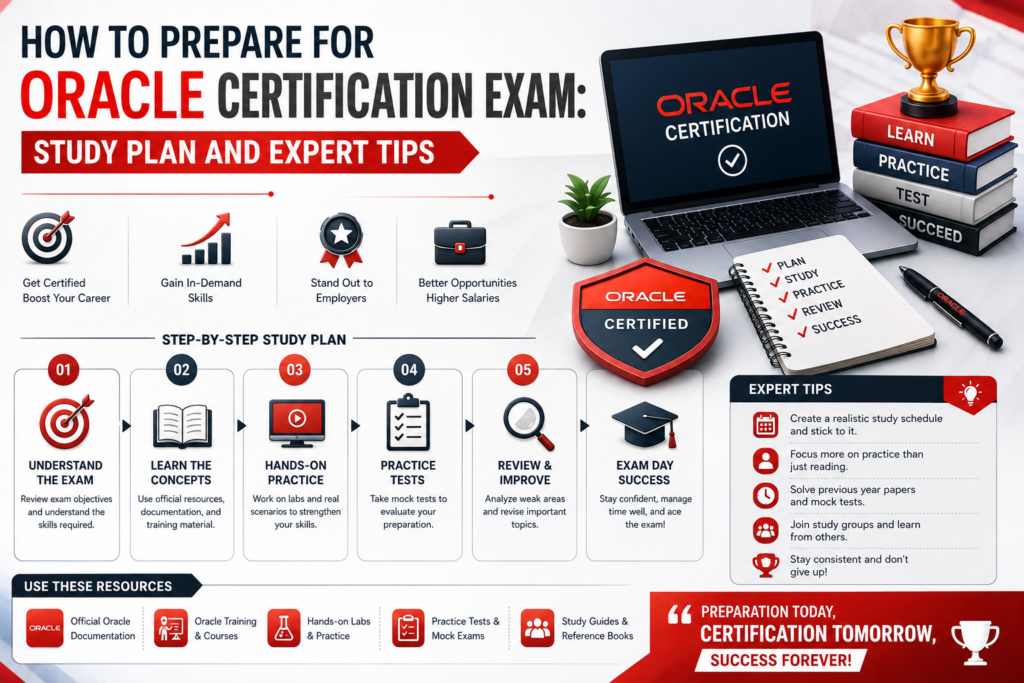
Oracle certifications are recognized worldwide for validating skills in database administration, cloud infrastructure, Java development, enterprise applications, and other Oracle technologies. Whether you are pursuing your first Oracle credential or advancing toward a professional or specialist certification, proper preparation plays a significant role in achieving success.
Many candidates begin studying without a clear strategy, only to discover they have spent weeks reviewing topics that carry little weight on the actual exam. A structured study plan helps you stay organized, prioritize important objectives, and measure your progress throughout the preparation journey.
This guide explains how to prepare effectively for an Oracle certification exam, including a practical study plan, proven preparation techniques, and common mistakes to avoid.
Start with the Official Exam Objectives
Every successful preparation journey begins with understanding exactly what the certification measures.
Oracle publishes official exam objectives that outline the knowledge and skills expected from candidates. Reviewing these objectives allows you to identify the topics you already understand and those requiring additional attention.
Rather than studying randomly, organize your schedule around these objectives so every study session contributes directly to your exam readiness.
Know Your Certification Level
Oracle offers certifications for different experience levels and technologies.
Understanding where your chosen exam fits helps you prepare more efficiently.
| Certification Level | Typical Focus | Suitable For |
| Foundations | Basic concepts and terminology | Beginners |
| Associate | Core technical knowledge | Entry-level professionals |
| Professional | Advanced administration and implementation | Experienced practitioners |
| Specialist | Product-specific expertise | Professionals focusing on a particular Oracle technology |
Choosing a certification that matches your current knowledge makes the learning process more manageable and realistic.
Build a Weekly Study Plan
Consistency is far more effective than occasional long study sessions.
A simple weekly plan could include:
- Reviewing one exam domain at a time.
- Reading official Oracle documentation.
- Watching technical training where appropriate.
- Completing practice questions.
- Performing hands-on exercises.
- Reviewing incorrect answers.
- Revising completed topics every weekend.
Breaking preparation into manageable sections helps prevent information overload while improving long-term retention.
Practice in a Real Environment
Oracle certifications often assess practical understanding rather than theoretical definitions alone.
Whenever possible, spend time working directly with Oracle technologies by:
- Creating test environments.
- Exploring administrative tools.
- Practicing configuration tasks.
- Running SQL queries.
- Managing users and permissions.
- Performing troubleshooting exercises.
Hands-on experience reinforces concepts and improves confidence when answering scenario-based questions.
Focus on Understanding, Not Memorization
Many candidates make the mistake of memorizing answers without understanding the underlying concepts.
Instead, ask yourself:
- Why is this solution correct?
- What problem does this feature solve?
- When would this technology be used?
- Why are the other options incorrect?
Thinking critically helps you answer unfamiliar questions that require analysis rather than recall.
Use Practice Questions Wisely
Practice questions are valuable because they help you measure your progress and become familiar with the exam format.
They can help you:
- Identify weak areas.
- Improve time management.
- Understand common question styles.
- Reinforce important concepts.
- Build confidence before exam day.
The greatest benefit comes from carefully reviewing explanations for both correct and incorrect answers instead of focusing only on your score.
Strengthen Weak Topics Early
Every candidate has stronger and weaker subject areas.
After completing practice tests, create a list of objectives where your performance needs improvement. Spend additional time revisiting official documentation, performing practical exercises, and reviewing examples related to those topics.
Addressing weak areas early prevents them from becoming larger challenges closer to the exam date.
Avoid Common Preparation Mistakes
Certain habits can reduce the effectiveness of your study efforts.
Avoid:
- Ignoring the official exam objectives.
- Studying without a schedule.
- Memorizing answers instead of concepts.
- Skipping hands-on practice.
- Waiting until the final week for revision.
- Neglecting to review incorrect practice questions.
A balanced preparation strategy is usually far more effective than relying on any single study method.
Prepare for Exam Day
During the final week before your exam:
- Review key concepts instead of learning entirely new topics.
- Complete one or two full-length timed practice exams.
- Revisit difficult objectives.
- Get adequate rest before exam day.
- Read every exam question carefully.
- Manage your time throughout the examination.
A calm and organized approach often leads to better decision-making during the exam.
Oracle certification candidates can enhance their preparation by practicing with current exam questions, completing realistic mock tests, and using Cert Empire’s structured resources alongside Oracle’s official courses and practical learning experiences.
Certification Supports Long-Term Growth
Passing an Oracle certification is only one milestone in your professional journey.
The knowledge gained while preparing can improve your ability to work with enterprise databases, cloud services, middleware, Java technologies, and Oracle business applications. Employers often value professionals who combine certification with practical experience and continuous learning.
Maintaining a habit of regularly reviewing new Oracle technologies will help keep your skills relevant as products and certification paths continue to evolve.
Conclusion
Preparing for an Oracle certification exam requires more than simply reading study guides. Success comes from following the official exam objectives, creating a realistic study schedule, practicing in real environments, completing quality practice questions, and reviewing your weaker areas consistently.
By focusing on genuine understanding instead of memorization and combining theory with hands-on experience, you can approach your Oracle certification exam with greater confidence while developing practical skills that benefit your career long after the exam is complete.
FAQs
How should I begin preparing for an Oracle certification exam?
Start by reviewing the official exam objectives, identifying your knowledge gaps, creating a structured study schedule, and gathering reliable learning resources before beginning detailed preparation.
Are hands-on exercises important for Oracle certification?
Yes. Practical experience helps reinforce technical concepts, improves troubleshooting skills, and prepares candidates for scenario-based questions commonly included in Oracle certification exams.
How long should I study before taking the exam?
Preparation time varies with experience, but consistent weekly study combined with practical exercises and regular revision generally produces better results than last-minute preparation.
Should I use practice questions during my preparation?
Yes. Quality practice questions help assess readiness, identify weaker topics, improve time management, and reinforce concepts when reviewed alongside official learning materials.
What is the best strategy for passing an Oracle certification exam?
Study the official objectives, gain practical experience, complete realistic practice exams, review incorrect answers carefully, and maintain a consistent study schedule throughout your preparation.
Learn More: IT Certification Cost Guide 2026: Exam Fees, Training, and Preparation