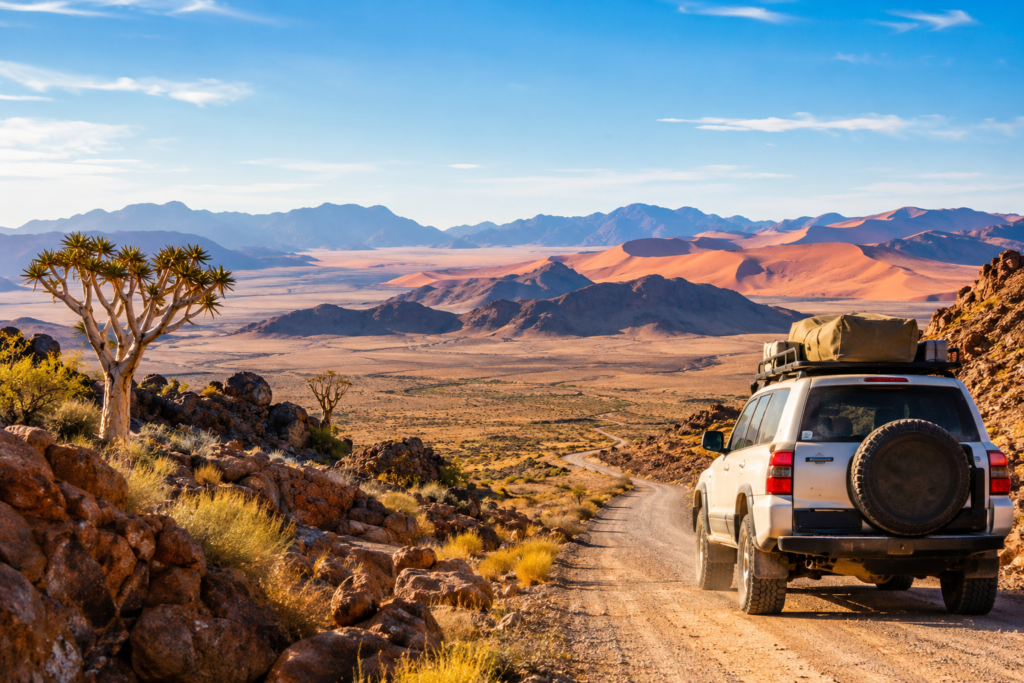
Namibia is an incredible destination for travellers who want the freedom to explore vast deserts, dramatic coastlines, wildlife-rich national parks and remote landscapes at their own pace. A self-drive holiday offers the flexibility to stop at scenic viewpoints, discover small desert towns and spend extra time in places that capture your imagination. For first-time visitors, however, driving across such a spacious country requires thoughtful planning.
Understanding Namibia road conditions, choosing suitable routes and learning a few essential driving habits can make your journey more comfortable and rewarding. Distances between destinations can be long, fuel stations may be far apart, and many roads are gravel rather than paved. With the right preparation, driving in Namibia can be a memorable way to experience the country’s extraordinary natural beauty.
1. Understanding Namibia Road Conditions Before You Travel
Namibia has a road network that includes well-maintained tarred highways, gravel roads and rougher tracks leading to remote attractions. The main roads connecting larger towns are generally straightforward to navigate, while many popular scenic routes pass through open countryside on unpaved surfaces.
Gravel roads are a normal part of travelling here. Their condition can vary depending on recent maintenance, traffic, weather and the season. Some are smooth and compact, while others may have loose stones, corrugations, potholes or sandy sections. These differences can affect both driving speed and comfort.
A common mistake among first-time visitors is underestimating travel times. A journey that looks short on a map may take several hours because of road conditions, wildlife crossings and stops for photographs. Rather than planning every day around maximum driving distances, allow enough time to arrive before sunset.
Before setting off, ask your accommodation or car rental company about current road conditions along your intended route. Recent local advice can be particularly useful after heavy rainfall, when some roads may become difficult or temporarily impassable. Check your route again each morning, especially when travelling through remote areas.
2. Choosing the Right Vehicle for Your Namibia Self-Drive
The best vehicle depends on your itinerary, travel season and driving experience. A standard car may be suitable for certain tarred roads and well-maintained gravel routes, but a higher-clearance vehicle can provide additional comfort on rougher surfaces.
For a classic Namibia road trip, many travellers choose a reliable SUV or a suitable four-wheel-drive vehicle. Four-wheel drive is not essential for every itinerary, and it does not make a vehicle immune to loose sand, tyre damage or poor road conditions. Choose your vehicle based on the roads you actually intend to use rather than assuming that the largest option is always necessary.
Before leaving the rental depot, inspect the vehicle carefully. Check the tyres, including the spare, and make sure you understand how to change a wheel or contact roadside assistance. Confirm that the jack, wheel spanner and other required equipment are present. It is also sensible to ask about the rental company’s policies on gravel-road driving, tyre damage and travelling into remote regions.
If you plan to visit isolated areas, check whether your vehicle has suitable clearance and whether a second spare tyre is recommended for your route. Learn how the vehicle handles before beginning a long drive, and keep your rental documents and emergency contact details accessible.
3. The Best Namibia Self-Drive Routes for First-Time Visitors
Namibia offers several memorable routes, and the ideal itinerary depends on how much time you have available. For a first visit, combining desert scenery, coastal towns and wildlife viewing creates a varied experience without making every day feel rushed.
Windhoek is a practical starting point for most road trips. From the capital, you can travel towards the Namib Desert and explore the spectacular landscapes around Sossusvlei and Deadvlei. Towering red dunes, wide-open desert plains and unforgettable sunrise views make this region a highlight of any Namibia itinerary.
Next, consider travelling to Swakopmund, a coastal town known for its German-influenced architecture, ocean views and outdoor activities. The drive through the desert landscapes is beautiful, but allow sufficient time for changing surfaces and scenic stops.
If wildlife is a priority, continue towards Etosha National Park. Its waterholes attract elephants, giraffes, zebras, antelopes and other animals, making self-drive wildlife viewing particularly rewarding. You can explore at your own pace while following park regulations and observing animals from your vehicle.
Travellers with more time might add Damaraland, famous for rugged mountains, ancient rock engravings and dramatic scenery. However, some routes in this region are rougher and more remote, so check whether your vehicle is suitable.
For a first trip, allow around 10–14 days for a comfortable circuit combining Windhoek, Sossusvlei, Swakopmund and Etosha. This provides time to enjoy the destinations rather than spending most of your holiday behind the wheel.
4. Essential Namibia Self-Drive Tips for Safe and Confident Driving
Driving in Namibia requires patience, especially when travelling on gravel roads. Keep your speed appropriate to the surface, maintain a generous distance from other vehicles and avoid sudden braking or sharp steering movements. Namibia’s tourism authorities advise drivers to travel more slowly on gravel, with 80 km/h generally treated as an upper guideline rather than a target speed. Always follow posted limits and rental-company restrictions.
Visit Namibia+1
Namibia drives on the left-hand side of the road. If you are accustomed to driving on the right, take extra care at junctions, roundabouts and when leaving parking areas. All occupants should wear seat belts, and headlights should be used as required by local regulations.
One of the most important Namibia self-drive tips is to avoid driving after dark outside towns. Wildlife and livestock can appear unexpectedly, while limited lighting makes hazards difficult to spot. Plan your daily journey so that you reach your accommodation well before sunset.
Navigation also deserves attention. Download offline maps before entering remote areas and carry a reliable road map as a backup. Mobile coverage may be limited, and a navigation app may not always reflect the latest road conditions.
During the rainy season, heavy showers can damage gravel roads and cause flash flooding. Never attempt to cross flowing water if you cannot confirm that it is safe. Check local advice before travelling after significant rainfall.
5. Fuel, Accommodation and Emergency Preparation
Distances between fuel stations can be considerable, particularly in less populated regions. Refuel whenever a suitable station is available instead of waiting until your tank is nearly empty. Before travelling through remote areas, confirm where fuel is available along the route and check the opening hours of essential stops.
Carry plenty of drinking water, snacks, a charged mobile phone and a first-aid kit. A power bank, sun protection and basic vehicle supplies can also be useful. Tell someone your planned route and expected arrival time, particularly when heading into isolated areas.
Tyre punctures are a practical concern on gravel roads. Check your tyres regularly and make sure the spare tyre is properly inflated. Before departure, confirm that you have the necessary tools and know how to contact roadside assistance. Ask your rental provider whether a second spare is advisable for your planned route.
Read your rental agreement carefully, paying attention to insurance exclusions, gravel-road restrictions, tyre and windscreen cover, and emergency support. Comprehensive cover does not automatically mean every type of damage is included.
Book accommodation in advance when visiting popular destinations during busy travel periods. Staying near your next day’s main attraction can reduce unnecessary driving and give you more time to explore.
6. When to Visit Namibia and How to Plan Your Journey
Namibia can be explored throughout the year, but seasonal conditions influence the driving experience. The dry season, generally from May to October, is popular for wildlife viewing because animals often gather around waterholes. Days are usually pleasant, although winter mornings and evenings can be cold.
The warmer summer months, broadly from November to April, can bring dramatic landscapes, greener scenery and occasional rainfall. However, wet weather may make some gravel roads more challenging, so flexibility becomes especially important.
When planning your journey, avoid scheduling several long drives on consecutive days. Build in time for unexpected delays, photographs and spontaneous stops. A flexible itinerary is particularly valuable when visiting remote areas where road conditions can change.
First-time visitors should also be realistic about their driving experience. If a route involves deep sand, difficult tracks or remote terrain beyond your comfort level, consider a guided excursion instead of attempting it independently.
A Namibia self-drive holiday is about more than reaching famous landmarks. It is an opportunity to enjoy immense desert horizons, quiet roads, remarkable wildlife and the freedom to discover places at your own pace. With suitable preparation, a reliable vehicle and sensible driving habits, your first road trip through Namibia can become an unforgettable adventure.