
A student identification card can serve several everyday purposes. Colleges and universities use student IDs to identify enrolled individuals, provide access to campus facilities, manage library services, and support certain student benefits. Retailers and online platforms may also accept student credentials when verifying eligibility for education-related discounts.
However, searching for a fake student ID can lead people into a very different situation. Websites advertising customizable student cards, realistic designs, holographic features, and scannable barcodes may make these products appear more useful or legitimate than they actually are.
The important distinction is that a card’s appearance does not establish someone’s student status. A genuine student ID is issued or authorized by an educational institution for an eligible student. A privately produced card does not become an official academic credential simply because it contains a school name, photograph, identification number, or professional-looking design.
Using an unauthorized student identification card can create legal, academic, financial, and privacy problems. It may also fail when presented to a retailer, educational institution, or verification service.
Understanding these risks is particularly important for people considering online student ID generators or unfamiliar identification-card websites. There are legitimate alternatives for students who need replacement credentials, want to access educational benefits, or have difficulty proving their enrollment.
This guide explains what fake student IDs are, why they can create problems, how student verification works, and what legitimate options are available in the United States.
What Is a Fake Student ID?
A fake student ID is a card or digital credential that falsely represents someone as a student or suggests that an identification document was issued or authorized by an educational institution when it was not.
The term can describe several different situations.
For example, someone might possess a card that:
-
Uses the name of a college they do not attend.
-
Contains invented enrollment information.
-
Presents another person’s student identity as their own.
-
Reproduces the appearance of an institution’s official identification card without authorization.
-
Contains inaccurate information intended to obtain student benefits.
-
Claims to provide academic privileges that the cardholder has not earned.
Not every unofficial identification-style card is automatically fraudulent. A clearly fictional prop made for a theatrical production, film, or private collection is different from a document intended to deceive someone into accepting it as genuine.
The intended use, representation, applicable law, and circumstances matter.
Genuine Student ID vs. Unauthorized Student ID
Understanding the difference helps explain why a professional appearance is not enough to establish authenticity.
| Feature | Genuine student ID | Unauthorized student ID |
|---|---|---|
| Issuing authority | Authorized educational institution | Unofficial or unauthorized producer |
| Enrollment status | Connected to legitimate enrollment | May contain invented or misleading information |
| Student identity | Assigned to the eligible individual | May misrepresent identity |
| Institutional recognition | Recognized according to school policy | Not automatically recognized |
| Campus access | May provide authorized access | Does not establish permission |
| Student discounts | Accepted where eligibility is verified | Does not establish discount eligibility |
| Replacement process | Managed by the institution | No official replacement authority |
A university-issued card is meaningful because the institution recognizes the person associated with it.
A privately produced card cannot independently establish that relationship.
Why Do People Search for Fake Student IDs?
Searches for fake student ID cards can reflect several different needs. Not everyone searching for this phrase necessarily intends to commit fraud.
Understanding the underlying motivations helps identify safer solutions.
1. Accessing Student Discounts
Student discounts are one of the most common reasons people look for student identification.
Technology companies, clothing retailers, software providers, entertainment services, and other businesses sometimes offer reduced prices to eligible students.
However, many discount programs require actual enrollment verification rather than simply accepting a photograph of a card.
Some services use academic email addresses, institutional records, or additional enrollment documents to establish eligibility.
A privately created card does not provide legitimate proof of enrollment.
2. Replacing a Lost Student Card
Students sometimes lose their university identification cards or damage them through everyday use.
This can become inconvenient when the card is required for:
-
Library access.
-
Campus facilities.
-
Meal plans.
-
Student transportation programs.
-
Examination identification.
-
University services.
The appropriate solution is to contact the institution’s card office or student services department.
Most institutions have an established process for replacing lost or damaged credentials.
3. Obtaining Educational Benefits
Some students need identification to access educational software, academic resources, student memberships, or institutional programs.
Eligibility requirements differ between providers.
A person who is genuinely enrolled but cannot immediately access their student card should ask the relevant provider which alternative documents it accepts.
4. Creating a Novelty or Collectible Card
Some people want identification-style cards for entertainment, photography, theater, or personal collections.
There is an important distinction between a clearly fictional novelty card and a document designed to be mistaken for an official university credential.
Novelty materials should be unmistakably fictional and should not be represented as valid academic identification.
What Do Online Fake Student ID Websites Actually Offer?
Online searches may reveal websites advertising student ID generators, customizable identification cards, and physical card production.
One example is the student ID generator page supplied for this article’s website review.
Its product page advertises a customizable student identification card with a displayed price of €49. It lists fields such as a name, photograph, identification number, date of birth, institution branding, and validity information.
The page also makes marketing claims about holographic elements, QR codes, barcodes, and worldwide shipping. It advertises customer reviews and describes the product in terms that include both fake identification and novelty identification. These are statements made by the seller, not independently established evidence of institutional authorization or acceptance.
That distinction is important.
A website can advertise technical features without demonstrating that an educational institution recognizes its products.
Why Professional Appearance Can Be Misleading
A professionally presented identification card may contain visual elements that resemble those found on genuine credentials.
However, the presence of those elements does not establish:
-
That the educational institution issued the card.
-
That the person is currently enrolled.
-
That the identification number is recognized by the school.
-
That the card grants access to university facilities.
-
That a retailer will accept it.
-
That the card is authorized for academic or commercial verification.
A seller’s description of a product as authentic-looking, scannable, or professionally manufactured should not be confused with official recognition.
What Should Consumers Understand About Seller Claims?
When examining an unfamiliar identification-card website, it is important to distinguish between three categories of information.
| Information category | What it establishes |
|---|---|
| Product description | What the seller claims to provide |
| Customer rating | What a review platform or seller displays |
| Institutional authorization | Whether the relevant institution actually recognizes the credential |
These categories are not interchangeable.
A high rating does not prove that a product is lawful or accepted by universities.
Likewise, a seller’s statement that a card contains scannable codes does not establish that an authorized verification system recognizes it.
Is Having a Fake Student ID Illegal in the United States?
There is no single nationwide rule that treats every unofficial student-themed card identically.
The legal consequences depend on the document, its intended purpose, how it is represented, the person’s conduct, and the applicable federal, state, and local laws.
A decorative novelty card and a credential deliberately presented as an official university-issued document can raise very different legal questions.
Federal Identification Document Laws
One relevant federal statute is 18 U.S.C. § 1028, which addresses fraud involving identification documents, authentication features, and identifying information.
The statute covers specified conduct involving unauthorized production or transfer of identification documents and false identification documents, among other activities.
Its application depends on the statutory definitions and jurisdictional circumstances.
For example, the statute defines certain identification documents by reference to government issuing authorities. A false identification document under the statute must also appear to have been issued by or under the authority of a specified governmental entity.
Consequently, it would be inaccurate to claim that every privately manufactured student card automatically violates this federal statute.
The facts and applicable legal provisions must be examined individually.
State Laws Can Be Different
States have their own identification-document laws, and some expressly address official student identification cards.
Virginia provides a particularly relevant example.
Under Virginia Code § 18.2-204.2, manufacturing, advertising for sale, selling, or possessing certain simulated official identification documents is prohibited.
The statute specifically includes official student identification cards issued by institutions of higher education when the statutory conditions apply.
It classifies specified manufacturing and selling conduct as a Class 1 misdemeanor and possession as a Class 2 misdemeanor.
This example demonstrates why someone should not assume that a student ID is outside identification-related laws simply because it is not a driver’s license.
Other states have different statutory definitions and penalties.
University Disciplinary Consequences
Criminal law is not the only concern.
Educational institutions may have their own conduct policies covering fraudulent identification, unauthorized use of university credentials, misrepresentation, and misuse of another student’s identity.
The University of Illinois, for example, explains that fraudulent or altered identification can create criminal and university disciplinary consequences.
Its guidance identifies potential disciplinary outcomes that include suspension or expulsion, depending on the applicable student conduct rules and circumstances.
Therefore, someone enrolled at a university may face academic consequences in addition to any legal issues.
Potential Consequences of Using a Fake Student ID
The consequences depend on what happened and which laws or institutional policies apply.
Nevertheless, several categories of risk deserve attention.
1. Criminal or Civil Legal Problems
Presenting a fraudulent credential to obtain a benefit can create legal exposure.
Potential issues may involve:
-
Misrepresentation.
-
Forgery-related offenses.
-
Fraud.
-
Unauthorized use of identifying information.
-
Violations involving simulated official identification.
-
Other state-specific offenses.
Not every situation produces the same charge or outcome.
Intent, the document’s appearance, the benefit sought, and the applicable statute can all matter.
2. University Disciplinary Action
Students who misrepresent their enrollment or misuse institutional identification may violate university policies.
Possible consequences can include:
-
Formal disciplinary proceedings.
-
Loss of campus privileges.
-
Suspension.
-
Expulsion.
-
Restrictions on access to certain university services.
These outcomes depend on the institution’s policies and the circumstances of the incident.
3. Loss of Student Benefits
A business may reject a credential that does not establish eligibility.
A student discount account could also be suspended or reviewed if a provider identifies inaccurate verification information.
Even someone who is genuinely enrolled may create unnecessary problems by submitting misleading documentation.
4. Financial Loss
An individual who pays an unfamiliar seller for an unauthorized identification product may receive something that has no practical value for the intended purpose.
Other financial concerns include:
-
Unexpected charges.
-
Unclear refund policies.
-
Disputed transactions.
-
Additional fees.
-
Loss of money to fraudulent sellers.
The FTC recommends reviewing online sellers, checking refund policies, understanding payment protections, and keeping transaction records.
5. Personal Information Exposure
An identification-card order or generator may request personal information, photographs, dates of birth, addresses, or payment details.
Such information can be valuable to criminals when improperly collected, stored, or disclosed.
The Federal Trade Commission advises consumers to understand what personal information websites collect and how that information may be used or shared.
For this reason, providing personal documents to an unfamiliar identification-card website deserves particular caution.
Can a Fake Student ID Work for Student Discounts?
A common misconception is that a student discount can be obtained simply by presenting a card that looks like a university credential.
In reality, acceptance depends on the retailer’s eligibility rules and verification process.
Many providers distinguish between possessing a student-themed card and demonstrating current student enrollment.
How Student Discount Verification Works
Student verification services may use different methods to establish eligibility.
These can include:
-
Academic email verification.
-
Institutional enrollment records.
-
Student documentation.
-
University account authentication.
-
Additional manual review.
The exact requirements vary by service.
For example, ID.me explains that eligible students can verify their status for certain discounts using their school information and, when necessary, supporting documentation.
Student Beans also describes manual verification options that can include an institution-issued student card, an acceptance letter, an academic transcript, or a student portal record.
These methods demonstrate that legitimate student benefits are based on eligibility verification, not simply the appearance of an identification card.
Why a Card May Be Rejected
A card may fail to establish eligibility for several reasons:
| Situation | Possible outcome |
|---|---|
| The person is not currently enrolled | Student verification may be denied |
| The card is not institution-issued | The provider may reject it |
| Enrollment information is outdated | Additional verification may be required |
| The institution cannot be confirmed | Manual review may be necessary |
| Submitted information is inconsistent | Verification may be unsuccessful |
| The provider requires a different document | The applicant must submit an accepted alternative |
A rejection does not necessarily mean someone has done anything wrong.
Legitimate students can also encounter verification problems because of outdated records, institutional email changes, or differences between enrollment systems.
The appropriate response is to contact the verification provider rather than submit fabricated information.
How to Prove Genuine Student Status Without a Physical Student ID
Not having a physical student identification card does not necessarily mean someone cannot establish their enrollment.
Several legitimate alternatives may be available.
1. Use an Official University Enrollment Letter
Many educational institutions provide enrollment confirmation documents.
An official letter may identify:
-
The student’s name.
-
The institution.
-
The current academic term.
-
The student’s enrollment status.
-
Relevant institutional contact information.
Whether a particular service accepts this document depends on its eligibility rules.
2. Obtain an Official Academic Transcript
An academic transcript may provide evidence of enrollment or educational participation.
Some verification providers accept transcripts as supporting documentation.
However, an old transcript might not establish current enrollment.
Students should check whether the provider requires a recent document.
3. Use an Official Student Portal
Many universities maintain online student portals.
Depending on the institution, the portal may display enrollment information, registration status, academic schedules, or other relevant details.
Some verification services accept a screenshot of an official student portal when it clearly demonstrates the required information.
Only submit documents through the provider’s authorized verification process.
4. Request a Replacement University Card
Students who have lost their identification cards should contact their institution.
The university may provide:
-
A replacement physical card.
-
A temporary identification document.
-
An official digital credential.
-
A temporary access arrangement.
-
Written enrollment confirmation.
Policies and fees differ between institutions.
5. Contact the Student Verification Provider
If an academic email address or student record is not recognized, contact the verification service directly.
Ask which alternative documents it accepts and whether manual review is available.
This is generally a better solution than paying an unofficial website for an identification product that may not establish eligibility.
Legitimate Student Discount Platforms and Verification Options
Students in the United States have several legitimate ways to access education-related discounts.
The most suitable option depends on the retailer, the student’s eligibility, and the documents accepted by the relevant provider.
ID.me
ID.me provides identity and eligibility verification services, including student-status verification for certain discounts.
Its student verification guidance describes eligibility requirements and supporting-document options.
The service explains that eligible students may need to provide their school information and additional documentation when automatic verification is unsuccessful.
Students should review the current requirements before submitting an application.
Student Beans
Student Beans provides student discount services through its website and application.
Its verification guidance identifies several documents that may help establish student status.
These include:
-
An institution-issued student card.
-
An acceptance letter.
-
An academic transcript.
-
A screenshot of an online student portal.
The provider may require information showing the applicant’s name, educational institution, and current enrollment status.
Direct University Verification
Some retailers operate their own educational discount programs.
They may ask applicants to sign in through an institutional account or provide specific enrollment documents.
Students should always check the retailer’s official eligibility requirements.
Contacting the Retailer Directly
If a verification system does not recognize a legitimate student account, contacting the retailer can help clarify the available options.
Some companies may provide manual review or alternative educational offers.
A verification failure should not automatically be treated as a reason to seek an unofficial student ID.
How to Identify Risky Fake Student ID Websites
Online identification-card sellers can present themselves as professional businesses.
However, a polished website does not establish that its products are authorized, legitimate, or accepted by educational institutions.
Before sharing personal information or making a payment, consider the following warning signs.
1. Claims That a Card Is Universally Accepted
No independent seller can automatically establish acceptance across every university, retailer, and verification provider.
Acceptance depends on the receiving organization’s policies.
Treat broad promises of universal recognition with skepticism.
2. Claims Based Entirely on Appearance
Descriptions involving premium materials, professional printing, realistic presentation, or security-style features do not prove that a credential is officially issued.
A physical resemblance is not equivalent to institutional authorization.
3. Unclear Business Identity
Consumers should be cautious when a seller provides insufficient information about its legal business identity, contact details, refund procedures, or customer support.
The absence of transparent information makes it harder to evaluate accountability.
4. Questionable Customer Reviews
Some websites display impressive customer ratings or large review counts.
However, a displayed rating alone does not establish the accuracy of the reviews.
The FTC recommends checking multiple independent sources and evaluating reviews critically rather than relying exclusively on star ratings.
5. Requests for Excessive Personal Information
An unfamiliar website may request more information than appears necessary for its stated purpose.
Before sharing anything, consider whether the business needs that information, how it will be stored, and whether its privacy policy explains the intended use.
6. Unusual Payment Requirements
Be particularly cautious when a seller insists on irreversible payment methods.
The FTC warns consumers against sellers who require gift cards, wire transfers, cryptocurrency, or certain payment-app transfers because recovering the money can be difficult.
Credit cards generally provide stronger dispute protections for qualifying transactions.
What Should You Do If You Have Already Ordered a Fake Student ID?
If you have already purchased an unauthorized identification card, the most important step is to avoid using it to misrepresent your identity or enrollment.
There are also practical steps that may help limit further problems.
Step 1: Do Not Present the Card as Official Identification
Do not use the card to obtain discounts, access restricted facilities, establish academic eligibility, or represent yourself as enrolled when that is not true.
If the card was intended as a novelty item, keep it clearly separate from official credentials.
Step 2: Review Your Transaction Records
Keep copies of:
-
Payment confirmations.
-
Order receipts.
-
Seller communications.
-
Advertised product descriptions.
-
Refund policies.
-
Relevant transaction records.
These materials may help if a payment dispute or consumer complaint becomes necessary.
Step 3: Review the Information You Shared
Consider what information the website received.
If you submitted sensitive personal information, monitor relevant accounts and take appropriate steps to protect your identity.
If payment details may have been compromised, contact your bank or card issuer.
Step 4: Contact Your Payment Provider
If you believe you were misled, charged improperly, or did not receive what was promised, contact your payment provider promptly.
Explain the circumstances and ask about available dispute procedures.
Step 5: Report Suspected Consumer Fraud
The Federal Trade Commission accepts reports involving suspected scams and deceptive business practices through its official reporting service.
If personal identifying information was exposed or misused, consider the appropriate identity-protection and reporting resources as well.
Step 6: Seek Legal Advice When Necessary
If you have already presented an unauthorized identification card or received a legal notice, speak with a qualified attorney familiar with the applicable state law.
Do not assume that the matter is insignificant simply because the document was described as a novelty product.
Common Mistakes People Make When Searching for Fake Student IDs
Several misunderstandings can cause unnecessary legal and financial problems.
Assuming a Realistic Card Is an Official Credential
A card can look professionally manufactured without being authorized by a university.
The issuing institution’s recognition is what matters.
Believing That a QR Code Proves Authenticity
The presence of a QR code does not establish that the underlying information is genuine.
A code is only useful for verification when the receiving organization recognizes and validates the relevant information through an authorized process.
Assuming Student Discounts Require Only a Physical Card
Many discount programs use additional verification methods.
Some accept enrollment letters or academic transcripts, while others use institutional records.
Believing That Novelty Labels Automatically Make Every Use Legal
A seller’s description of a product as a novelty item does not automatically determine how the document will be treated under applicable law.
The actual appearance, representation, intended use, and circumstances matter.
Trusting Marketing Claims Without Independent Verification
Claims about customer numbers, ratings, technical features, or international shipping should not be confused with evidence of legal authorization or institutional acceptance.
Ignoring Privacy Risks
Uploading a photograph, date of birth, or other identifying information to an unfamiliar website can create risks beyond the purchase itself.
Consumers should carefully evaluate what information they share.
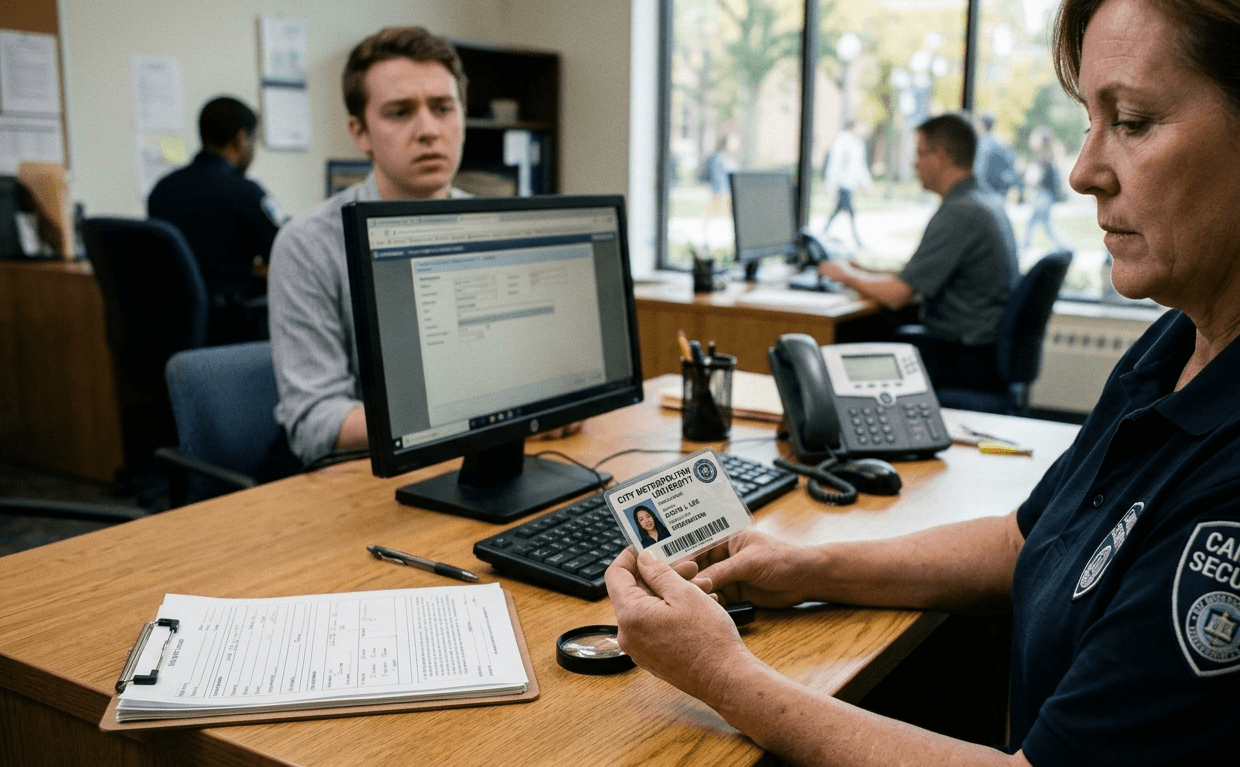
Legitimate Alternatives to a Fake Student ID
People looking for student identification or educational benefits usually have more practical options than purchasing an unauthorized card.
| Actual need | Legitimate alternative |
|---|---|
| Lost university card | Request an official replacement |
| Temporary campus identification | Contact the university card office |
| Proof of current enrollment | Request an enrollment verification letter |
| Student discount eligibility | Use an authorized verification provider |
| Academic account access | Contact university IT support |
| Educational software discounts | Apply through the provider’s official education program |
| Novelty or entertainment card | Use an unmistakably fictional prop |
| Verification difficulties | Request manual review |
The Best Approach for Current Students
Students should start with their university’s registrar, student services department, or campus identification office.
These departments can explain how to obtain replacement credentials and which official documents are available.
The Best Approach for Former Students
Former students should not represent themselves as currently enrolled.
Depending on the institution and retailer, alumni programs, former-student offers, or general promotional discounts may provide legitimate alternatives.
The Best Approach for People Who Are Not Enrolled
People who do not meet a student program’s eligibility requirements should look for publicly available promotions, seasonal sales, educational resources, or other discounts that do not require student status.
There is no need to misrepresent academic enrollment to find affordable products and services.
Conclusion
Searching for a fake student ID may begin with a simple goal, such as accessing a student discount, replacing a lost campus card, or finding proof of enrollment. However, purchasing an unofficial identification card can introduce problems that extend well beyond the original purpose.
A realistic appearance, customizable information, holographic features, or a scannable code does not establish that an educational institution recognizes a credential.
Depending on the circumstances and applicable laws, creating, possessing, or using a fraudulent identification document may lead to legal consequences. Misrepresentation can also result in rejected verification applications, loss of benefits, university disciplinary action, financial losses, and exposure of personal information.
The United States does not treat every unofficial student-themed card identically. Federal statutes, state identification laws, local requirements, and institutional conduct policies must be considered separately.
For genuine students, legitimate options already exist. Official enrollment letters, academic transcripts, university portals, replacement student cards, and authorized verification services can provide appropriate ways to demonstrate student status.
Ultimately, the most useful student identification is not the card that looks the most convincing. It is the credential that is genuinely issued or authorized, accurately represents the holder’s status, and is accepted for the purpose for which it is presented.
FREQUENTLY ASKED QUESTIONS
1. Is it illegal to have a fake student ID in the United States?
It depends on the circumstances and applicable laws. Some states specifically prohibit manufacturing, selling, possessing, or using simulated official student identification cards. Other legal provisions may apply when a document is used for fraud or misrepresentation. A clearly fictional novelty card is different from a credential intended to deceive someone into accepting it as official.
2. Can you use a fake student ID to get student discounts?
An unauthorized student ID does not establish legitimate enrollment or discount eligibility. Retailers and verification providers may require institutional records, academic email verification, or supporting documents. Submitting false information may result in rejected applications or additional consequences.
3. Can a student ID generator create an official university ID?
No private generator can independently authorize a person to hold an official university identification credential. Only the educational institution or an authorized issuing provider can establish that recognition.
4. What happens if a university discovers someone using a fake student ID?
Depending on the circumstances and institutional policies, the university may investigate the incident and impose disciplinary measures. Possible outcomes include loss of campus privileges, suspension, or expulsion. Criminal consequences may also apply under relevant laws.
5. Can a fake student ID pass online verification?
An unofficial card does not establish genuine enrollment. Online verification services may require institutional records, academic email verification, or supporting documentation. A card’s appearance alone does not demonstrate eligibility.
6. What documents can prove student status without a student ID?
Depending on the verification provider, acceptable documents may include an official enrollment letter, academic transcript, acceptance letter, or screenshot of an authenticated student portal. Requirements vary, so applicants should check the provider’s current documentation rules.
7. Are novelty student ID cards legal?
A clearly fictional card created for entertainment, theatrical productions, or personal collections is different from an identification document intended to be mistaken for an official credential. Applicable laws and the way the card is represented and used determine the legal considerations.
8. Can a former student use an old student ID for discounts?
Not necessarily. Many student discount programs require current enrollment. Former students should review the retailer’s eligibility requirements and explore alumni benefits or publicly available promotions instead of misrepresenting their academic status.
9. What should I do if I paid for a fake student ID online?
Avoid using the card to misrepresent your identity or enrollment. Keep your payment records, review what personal information you shared, and contact your payment provider if you suspect a fraudulent transaction. You can also report suspected deceptive business practices to the Federal Trade Commission.
10. What is the safest alternative to buying a fake student ID?
If you are enrolled, request an official student card or enrollment confirmation from your educational institution. If you need a discount, use an authorized student verification service and provide the documents it accepts. If you are not eligible, look for discounts available to the general public.