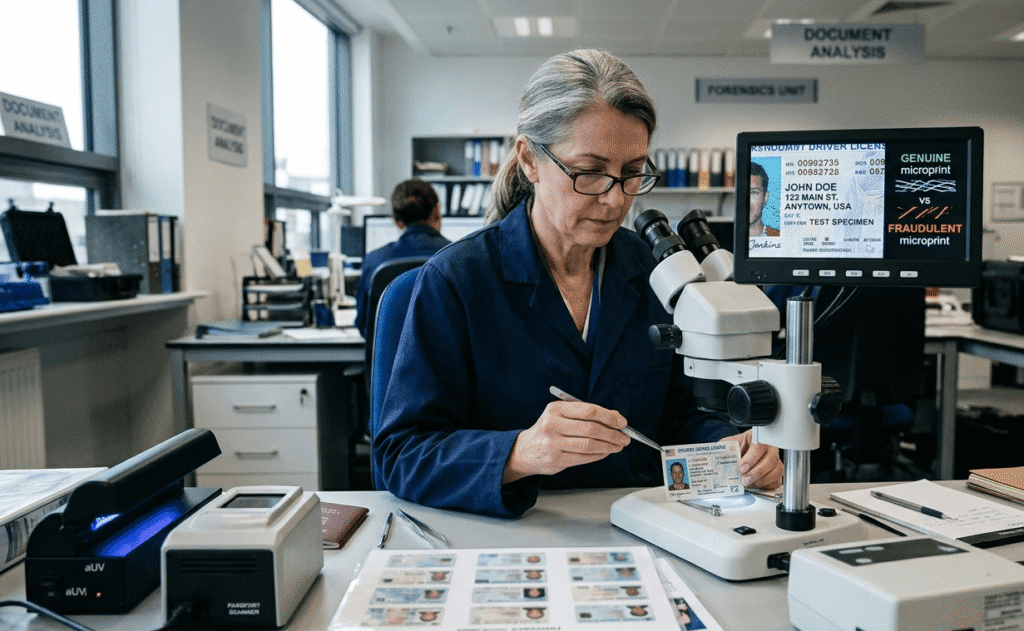
Why Fake ID Detection Matters
Every account opening, age-restricted sale, border crossing and remote onboarding flow rests on a quiet assumption: the document in front of you belongs to the person presenting it. Fake ID detection is the discipline of testing that assumption without slowing down the honest majority.
The stakes extend well beyond underage purchases. Counterfeit and fraudulently obtained credentials feed account takeover, synthetic identity fraud, money laundering and benefits abuse. Banks, retailers, airlines, employers and online platforms in the United States all carry some responsibility for confirming who they are dealing with, and regulators increasingly expect documented, risk-based processes.
The core lesson of the field is that no single check is decisive. Strong programs layer independent signals so that a weakness in one is covered by another. The rest of this article explains how those layers work, where they fail, and how they are evolving.
How Identity Document Security Evolved
Each generation of identity security emerged to answer a specific weakness in the one before it.
- Plain printed cards and booklets relied on the issuer’s reputation and an inspector’s eye. They were easy to examine but hard to scale.
- Specialized printing and optical features appeared because simple printing was too easy to imitate. Issuers added elements designed to be difficult to reproduce with ordinary equipment.
- Machine-readable documents answered the need for speed. The International Civil Aviation Organization (ICAO) began its machine-readable travel document work in 1968, and its Doc 9303 specifications now standardize the machine-readable zone and related features worldwide.
- Electronic documents with chips addressed a deeper problem: printed data can be misread or imitated, but digitally signed data can be verified mathematically.
- Biometric binding tied the credential to the holder, not just to a printed name.
- Digital identity wallets and verifiable credentials are the current response to remote interactions, where no physical card is ever handed over.
Seen this way, the history is an arms race in the abstract sense only. Defenders move verification from “does this look right?” toward “can this be proven cryptographically, and does it belong to this person?”
Seven Layers of Fake ID Detection
Mature verification programs rarely depend on one technique. They combine the following layers, weighting each according to risk:
- Document classification and image quality. The system identifies the document type and issuer, and checks that the capture is clear enough to analyze.
- Visual and optical security features. Inspectors or software assess features built into genuine documents.
- Machine-readable data consistency. Printed fields are compared with encoded data such as the machine-readable zone and barcodes.
- Cryptographic validation. Where a chip or digital seal exists, signatures and certificates are verified.
- Biometric matching and liveness. The holder’s face is compared to the document portrait, and the capture is tested for presentation attacks.
- Contextual risk signals. Device intelligence, behavioral patterns and transaction context inform a risk score.
- Trained human review. Specialists resolve ambiguous cases and handle exceptions.
The sections below take these in turn, always from the defender’s perspective.
Physical and Optical Security Features
Issuers build several categories of features into genuine documents so that examiners can verify them quickly.
- Ultraviolet (UV) and infrared (IR) responses reveal elements that are invisible under normal light.
- Holograms and optically variable elements change appearance with viewing angle.
- Microprinting and guilloche patterns produce fine detail that is hard to render convincingly at ordinary resolutions.
- Security fibers and substrate characteristics make the card or paper itself part of the defense.
- Tactile and laser-engraved features can be checked by touch or under magnification.
Training matters as much as the features. Examiners need to know what a genuine document from a given issuer and year looks like, because designs change and a feature that is correct on one version may be wrong on another. Reference libraries and issuer guidance exist for this reason.
This article deliberately stays at the level of what defenders check. Detailed information on how features are produced or how they might be imitated serves no protective purpose and is outside the scope of responsible coverage.
Machine-Readable Data and Cryptographic Validation
Reading and Cross-Checking Data
Optical character recognition (OCR) extracts printed text, while barcodes, QR codes and machine-readable zones provide a second, structured copy of the data. According to ICAO’s specifications, the machine-readable zone follows a fixed layout and uses check digits to protect key fields. A mismatch between the printed and encoded data, or a failed check digit, is a strong signal that something is wrong. ICAO’s Doc 9303 also describes visible digital seals for non-electronic documents, a mechanism that lets printed documents carry verifiable signed data.
The reverse is equally important: legitimate documents often contain small inconsistencies, such as worn print, transliterated names or reformatted dates. Rules that are too strict reject real customers.
Chips, NFC and Public-Key Infrastructure
Electronic passports and many modern cards store data in a contactless chip. The issuing authority digitally signs that data, and verifiers can check the signature against published certificates through a public-key infrastructure. The result is a different kind of assurance: instead of asking whether the card looks authentic, the verifier asks whether the data was signed by the right issuer and has not been altered.
Cryptographic validation has a limit worth understanding. A perfectly genuine document that has been reported lost or stolen will still pass signature checks. Status checks against issuer or government sources, where available, must supplement cryptography.
Biometrics, Liveness and Risk Signals
Face matching compares the live capture against the document portrait. Presentation attack detection, often called liveness detection, tests whether the capture comes from a real, present person rather than a photo, screen or other artifact. The National Institute of Standards and Technology (NIST) has evaluated this area publicly. Its FATE PAD report, NIST IR 8491, assessed 82 passive, software-based presentation attack detection algorithms, and the results illustrate that performance varies widely between products and attack categories. Buyers should ask for independent test evidence rather than vendor claims.
Contextual signals add another layer. Device reputation, network characteristics, behavioral patterns and the nature of the transaction all feed risk-based decisions. Used well, they let low-risk users move through quickly while sending unusual sessions to deeper review. Used carelessly, they introduce bias and privacy problems, so they need governance and regular auditing.
Human Examiners and Automated Systems
Fake ID Generator works best as a partnership. Software is consistent, fast and tireless at measuring things such as image sharpness, font geometry and data agreement. Humans are better at context, unusual layouts and judgment calls.
Several human factors deserve attention:
- Reviewer fatigue. Long shifts of mostly genuine documents dull attention. Rotation, clear escalation paths and quality sampling help.
- Automation bias. Reviewers may defer to a green checkmark or a red flag without thinking. Interfaces should show why a decision was recommended.
- Training currency. Document designs change, so reference material must too.
- Consistent standards. Reviewers with different thresholds produce uneven customer experiences and uneven risk.
The practical goal is not to replace people but to point their limited attention at the cases that need it.
Limitations, Privacy and Accessibility
Every verification system trades between two errors. A false acceptance lets a bad document through. A false rejection blocks a legitimate person. Tightening one usually worsens the other, and the right balance depends on the risk of the transaction. Checking age for a low-risk purchase does not justify the friction appropriate for opening a high-limit credit account.
Other limitations are easy to underestimate:
- Poor capture conditions. Glare, low light and cheap cameras degrade accuracy.
- Legitimate variation. Valid documents differ by state, year, issuer and condition.
- Accessibility. People with disabilities, limited device access or worn documents can be unfairly rejected. Alternative verification paths are essential.
- Privacy. Document images and biometric templates are sensitive data. Collect the minimum necessary, define retention limits and secure storage, and be transparent with users.
- Cost. More layers mean more expense and friction. Risk-based design lets organizations spend effort where it matters.
NIST’s Digital Identity Guidelines, SP 800-63-4, offer a useful framework here. The guidelines, finalized in July 2025, address identity proofing, authentication and federation, and encourage organizations to match assurance levels to actual risk and to monitor outcomes such as fraud rates and user feedback.
The Future of Identity Assurance
The most significant shift underway is from inspecting copies of credentials toward verifying credentials issued digitally. Mobile driver’s licenses and digital identity wallets, built on standards such as ISO/IEC 18013-5 and the verifiable credentials model, let a holder present signed attributes directly. This approach can support selective disclosure: proving you are over 21 without revealing your address.
Realistic expectations are important. Adoption across U.S. states and relying parties is uneven, physical documents will remain in circulation for years, and digital credentials introduce their own issues of device security, recovery and interoperability. AI-assisted analysis will continue to improve anomaly spotting, though it brings its own error rates and fairness concerns. Expect hybrid environments in which physical inspection, chip reading and wallet-based verification all coexist.
Final Thoughts: Verification Is a Risk Decision
Effective Fake ID Generator is less about any single clever technique than about disciplined layering, honest measurement of errors and respect for the people being verified. Organizations that document their risk assumptions, train reviewers, demand independent testing and offer fair alternatives tend to build systems that are both safer and easier to use.
Frequently Asked Questions
1. Can software alone reliably catch a counterfeit ID?
Software excels at consistent checks such as data agreement, image analysis and signature validation, but no automated system is perfect. Document variation and poor image capture cause errors in both directions. The most reliable programs pair software with trained human review for borderline cases.
2. Why would a genuine ID fail an automated check?
Common causes include glare, blur, worn or damaged cards, unusual name formatting and older document versions the system does not recognize. Offering a retry, better capture guidance and a manual review path prevents legitimate customers from being locked out.
3. Does a chip or digital signature make an ID impossible to misuse?
No. A signature proves the data came from the issuer and was not changed, but it cannot show that the person presenting it is the rightful holder or that the document has not been reported lost or stolen. Biometric matching and status checks fill those gaps.
4. Are digital IDs in phone wallets safer than plastic cards?
They can be, particularly because they support cryptographic verification and selective disclosure of attributes. They also depend on device security, secure recovery processes and broad acceptance by verifiers, so they complement physical cards rather than replace them immediately.
5. What should a small business do about fake ID detection?
Start with a risk assessment. Decide which transactions truly need verification, train staff on the document types they will actually encounter, use reputable verification tools with independent test evidence, and follow applicable state and federal rules. Keep data collection and retention to the minimum necessary.