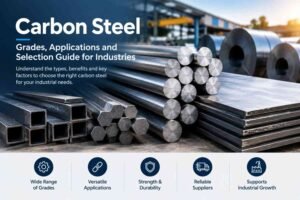
Carbon steel continues to be a fundamental material in modern manufacturing, engineering, construction, and industrial fabrication. Its versatility, availability in multiple product forms, and range of mechanical properties make it suitable for applications ranging from general fabrication to precision-engineered components. However, selecting the right material requires an understanding of carbon content, grade specifications, manufacturing requirements, and operating conditions.
For industrial buyers, choosing the appropriate carbon steel grade is not simply a purchasing decision. It directly influences machining efficiency, component performance, fabrication quality, and overall production costs. Understanding these factors helps businesses make informed procurement decisions and establish more reliable material sourcing processes.
Understanding the Composition and Properties of Carbon Steel
Carbon steel is primarily an iron-carbon alloy, with other elements present in quantities determined by the applicable grade and manufacturing specification. Carbon content has a significant influence on hardness, strength, ductility, and heat-treatment response, although these properties also depend on processing and microstructure.
Low-carbon steels are generally valued for their formability and weldability. Medium-carbon steels can provide a useful balance of strength and ductility, while high-carbon steels can achieve greater hardness and wear resistance when processed appropriately.
These distinctions explain why carbon steel is used across many sectors. Nevertheless, a higher carbon content does not automatically make a material better. The appropriate grade depends on the component’s intended purpose, loading conditions, fabrication method, and required mechanical properties.
What Are the Different Forms of Carbon Steel Available?
Carbon steel is supplied in several forms to meet different manufacturing and fabrication needs. Selecting the correct product form helps reduce unnecessary machining, material waste, and production delays.
Carbon Steel Round Bars
Round bars are widely used for shafts, pins, rollers, fasteners, and machined engineering components. Their suitability depends on the grade, diameter, dimensional tolerances, and required mechanical properties.
Carbon Steel Flat Bars
Flat bars are useful in fabrication, brackets, supports, frames, and general engineering applications. Buyers should verify thickness, width, straightness, and the required material specification.
Carbon Steel Square and Hexagonal Bars
Square bars are used in selected machining and fabrication applications, while hexagonal bars are frequently chosen for components such as nuts, fittings, and other parts requiring a hexagonal profile.
Carbon Steel Plates and Coils
Plates are commonly used in equipment fabrication, industrial structures, and machinery. Coils support sheet-metal processing, forming, and manufacturing operations. The correct selection depends on thickness, grade, surface condition, forming requirements, and applicable standards.
Carbon Structural Steel
Structural steel products serve construction and fabrication applications where specified strength, weldability, and dimensional requirements must be met. Buyers should confirm the exact structural grade and applicable standard rather than treating all carbon steels as interchangeable.
Which Industries Depend on Carbon Steel?
Carbon steel plays a significant role in numerous industrial sectors because it can be selected and processed to suit different engineering requirements.
Manufacturing and engineering: Suitable grades are machined into shafts, pins, machine parts, and other components used in production equipment.
Automotive components: Carbon steel is used in selected fasteners, mechanical parts, and engineered components, with material selection guided by the relevant design and performance requirements.
Construction and fabrication: Plates, bars, and structural products are used in frameworks, supports, equipment, and fabricated assemblies.
Agricultural and industrial machinery: Various carbon steel products are incorporated into machine components, implements, and equipment parts where the selected grade meets service requirements.
General metalworking: Fabricators and machine shops use different carbon steel forms for cutting, forming, machining, and assembly operations.
Across these sectors, the material specification should be matched to the actual application rather than selected on price alone.
How Should Businesses Choose the Right Carbon Steel Grade?
Choosing a suitable grade begins with identifying the component’s operating requirements. Engineers and procurement professionals should consider the following factors before placing an order.
Application and loading: Determine whether the component must withstand tensile loads, impact, wear, repeated loading, or other service conditions.
Mechanical properties: Establish the required strength, hardness, ductility, and other properties from the engineering design or applicable specification.
Manufacturing process: Consider machining, welding, forming, cutting, and any planned heat treatment. Different grades respond differently to these processes.
Dimensional requirements: Confirm product shape, dimensions, tolerances, and delivery condition to ensure the material suits the production process.
Standards and certification: Check the applicable material standard and request relevant test documentation. Confirm that certificate details correspond to the supplied material.
Operating environment: Evaluate moisture, chemicals, temperature, and corrosion exposure. Standard carbon steel may require protective coatings or other corrosion-control measures depending on the application.
A documented selection process makes procurement more consistent and reduces the risk of material incompatibility or costly rework.
Why Should Businesses Evaluate Carbon Steel Suppliers Carefully?
Reliable sourcing is essential for businesses that depend on consistent material quality and predictable production schedules. Evaluating Carbon Steel Suppliers involves more than comparing quoted prices.
Buyers should examine whether a supplier can source the required grade and product form, provide relevant material documentation, communicate realistic lead times, and coordinate delivery according to the order requirements. Clear communication about stock availability, minimum order quantities, dimensions, and packaging can also prevent misunderstandings.
For specialist applications, purchasers should confirm that the supplier understands the requested specification and can provide the necessary supporting documents. Independent verification of material properties remains important, especially where safety, performance, or regulatory requirements apply.
Businesses exploring different grades and product forms can review the Carbon Steel range offered through Steel Exchange to identify relevant sourcing options for their industrial requirements.
How Can Businesses Improve Carbon Steel Procurement?
An effective procurement process starts with a clear purchase specification. Buyers should state the required grade, standard, product form, dimensions, quantity, delivery condition, and certification requirements.
Comparing quotations on equivalent specifications makes pricing evaluations more meaningful. Procurement teams should also confirm lead times, delivery arrangements, and procedures for addressing discrepancies in supplied material.
Maintaining purchase records and linking material certificates to received batches can improve traceability. For recurring orders, documenting approved grades and supplier performance helps standardize purchasing and reduce avoidable delays.
Conclusion
Carbon steel remains an essential material for manufacturing, engineering, construction, and industrial fabrication. Its broad range of grades and product forms allows businesses to meet different strength, machining, fabrication, and cost requirements.
The key to successful material selection is understanding the application’s technical needs, verifying grade specifications, reviewing documentation, and sourcing from suppliers capable of meeting the purchase requirements. By combining engineering knowledge with a structured procurement process, businesses can make more informed decisions and support consistent industrial production.