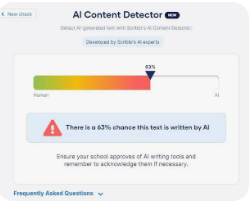
Artificial intelligence has changed how people write, research, and create digital content. From blog articles and academic assignments to business reports, AI writing tools can generate text within seconds. However, as AI-generated content becomes more common, identifying its origin is increasingly important. An effective AI detector helps users analyze written content and understand whether it may have been produced by artificial intelligence or written by a human. Alongside this, a KI detector provides similar functionality for identifying AI-generated text, particularly for German-speaking users.
What Is an AI Detector?
An AI detector is a tool designed to analyze written content and estimate whether it was generated by an artificial intelligence system. It examines different language patterns, sentence structures, vocabulary choices, and writing characteristics that may indicate machine-generated text.
These tools are useful for students, teachers, content creators, editors, and businesses that want to evaluate the originality and authenticity of written material.
Unlike traditional plagiarism checkers, which compare content against existing sources, AI detection tools focus on identifying patterns commonly associated with AI-generated writing.
How Does AI Content Detection Work?
AI detection systems use machine learning models and language analysis techniques to examine text. They look for several characteristics, including:
- Sentence predictability: AI-generated writing may contain predictable word sequences and sentence patterns.
- Writing consistency: Some AI-generated content maintains an unusually consistent tone and structure.
- Vocabulary patterns: Repeated expressions and predictable word choices can provide useful signals.
- Sentence variation: Human writing often contains more natural variations in sentence length and structure.
- Contextual patterns: Detection models examine how words and sentences relate to one another.
The system combines these signals to produce an assessment of how likely the content is to be AI-generated.
However, AI detection results are estimates rather than definitive proof. Human writing can sometimes be flagged incorrectly, while carefully edited AI content may not always be detected.
What Is a KI Detector?
A KI detector is essentially an AI detection tool, with KI being the German abbreviation for Künstliche Intelligenz, meaning artificial intelligence.
Its purpose is to analyze text and identify characteristics that may indicate it was generated using AI writing tools.
KI detection is particularly relevant in German-speaking countries, where students, educators, publishers, and businesses increasingly work with AI-generated content.
Why Is a KI Detector Important?
As AI writing technology develops, maintaining transparency and originality has become important across different industries.
A reliable KI detector can help with:
- Evaluating German-language academic assignments.
- Reviewing AI-assisted business documents.
- Checking articles before publication.
- Supporting editorial quality control.
- Understanding whether written material may contain AI-generated sections.
German-language content can have different grammatical structures and linguistic characteristics from English. Therefore, detection tools should be evaluated based on their language support and performance rather than assuming that every detector works equally well across languages.
AI Detector vs. Plagiarism Checker: What Is the Difference?
AI detection and plagiarism checking serve different purposes, although both contribute to content evaluation.
An AI detector estimates whether text may have been created using artificial intelligence. A plagiarism checker searches for similarities between submitted content and existing published or indexed material.
For example, an original article written by ChatGPT may not contain copied sentences from another website, but it could still receive an AI-generated classification.
Similarly, a human-written article may contain properly quoted or unintentionally similar passages that require a plagiarism review.
Using both types of tools can provide a broader understanding of content originality and quality.
How to Use an AI Detector Effectively
Getting useful results from an AI detection tool requires more than simply pasting text and reading a percentage.
Follow these practical steps:
1. Prepare Your Content
Copy the complete article, assignment, or document you want to evaluate. Make sure the text contains enough meaningful content for analysis.
2. Submit the Text for Analysis
Choose an appropriate detection tool and paste your content into its text input area. If document uploads are supported, you can also use the available upload option.
3. Review the Detection Results
Examine the generated report carefully. Pay attention to the overall assessment and any highlighted sections rather than relying entirely on a single score.
4. Improve Content Quality
If certain sections appear overly repetitive or unnatural, review their clarity, sentence structure, examples, and supporting information.
The goal should be to improve genuine writing quality, not simply manipulate a detection score.
Best Practices for Creating High-Quality Content in 2026
Search engines increasingly emphasize helpful, reliable, people-first content. Whether an article is written by a human or developed with AI assistance, its usefulness matters.
Consider these practices:
- Provide accurate information supported by reliable sources.
- Include relevant examples and practical explanations.
- Use descriptive headings to improve readability.
- Avoid repetitive sentences and unnecessary keyword placement.
- Add original insights and meaningful experiences where appropriate.
- Review AI-assisted content for factual accuracy.
- Make sure the content satisfies the reader’s search intent.
AI detection scores should not replace editorial judgment. A useful article must demonstrate clarity, accuracy, originality, and relevance.
Is AI Detection Always Accurate?
No AI detector can guarantee perfect accuracy. Detection systems can produce false positives, meaning human-written text may be incorrectly classified as AI-generated.
They can also produce false negatives when AI-generated material has been significantly edited or rewritten.
For this reason, AI detection results should be treated as supporting information rather than conclusive evidence. Educational institutions, publishers, and businesses should consider writing history, context, and human review before making important decisions.
Isgen: AI Detection and Content Analysis
Isgen is an online platform that provides AI detection and content analysis solutions. Its tools help users examine written material and better understand AI-generated content. Whether you are a student, educator, writer, or digital content professional, Isgen offers online resources for evaluating text and supporting content quality workflows. Visit the Isgen website at isgen.ai to explore its available tools and services.
Final Thoughts
AI detectors and KI detector have become useful tools for evaluating digital content in 2026. They help users identify potential AI-generated writing patterns, review documents, and make more informed decisions about content authenticity.
By combining AI detection with plagiarism checking, careful editing, and human judgment, individuals and organizations can maintain better content standards. The most effective approach is to use detection tools responsibly while prioritizing accurate, original, and genuinely helpful information.