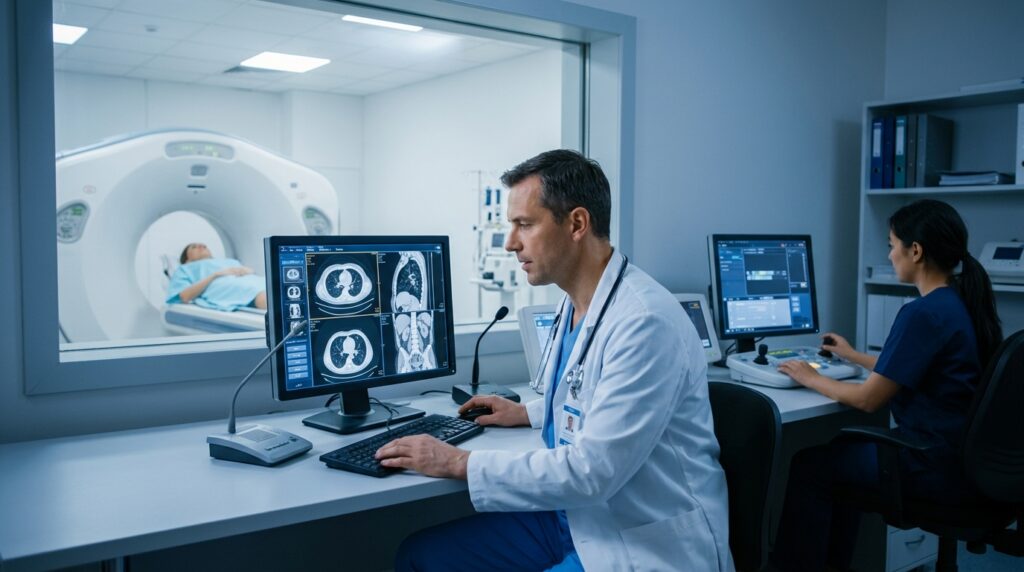
When a doctor prescribes a computed tomography (CT) scan, the natural first reaction for most patients is to pull out a smartphone and search for a ct scan centre near me. In a city like Bangalore, where healthcare infrastructure is rapidly evolving, the results can be overwhelming. You are likely to find hundreds of options ranging from small standalone labs to massive multi-specialty hospitals. However, finding the *closest* centre is rarely the same as finding the *best* one for your specific diagnostic needs.
In 2026, the landscape of medical imaging has shifted. It is no longer just about having a machine that takes pictures; it is about the integration of artificial intelligence (AI), the precision of high-slice technology, and the reliability of accredited reporting. Choosing the wrong facility can lead to grainy images, “false positives” that cause unnecessary anxiety, or worse, missed diagnoses that delay critical treatment. This guide is designed to help you navigate these choices, ensuring you find a facility that balances proximity with clinical excellence.
Diagnostic accuracy is the cornerstone of effective treatment. Whether you are investigating persistent abdominal pain, screening for lung health, or requiring a detailed cardiac evaluation, the quality of the scanner and the expertise of the radiologist are non-negotiable. By understanding what to look for in a modern imaging centre, you can transform a routine search into a strategic decision for your long-term health.
Prioritizing Technology: Why Slices and AI Matter in 2026
The first thing you should evaluate when looking for a ct scan centre near me is the specific technology they utilize. In 2026, the “slice count” of a CT scanner remains a primary indicator of its capability. A “slice” refers to the number of cross-sectional images the machine can capture in a single rotation. While a 16-slice scanner is still clinically adequate for routine bone or basic chest scans, more complex requirements—such as coronary artery imaging or detailed oncology staging—benefit significantly from 64-slice, 128-slice, or even the latest 256-slice systems.
Higher slice counts do more than just provide “clearer” pictures; they provide speed. A 256-slice scanner can capture an image of the entire heart in just two beats, which is crucial for patients who cannot hold their breath for long or those with high heart rates. Furthermore, 2026 has seen the mainstreaming of “Photon-Counting CT” and “Spectral CT.” These technologies allow doctors to see the chemical composition of tissues, making it easier to distinguish between a benign cyst and a malignant tumor without invasive biopsies.
Beyond the hardware, AI integration has become a standard for reliability. Modern centres now use AI-driven denoising algorithms that produce high-resolution images even at significantly lower radiation doses. AI also acts as a “second pair of eyes” for the radiologist, flagging urgent findings like a brain hemorrhage or a pulmonary embolism within seconds of the scan being completed. This ensures that life-threatening conditions are prioritized in the reporting queue.
Comparing CT Scanner Capabilities in 2026
| Feature | Entry-Level (16-32 Slices) | Mid-Range (64-128 Slices) | Premium (256+ Slices / Spectral) |
| :— | :— | :— | :— |
| Best Use Case | Routine bone/chest/extremity | Cardiac, trauma, abdominal | Oncology, advanced cardiac, research |
| Scan Speed | Moderate (30-40 seconds) | Fast (10-15 seconds) | Ultra-fast (<5 seconds) |
| Radiation Dose | Standard | Reduced (Iterative) | Ultra-Low (AI-enhanced/Photon) |
| Detail Level | Good for anatomy | Excellent for blood vessels | Molecular-level tissue detail |
The Accreditation Standard: Navigating the Quality Crisis
The most critical factor in your search for a ct scan centre near me is often the one you cannot see: accreditation. In India, there is a significant “quality crisis” in the diagnostic sector. Out of nearly 3 lakh laboratories, only a small fraction are accredited by the National Accreditation Board for Testing and Calibration Laboratories (NABL). NABL accreditation is the gold standard; it ensures that the facility follows strict international protocols for machine calibration, hygiene, and reporting accuracy.
When a centre is NABL or NABH (National Accreditation Board for Hospitals & Healthcare Providers) certified, it means their processes are audited regularly. For a patient, this translates to “repeatable” results. A scan taken at an accredited centre in Bangalore should, in theory, be interpreted the same way by a specialist in New York or London. Without these standards, you risk receiving a report based on faulty measurements or sub-optimal imaging protocols, which could lead to an incorrect diagnosis.
Furthermore, accreditation covers the qualifications of the staff. It guarantees that the person operating the machine is a certified radiographer and that the final report is signed by a qualified MD Radiologist. In an unorganized market, some smaller centres might use technicians to “draft” reports, which are then signed in bulk. Choosing an accredited facility protects you from these shortcuts, ensuring that your health data is handled with professional integrity.
Why Accreditation is Your Best Safety Net
- Machine Calibration: Regular checks ensure the radiation dose is accurate and the sensors are functioning at peak sensitivity.
- Hygiene Protocols: Strict standards for disinfecting the gantry and changing linens between patients.
- Standardized Reporting: Use of international lexicons (like BI-RADS for breast or PI-RADS for prostate) to ensure clarity for your treating doctor.
- Error Tracking: Accredited centres are required to maintain logs of any “near misses” or errors to improve future performance.
Understanding 2026 Pricing and Digital Health Integration
When searching for a ct scan centre near me, price transparency is a major concern. In 2026, CT scan costs in Bangalore vary widely depending on the complexity of the scan and the technology used. A basic NCCT (Non-Contrast CT) of the brain might cost between ₹1,500 and ₹3,500, while a high-end Coronary CTA (Angiography) or a whole-body PET-CT can range from ₹12,000 to ₹25,000. Reliable centres will provide a clear breakdown of these costs upfront, including the price of contrast media and any additional nursing charges.
Digital integration has also revolutionized how you receive and store your scan data. Under the Ayushman Bharat Digital Mission (ABDM), many top centres now link your reports directly to your ABHA (Ayushman Bharat Health Account). This means you no longer have to carry bulky plastic films or printed reports when visiting different specialists. Your images are stored in a secure cloud, accessible via a QR code or a secure link, ensuring care continuity across different hospitals.
Choosing a centre that offers digital access is not just about convenience; it is about efficiency. If you need a second opinion, you can share the high-quality DICOM (Digital Imaging and Communications in Medicine) files with a specialist anywhere in the world instantly. Traditional films often lose detail when photographed or scanned, but digital access ensures the second consultant sees exactly what the first one did.
Estimated CT Scan Price Ranges in Bangalore (2026)
| Scan Type | Purpose | Estimated Cost (₹) |
| :— | :— | :— |
| NCCT Brain | Headache, trauma, stroke screening | 1,500 – 3,500 |
| HRCT Chest | Lung infections, pneumonia, fibrosis | 3,000 – 5,500 |
| CECT Abdomen | Persistent pain, organ health, tumors | 5,000 – 8,500 |
| Coronary CTA | Heart artery blockages, calcium score | 9,000 – 15,000 |
| Whole Body PET-CT | Cancer staging and monitoring | 18,000 – 25,000 |
Safety First: Radiation Management and Advanced Contrast Protocols
Safety is often the biggest hesitation patients have when considering a CT scan. The fear of “radiation exposure” is valid, but in 2026, it is manageable. A reliable ct scan centre near me will practice the ALARA principle (As Low As Reasonably Achievable). This means they customize the radiation dose based on your body weight and the specific clinical question. Pediatric patients, for instance, should always be scanned using “Ultra-Low Dose” protocols that utilize AI to maintain image quality while cutting radiation by up to 80%.
Another safety aspect involves the use of contrast dye (iodine). While contrast is essential for “lighting up” blood vessels and tumors, it can be hard on the kidneys. Top-tier diagnostic centres now use non-ionic, low-osmolar contrast media, which is much safer and less likely to cause allergic reactions. Before administering contrast, a reliable centre will always check your kidney function (Creatinine/eGFR levels) and provide a detailed hydration protocol to help your body flush the dye out post-scan.
Furthermore, the patient experience during contrast administration has improved. Many centres in Bangalore have adopted specialized “bitterness-blocked” oral contrast beverages, replacing the chalky, unpleasant liquids of the past. This leads to better patient compliance and clearer abdominal images. When you call a centre, ask if they use automated contrast injectors, which ensure the dye enters the bloodstream at a precise rate for optimal timing and safety.
Safety Checklist: Questions to Ask the Centre
- “Do you use AI-based dose reduction software?”
- “Will a doctor be present or immediately available during contrast administration?”
- “Do you use non-ionic contrast media?”
- “What are your protocols for patients with borderline kidney function or allergies?”
- “Do you provide a lead shield for non-target areas (like the thyroid or pelvis)?”
Assessing the Human Factor: Radiologist Expertise and Reporting Speed
While the machine takes the picture, the radiologist tells the story. When you look for a ct scan centre near me, investigate who is reading your scans. In 2026, many centres use “Teleradiology” networks to ensure that a sub-specialist reviews your case. For example, a “Neuroradiologist” should ideally read your brain scan, while a “Musculoskeletal Radiologist” should look at your spine. A general radiologist is competent, but a sub-specialist can catch subtle nuances that might change your treatment plan.
Turnaround time is another critical factor. In emergency cases, such as a suspected stroke or internal bleeding, every minute counts. Leading diagnostic centres in Bangalore now offer “Stat” reporting, where an AI-triaged scan is reviewed and reported by a radiologist in under 30 to 60 minutes. For routine scans, a 6-to-12-hour turnaround is the current benchmark for quality. If a centre takes more than 24 hours to provide a report, it may indicate an overworked staff or a backlog that could affect reporting precision.
Finally, consider the communication. A high-quality report should not just be a list of medical terms; it should include a “Conclusion” or “Impression” section that directly answers your doctor’s referral question. Some modern centres even offer a brief “Patient Summary” written in plain language to help you understand the findings before you meet your consultant.
Indicators of Professional Excellence
- Sub-Specialized Readers: Access to radiologists trained specifically in neuro, cardiac, or oncology imaging.
- Peer Review Systems: A process where a second radiologist double-checks a percentage of the reports to ensure accuracy.
- Standardized Lexicons: Use of templates that ensure no part of the anatomy is overlooked during the review.
- 24/7 Availability: Ability to process and report emergency scans at any hour of the day or night.
Preparing for Your Scan: A Checklist for Maximum Accuracy
Finding a reliable ct scan centre near me is only the first step; your preparation plays a significant role in the scan’s success. Most CT scans require you to be “fasting” (NPO) for at least 4 hours if contrast is being used. This prevents nausea and ensures that your digestive system is at rest. However, hydration is equally important—drinking water (unless told otherwise) helps the contrast work better and protects your kidneys.
Comfort and communication are also vital. You should wear loose, metal-free clothing (like a tracksuit) to avoid having to change into a hospital gown. If you suffer from claustrophobia, inform the staff beforehand. Modern CT scanners have wider “bore” sizes (the hole you slide into) and are much faster than older models, significantly reducing the “closed-in” feeling. Some centres even use ambient lighting and music to create a more relaxing environment.
Lastly, always bring your previous reports and films. One of the most important things a radiologist does is “comparison.” Knowing if a lung nodule has stayed the same size for two years or if it is a new development is more valuable than any single high-resolution image. If your centre is linked to the ABDM, they might be able to pull these records digitally, but having a backup is always wise.
Final Pre-Scan Preparation Checklist
- Fasting: No solid food for 4 hours prior to a contrast scan.
- Hydration: Drink at least 500ml of water 2 hours before your appointment.
- Medication: Take your regular blood pressure or heart medications unless specifically told not to.
- Documentation: Carry your doctor’s prescription, recent Creatinine report, and any old CT/MRI films.
- Arrival: Arrive 15-30 minutes early, especially if you need to drink oral contrast.
- Information: Disclose any history of asthma, diabetes, or previous reactions to iodine.