Have you ever looked at a tree and wondered what species it is? You may recognize its general shape or remember seeing it many times, but identifying a tree accurately can be surprisingly difficult. Trees can look very different depending on their age, season, growing conditions, and location. Even two unrelated species may have similar leaves or bark.
The good news is that you do not need to be a professional botanist to learn how to identify a tree. By paying attention to a few visible characteristics, you can narrow down the possibilities and often identify the species with reasonable confidence.
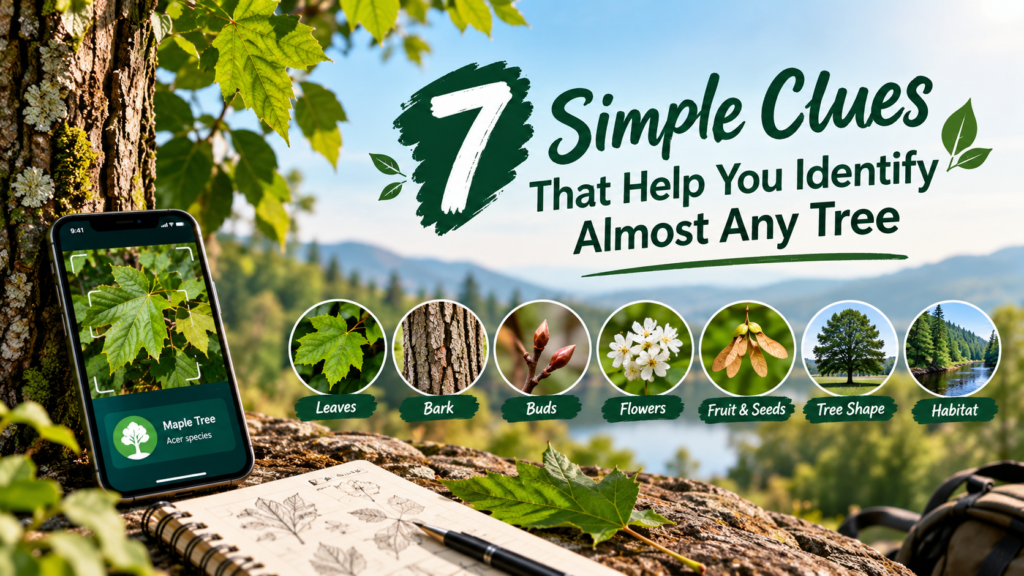
The most useful clues include leaves, bark, tree shape, branches, flowers, fruits, buds, and habitat. Instead of relying on one feature, it is usually better to combine several clues. A leaf may suggest one group of trees, while the bark and fruit can provide additional confirmation.
Whether you are exploring a forest, walking through a park, gardening at home, or simply curious about the trees around you, learning these clues can make outdoor observation much more interesting.
Why Tree Identification Starts With Observation
Before trying to name a tree, take a moment to observe it carefully. Many identification mistakes happen because people immediately focus on one noticeable feature, such as the leaf shape.
A better approach is to examine the entire tree.
Look at its overall height and shape. Notice whether the branches grow upward, spread widely, or hang downward. Examine the leaves, bark, twigs, flowers, and fruit if they are present. Also consider where the tree is growing.
This process is important because tree identification is based on a combination of characteristics rather than a single universal feature.
For example, a tree with heart-shaped leaves could potentially belong to several different species. However, if those leaves are combined with distinctive bark, opposite or alternate leaf arrangement, particular flowers, and a specific habitat, the number of possibilities becomes much smaller.
The goal is not simply to notice what looks unusual. The goal is to collect several clues and compare them.
1. Examine the Leaves Carefully
Leaves are often the first feature people use for identifying trees, and for good reason. They are relatively easy to observe and can provide several useful characteristics.
Start with the leaf’s overall shape. Is it oval, heart-shaped, round, triangular, needle-like, or deeply lobed? Next, examine the edge. A leaf margin may be smooth, toothed, wavy, or deeply divided.
Size also matters. Measure or estimate the length and width of the leaf if possible.
Another important clue is the way leaves are arranged on a twig. Some trees have alternate leaves, meaning one leaf emerges at a time along the stem. Others have opposite leaves, where two leaves emerge from roughly the same point. A smaller number have whorled arrangements, with several leaves growing around a stem.
Pay attention to the leaf surface as well. Is it glossy, rough, hairy, waxy, or smooth? Look closely at the veins. Some species have highly distinctive venation patterns.
Leaf color can help, but it should generally be treated as supporting evidence rather than the main identification feature. Sunlight, soil conditions, age, disease, and seasonal changes can affect leaf color.
If you are trying to identify a tree by its leaves, take a clear photograph showing both the shape and arrangement of several leaves rather than photographing only one leaf.
2. Study the Bark
Bark is one of the most useful clues when leaves are unavailable, particularly during winter.
Look at the color first. Bark may be gray, brown, reddish, greenish, nearly black, or even pale and almost white. However, color alone is rarely enough because many species share similar bark colors.
Texture is usually more informative.
Ask yourself whether the bark is smooth, rough, flaky, ridged, deeply furrowed, peeling, or covered with small scales. Some trees develop striking patterns as they mature, while young trees may have completely different bark from older specimens.
The thickness and pattern of the bark can also provide valuable information. Deep vertical grooves, horizontal markings, plates, or curling strips may help separate similar-looking species.
This makes tree bark identification especially useful when a tree has no obvious leaves, flowers, or fruit.
For accurate observation, examine bark from several parts of the trunk. Avoid relying on a damaged section because injuries, weather, insects, or human activity can change its appearance.
3. Look at the Tree’s Overall Shape
The overall form of a tree is sometimes overlooked, but it can provide an important identification clue.
Stand several steps away and look at the complete tree. Is it tall and narrow, broad and spreading, rounded, columnar, pyramidal, or irregular?
Branching patterns can also be distinctive. Some trees develop strong horizontal branches, while others have branches that point upward. Some species form dense crowns, whereas others have a more open appearance.
The shape of the crown may change with age and growing conditions, so it should not be used by itself. A tree growing in a crowded forest may become tall and narrow because it is competing for sunlight, while the same species growing in an open field may develop a broad crown.
Still, when combined with leaf, bark, and branch characteristics, tree shape can significantly improve identification accuracy.
If you are using a tree identification app, photographing the entire tree can sometimes provide useful context alongside close-up images of its leaves and bark.
4. Inspect the Branches and Twigs
When leaves are absent, small branches and twigs become particularly valuable.
Examine the color and thickness of young twigs. Some species have smooth, reddish, green, gray, or brown twigs. Others develop distinctive textures or small projections.
The arrangement of buds is another useful clue. Look at where buds appear along the twig and whether they are opposite or alternate. Their size, shape, color, and protective scales may also differ between species.
Branching patterns can provide additional information. Notice whether smaller branches emerge at regular intervals or form irregular clusters.
A close look at a twig may not seem exciting at first, but for people learning how to identify trees in winter, these small details can be extremely valuable.
Winter identification often requires more patience because many of the most obvious characteristics disappear. Instead of leaves, observers need to rely on bark, buds, twigs, branching patterns, and the tree’s overall form.
5. Check for Flowers, Fruits, and Seeds
Flowers and fruits can provide some of the strongest clues when they are available.
Flowers vary considerably in size, shape, color, fragrance, and arrangement. Some appear individually, while others grow in clusters, spikes, or hanging structures.
Fruit can be equally distinctive. Depending on the species, you may find berries, nuts, pods, cones, winged seeds, fleshy fruits, or other structures.
For example, a tree with small winged seeds has a very different set of identification possibilities from one producing large nuts. Likewise, cones can help distinguish many conifer species.
Do not assume that every tree will have fruit or flowers at the same time. Many trees produce these structures only during particular seasons. Weather and local growing conditions can also affect timing.
When available, fruit and flowers are particularly useful for confirming an identification based on leaves and bark.
If you are photographing a tree for plant identification, capture the reproductive structures clearly. A close-up photograph of fruit or flowers can sometimes provide more useful information than a distant image of the entire tree.
6. Consider Where the Tree Is Growing
Location is a powerful but sometimes overlooked clue.
Ask where you found the tree. Is it growing naturally in a forest, beside a river, on a mountain, in a dry landscape, in a city park, or in a residential garden?
Different species are adapted to different environments. Some prefer wet soils, while others tolerate drought. Some grow naturally at higher elevations, while others are associated with warmer lowland areas.
Geographic location can also dramatically reduce the number of possible species.
For example, if you are trying to identify a tree in a particular region, knowing the local flora can help you eliminate species that do not naturally occur there.
However, location should not be treated as absolute proof. People plant trees far outside their native ranges, and introduced species can become established in unexpected places.
The best approach is to combine habitat and geographic information with physical characteristics.
This is one reason modern AI tree identification tools can be useful. When an image-based identification system is combined with information about the photographed plant, region, and visible characteristics, it may help narrow down potential matches more efficiently.
7. Pay Attention to Seasonal Changes
A tree can look completely different throughout the year.
In spring, flowers and fresh leaves may dominate its appearance. During summer, a full canopy can make the tree easy to recognize from a distance. In autumn, leaves may change color or fall, revealing branches and bark. In winter, buds, twigs, and bark become much more important.
This means tree identification by season requires flexibility.
If you cannot identify a tree in summer, do not assume it will remain difficult in winter. You may discover that its bark or twig structure is much more distinctive once the leaves disappear.
Likewise, a tree that is difficult to identify from its winter bark may become obvious when it produces flowers or fruit.
Taking photographs throughout the year can therefore be a useful learning technique. Seasonal comparison helps you understand which characteristics remain stable and which ones change.
How to Combine Clues for a More Accurate Identification
One of the biggest mistakes beginners make is trying to identify a tree from one characteristic.
A leaf may look like the leaf of a familiar species, but similar leaves can occur across unrelated trees. The same applies to bark color, tree height, or fruit.
Instead, use a process of elimination.
Start with the leaf characteristics. Then check the arrangement of leaves and branches. Examine bark texture and color. Look for flowers, fruit, or seeds. Finally, consider the location and growing environment.
Suppose you find a tree with heart-shaped leaves. That observation gives you a starting point, but it does not necessarily provide a final answer. You can then examine the bark, leaf arrangement, fruit, and overall shape to narrow down the possibilities.
This method is more reliable than matching one feature.
For beginners, creating a simple observation checklist can make the process easier:
- Leaf shape and size
- Leaf arrangement
- Leaf edge and veins
- Bark color and texture
- Tree height and crown shape
- Branch and twig pattern
- Bud characteristics
- Flowers and fruit
- Habitat and geographic location
- Season of observation
The more independent clues that point toward the same species, the stronger your identification becomes.
Using Technology to Identify Trees
Traditional field guides remain useful, but technology has made tree identification more accessible to beginners.
Image-based identification tools allow users to photograph an unfamiliar tree or one of its identifying features and receive possible species matches. These tools can be especially helpful when a person does not know where to begin.
An AI tree identifier can analyze visual patterns in photographs and compare them with information associated with known plant species. Depending on the tool, users may be able to upload images of leaves, flowers, bark, fruit, or the entire tree.
However, technology should be treated as a helpful identification aid rather than an unquestionable authority.
Image quality, lighting, unusual growth forms, seasonal differences, and visually similar species can all affect results. If an identification is important, compare the suggested result with multiple physical characteristics and reliable botanical references.
The best approach combines technology with observation. Instead of simply asking an app for a name, use the result as a starting point and then check whether the tree’s leaves, bark, branches, fruit, and habitat support that identification.
How to Take Better Photos for Tree Identification
A clear photograph can make a significant difference when using an online or AI-based plant identifier.
Try to take several photographs rather than relying on one image.
Start with a full-tree photograph that shows its general shape. Then take a close-up of the leaves, making sure the leaf arrangement is visible. If possible, photograph the bark, young twigs, flowers, fruit, or seeds as well.
Avoid extremely dark or blurry images. Natural daylight generally makes details easier to see. Place the leaf against a simple background when taking a close-up photograph.
It is also helpful to photograph both sides of a leaf when the underside has different characteristics from the upper surface.
If you know the location and season, record that information as well. These details can provide additional context during identification.
Common Tree Identification Mistakes
Even experienced nature enthusiasts can make identification mistakes. Some errors are particularly common among beginners.
One mistake is relying only on leaf shape. Several unrelated species may have leaves that look almost identical at first glance.
Another is ignoring the tree’s age. Young trees can have different bark, branching patterns, and growth forms compared with mature specimens.
Seasonal changes can also cause confusion. A tree may look completely different after losing its leaves, while autumn colors may temporarily make several species appear similar.
Another common problem is assuming that location proves the species. Planted ornamental trees can grow far outside their natural distribution.
Finally, beginners sometimes accept the first identification result they see without checking it against other clues. Whether using a field guide or an AI tree identification tool, it is better to verify the result using multiple characteristics.
Why Learning Tree Identification Is Worthwhile
Learning how to identify trees is more than a practical skill. It can change the way you experience outdoor spaces.
A walk through a park becomes an opportunity to observe different species. A garden becomes a small botanical collection. A forest trail becomes a place to notice differences in bark, leaves, branches, and seasonal changes.
Tree identification can also improve your understanding of local ecosystems. Once you know the names of common species, you can begin learning about their growth patterns, wildlife relationships, environmental preferences, and ecological importance.
For gardeners and homeowners, knowing what species are growing on a property can also help with appropriate care and maintenance.
Most importantly, tree identification encourages careful observation. Instead of seeing a landscape as a collection of green shapes, you begin noticing the details that make each species unique.
Final Thoughts
Identifying an unfamiliar tree does not have to be complicated. By learning to recognize leaves, bark, tree shape, branches, flowers, fruits, habitat, and seasonal characteristics, you can make educated identifications even without advanced botanical training.
The key is to avoid depending on a single clue. Combine several observations and use each one to narrow down the possibilities.
Technology can make the process even easier. An AI tree identifier or plant identification tool can provide useful suggestions from photographs, while traditional observation and botanical references can help verify those results.
The next time you encounter an unfamiliar tree, take a closer look. Examine its leaves, feel the texture of its bark, study its branches, and consider where it is growing. With practice, those small details can turn an ordinary walk outdoors into an opportunity to discover the fascinating world of trees.