Why Nearshoring Alone Will Not Solve Supply Chain Risk
When supply chains broke during recent disruptions, boardrooms around the world reached a remarkably similar conclusion.
Move production closer.
Shorter distances would mean fewer delays, lower transportation exposure, and better control.
Nearshoring quickly transformed from an operational discussion into a corporate strategy.
Factories moved closer to end markets.
Regional suppliers received increased attention.
Investment shifted toward neighboring countries.
For many businesses, the move made sense.
For some, it worked extremely well.
But a growing number of companies are discovering an uncomfortable reality.
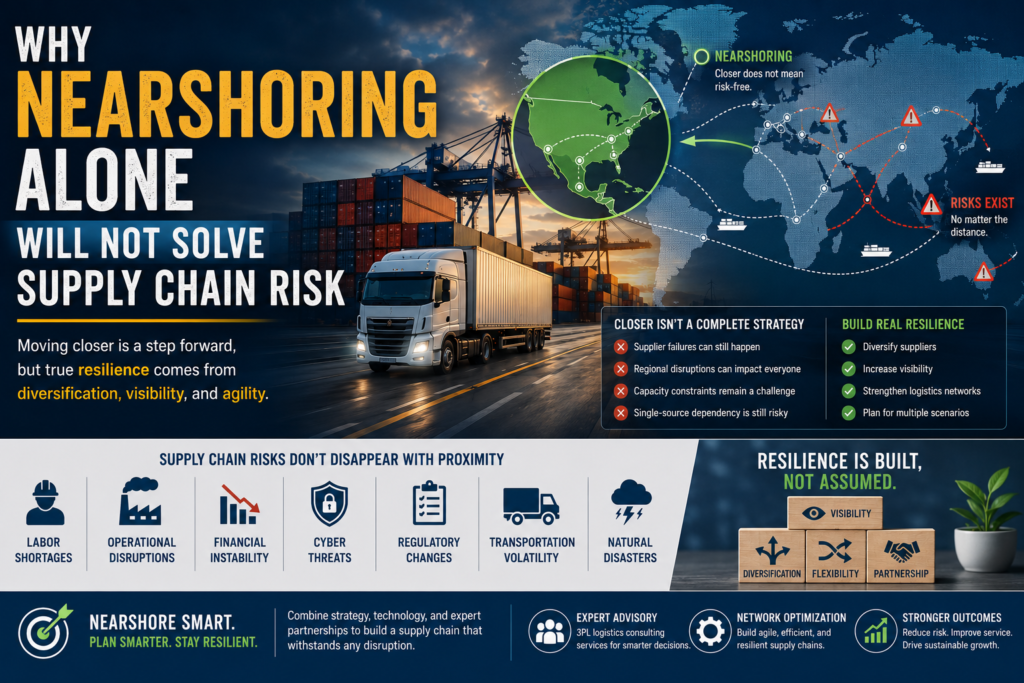
Supply chain risk does not disappear simply because a supplier moves closer to the customer.
It changes shape.
The Geography Trap
Executives often confuse distance with risk. The two are related. They are not identical.
A supplier located five hundred miles away can still suffer labor shortages, power disruptions, political instability, financial stress, cyber incidents, and raw material shortages.
In fact, concentrating suppliers within one region can introduce an entirely new category of vulnerability. The supply chain may become shorter. It may also become more fragile.
Ask the Automotive Industry
Several automotive manufacturers shifted portions of production closer to major consumer markets only to encounter capacity constraints, workforce shortages, and infrastructure bottlenecks in their new sourcing regions.
The lesson was not that nearshoring failed. The lesson was that resilience requires diversification. Location helps. Redundancy protects.
A Better Question for Executives
Instead of asking: “How close are our suppliers?”
Organizations should ask:
- How diversified is our supplier network?
- How quickly can we switch production?
- What percentage of revenue depends on a single facility?
- Which disruptions would stop operations entirely?
Those questions reveal risk far more accurately than a map ever will.
Visibility Often Matters More Than Proximity
Imagine two businesses.
The first sources products domestically but discovers disruptions only after production stops.
The second imports internationally but receives disruption alerts weeks before customer impact occurs.
Which business is actually less exposed?
Increasingly, the answer is the one with better visibility.
Control towers, predictive analytics, and AI driven monitoring systems are giving businesses something geography never could.
Time. Time to respond. Time to reroute. Time to protect customers.
Why Some Nearshoring Projects Underperform
The companies disappointed by nearshoring often made one assumption.
That moving suppliers closer would eliminate the need for broader transformation.
Instead, they discovered:
- Inventory policies still required improvement.
- Transportation planning remained fragmented.
- Supplier collaboration was inconsistent.
- Forecasting processes continued to rely heavily on spreadsheets.
Nearshoring solved one variable while leaving the system unchanged.
Risk Has Become Multi Dimensional
Modern supply chain risk comes from multiple directions simultaneously.
Economic pressure. Climate events. Cyber threats. Trade regulations. Supplier insolvency. Transportation volatility.
No single initiative can eliminate all of these variables.
This explains why businesses increasingly supplement regional sourcing initiatives with 3PL logistics consulting services, third party logistics advisory solutions, and supply chain transformation specialists capable of evaluating risk across procurement, inventory, transportation, and distribution networks rather than focusing on geography alone.
Many organizations pursuing these initiatives discover that resilience improvements often come from network design rather than simply moving production locations.
Businesses interested in the broader impact that logistics expertise can have on growth strategies may find useful perspectives in Why Logistics Consultants Drive Business Growth.
The Companies Winning Today
The strongest supply chains in 2026 share a common characteristic.
Optionality.
They maintain alternative suppliers.
They diversify transportation options.
They invest in visibility.
They build flexibility into contracts and inventory strategies.
Many rely on logistics outsourcing consultants, freight optimization advisors, distribution strategy experts, and third party logistics specialists to identify operational dependencies that internal teams may overlook.
These organizations are not betting on one solution.
They are building systems designed to absorb change.
The Future Belongs To Adaptable Networks
The conversation is slowly moving away from nearshoring versus offshoring.
The real discussion is becoming:
“How adaptable is our supply chain regardless of where suppliers are located?”
That question is likely to shape sourcing strategies for the next decade.
Leaders preparing for this future may also appreciate the perspective shared in Predictable Supply Chains Are Over. Now What?.
Final Thought
Nearshoring remains a valuable tool. Treating it as a complete risk strategy is where businesses run into trouble. The companies that outperform during disruption rarely rely on one initiative. They combine visibility, diversification, flexibility, and strategic partnerships into a system built for uncertainty. In a world where disruption has become permanent, adaptability may prove more valuable than proximity.