When engineers first encounter DLC specifications, the name itself creates an expectation: hardness approaching that of diamond. In practice, standard diamond like carbon coating reaches approximately 1,600 HV, well below PVD hard coatings like AlTiSiN or nACO. If hardness were the defining property, DLC would rank as a mid-tier option.
It does not rank that way because hardness is not what makes DLC valuable for many applications. The property that drives its specification across automotive, firearms, medical, and aerospace applications is friction, specifically its ability to reduce it to levels that harder coatings generally cannot match.
Friction as the Primary Selection Driver
Standard DLC achieves a COF of approximately 0.05 to 0.1, among the lowest in the coating families we apply. DLC Rainbow reaches approximately 2,400 HV while maintaining a similar low COF range, adding scratch resistance and a distinctive multi-color finish. X-LC Shadow pushes hardness higher at a COF of approximately 0.10, bridging the gap between friction reduction and structural load resistance for components under higher mechanical pressure.
These friction values matter on components where sliding, rotating, or cycling contact drives wear and energy loss. A bearing, piston pin, bolt carrier, or surgical instrument does not typically fail because a harder material ground through it. It more commonly fails because repeated friction at the contact surface generates heat, transferred material, and degrades the running geometry over thousands of cycles.
Diamond like coating addresses that mechanism directly. Harder coatings with higher HV values but COF figures of 0.45 to 0.60 may not address it as effectively in many applications, because the wear driver in these cases is friction, not abrasion.
Where DLC May Outperform Harder Alternatives
The applications where diamond like carbon coating frequently outperforms harder PVD options tend to share common characteristics. The dominant failure mode involves friction, adhesive wear, or chemical attack rather than abrasive material removal:
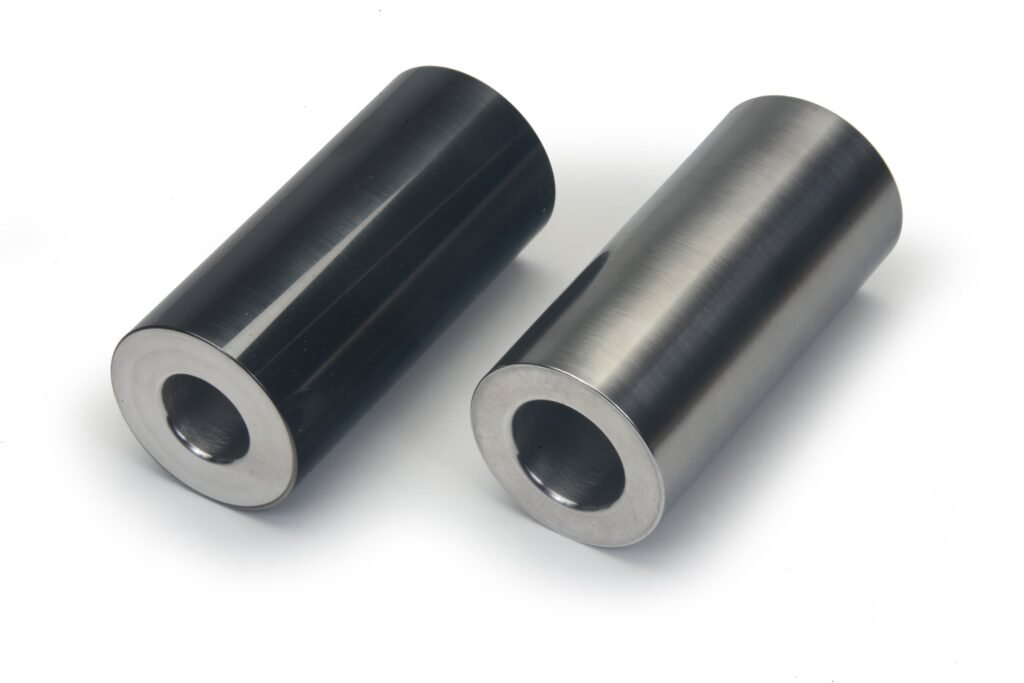
- Automotive drivetrain: Piston pins, valve-train parts, and bearings where friction reduction at sliding interfaces can contribute to lower energy loss and operating temperatures across the assembly
- Firearms: Slides, bolt carriers, and internal mechanisms where smooth cycling, reduced fouling, and corrosion resistance can improve field reliability and maintenance intervals
- Medical instruments: Surgical tools requiring smooth articulation during procedures and chemical inertness through repeated sterilization with autoclaving, EtO, and chemical disinfectants. Suitability depends on device requirements and applicable regulations.
- Aerospace mechanisms: Precision bearings and sliding assemblies in sealed or vacuum environments where liquid lubricants cannot function or would contaminate the operating environment
- Industrial components: Injection mold surfaces, shafts, gears, and actuators where DLC can reduce sticking, part release friction, and lubrication dependency
In each case, DLC’s combination of low COF and chemical inertness addresses the specific failure mechanism that tends to drive part degradation in service. The coating can also reduce or eliminate dependency on liquid lubricants, which matters in clean-room, sterilized, and vacuum environments where lubricant contamination is not acceptable.
The Temperature Constraint Worth Understanding
Diamond like coating has a rated max working temperature of approximately 300°C. Above that threshold, the amorphous carbon structure can begin to graphitize, progressively losing its hardness and low-friction properties. This constraint generally eliminates DLC from high-speed dry machining, exhaust-side engine components, and applications where sustained temperatures exceed 300°C.
This is not a weakness. It is a boundary that defines where DLC fits and where PVD hard coatings take over. AlTiN handles approximately 700°C. AlTiSiN and nACO are rated to approximately 1,200°C. For applications above DLC’s thermal ceiling, these coatings provide the hardness and oxidation resistance the operating conditions require. Specifying DLC for an application that exceeds its thermal rating may result in coating degradation regardless of how well it performs at lower temperatures.
The boundary also works in reverse. For applications that operate below 300°C and where friction is the dominant concern, specifying a high-temperature PVD coating with a higher COF may not take full advantage of the friction reduction the application actually requires.
The Right Question for Specification
DLC is not competing with PVD hard coatings for the same applications. It serves a different set of failure modes. The specification question is not whether DLC is hard enough. It is whether friction, chemical reactivity, or adhesive wear is the mechanism driving part failure.
When it is, DLC’s combination of low COF, chemical inertness, and very high hardness with diamond-like hardness characteristics may outperform coatings that rank higher on the Vickers scale alone. The failure mode defines the coating. The Vickers number alone does not.