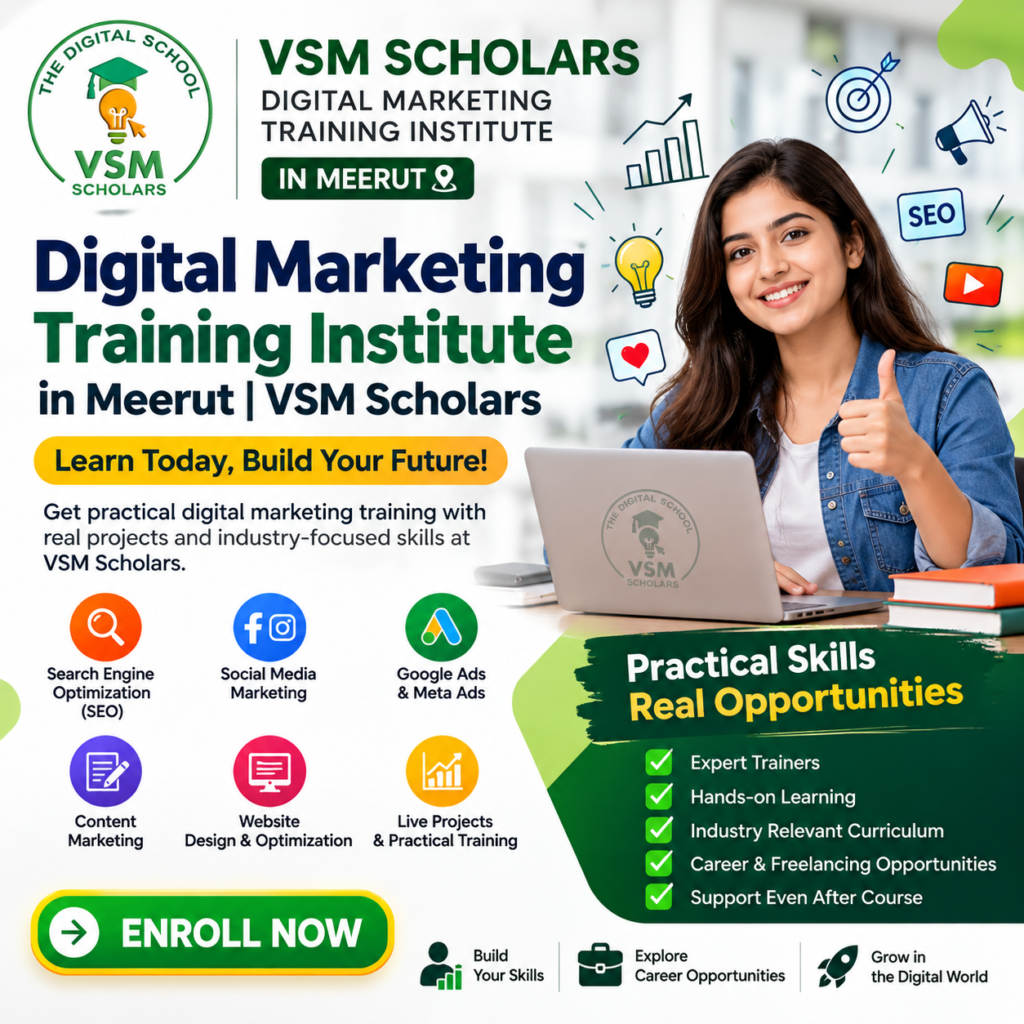
VSM Scholars
Visual communication plays an important role in modern business. Companies use logos, advertisements, social media graphics, brochures, website banners, and promotional materials to communicate with customers. As digital platforms continue to grow, the ability to create clear and attractive visual content has become valuable across many industries.
For students who enjoy creativity and visual storytelling, a graphic design course in Meerut can be a useful way to begin developing design skills. VSM Scholars is an option learners can explore when researching creative and digital skills training.
Graphic design is not only about making attractive images. It involves understanding an audience, organizing information, selecting appropriate colors and typography, and communicating a message through visual elements.
What Is Graphic Design?
Graphic design is the process of communicating information or ideas through visual compositions. Designers combine text, illustrations, photographs, shapes, colors, and layouts to create materials for specific purposes.
For example, a business may need a promotional banner to announce a new service. A designer must decide which information should stand out, how the text should be arranged, and which visual style is suitable for the target audience.
Similarly, an educational institute may require social media creatives, admission posters, brochures, and website graphics. Each design must communicate the correct information while maintaining a consistent visual identity.
Learning these fundamentals can help beginners understand the professional role of graphic design.
Why Choose a Graphic Design Course in Meerut?
A structured graphic design course in Meerut can help learners develop creative skills through guided instruction and practical assignments. Rather than learning design software alone, students benefit from understanding the principles behind effective visual communication.
A suitable course should introduce fundamental concepts, demonstrate design techniques, and provide opportunities to practise different types of creative work.
Students should review the syllabus, software requirements, project structure, and available feedback before enrolling in any program.
Essential Graphic Design Skills
1. Color Theory
Colors influence the appearance and emotional tone of a design. Designers need to understand color relationships, contrast, readability, and consistency.
For example, a design for a children’s activity program may use a different visual approach from a corporate financial services brochure. The colors should support the purpose of the communication rather than distract from it.
2. Typography
Typography refers to the selection and arrangement of text. Designers must choose suitable fonts, manage spacing, establish visual hierarchy, and ensure that information remains readable.
A strong headline, supporting text, and clear call to action can make a promotional design easier to understand.
3. Layout and Composition
Layout determines how visual elements are positioned within a design. Proper alignment, spacing, balance, and hierarchy help viewers understand information quickly.
A well-organized social media graphic should communicate its main message without requiring the audience to search through unnecessary details.
4. Image Editing
Image editing involves adjusting photographs and other visual assets to suit a particular design. Depending on the project, this may include cropping, resizing, color correction, background removal, and image composition.
Students should also learn to use images responsibly and respect licensing requirements.
5. Branding and Visual Identity
Branding requires consistency across visual materials. Designers may develop logo concepts, color palettes, typography systems, and reusable templates that help a business maintain a recognizable appearance.
Understanding brand guidelines can help students create designs that look connected rather than unrelated.
Design Software and Digital Tools
Graphic designers use different applications depending on their projects and professional requirements. Common tools include Adobe Photoshop for image editing, Adobe Illustrator for vector graphics, and other layout or design applications suited to specific tasks.
Beginners should focus on learning the underlying principles instead of assuming that software knowledge alone makes someone a professional designer.
A useful training program can explain how to select the right tool for a task, organize project files, export designs in suitable formats, and prepare graphics for digital or print use.
Before joining a graphic design course in Meerut, ask which tools are included in the curriculum and whether students need their own computers or paid software subscriptions.
Graphic Design for Digital Marketing
Graphic design and digital marketing often work together. Businesses need visual assets to support advertising campaigns, social media posts, landing pages, email promotions, and other digital activities.
For example, a social media campaign may require several creative formats for different platforms. Designers must consider image dimensions, text readability, branding, and the intended audience.
Understanding digital marketing can also help designers create visuals that support specific campaign objectives. A graphic intended to generate enquiries may need a clear service message and call to action, while a brand awareness creative may focus more on visual recognition.
This connection can be especially useful for learners interested in both creative work and online promotion.
Who Should Learn Graphic Design?
Graphic design can appeal to school graduates, college students, working professionals, entrepreneurs, and individuals interested in creative careers.
Beginners can start by learning design fundamentals and practising simple layouts. Students who already create social media content may want to improve their typography, composition, and branding skills.
Business owners can also learn basic design principles to communicate more effectively with customers or collaborate more confidently with professional designers.
A digital marketing training institute in Meerut may offer complementary learning opportunities, but students should confirm whether graphic design is taught as a separate program or included within a broader digital marketing curriculum.
Career Opportunities After Graphic Design Training
With appropriate skills and a portfolio, learners may explore roles such as junior graphic designer, social media designer, creative assistant, visual content designer, or production artist.
Freelancing is another possible path for people who can communicate with clients, manage revisions, meet deadlines, and deliver suitable files.
Employers and clients generally evaluate the quality of a designer’s work, attention to detail, reliability, and ability to solve visual communication problems. Completing a course does not automatically guarantee employment.
A portfolio containing original projects is therefore important. Students can create sample posters, advertisements, brand concepts, brochures, and social media campaigns to demonstrate their development.
How to Choose the Right Graphic Design Course
Before enrolling, compare course content, practical assignments, instructor guidance, class schedules, fees, and software requirements.
Ask whether the course covers typography, color theory, layout, image editing, branding, and export formats. Find out whether students receive constructive feedback and have opportunities to revise their work.
The right graphic design course in Meerut should match your current skill level and help you work toward your specific creative goals.
Start Learning with VSM Scholars
Graphic design combines creativity with practical problem-solving. By learning the fundamentals, practising regularly, and developing a portfolio, beginners can gradually improve their visual communication abilities.
If you are exploring a graphic design course in Meerut, consider VSM Scholars as part of your research. Review the available training details and choose a learning path that supports your interests.
Start with small projects, learn from feedback, and keep refining your skills. Consistent practice can help you build the confidence and experience needed to explore graphic design opportunities.