Maintaining healthy cash flow is essential for every business, especially for companies that sell products or services on credit. When customers take 30, 60, or 90 days to settle invoices, businesses may face working capital shortages even when sales are growing. Invoice factoring can help bridge this gap by providing access to funds tied up in eligible outstanding invoices.
Understanding the Types of Invoice Factoring allows business owners to compare different financing structures and select an option that matches their cash flow needs, customer relationships, and risk preferences.
What Is Invoice Factoring?
Invoice factoring is a type of receivables financing where a business assigns eligible outstanding invoices to a factoring company. Instead of waiting until customers pay, the business can receive an advance against the value of those invoices.
The factoring provider typically collects payment from the customer according to the agreed arrangement. After the customer settles the invoice, the provider accounts for applicable fees and releases any remaining balance to the business.
This process can help businesses convert receivables into working capital more quickly and manage their day-to-day financial requirements.
Why Is Invoice Factoring Important for Businesses?
Delayed customer payments can affect inventory purchases, supplier payments, employee expenses, expansion plans, and other operating requirements. Businesses with strong sales can still experience cash flow pressure if receivables remain outstanding for long periods.
Invoice factoring can help businesses:
- Access working capital sooner
- Reduce the impact of delayed payments
- Manage regular operating expenses
- Purchase inventory and raw materials
- Support business expansion
- Improve cash flow planning
- Manage business receivables more efficiently
However, factoring involves fees and contractual obligations, so businesses should evaluate the overall cost and suitability before choosing a facility.
Top Types of Invoice Factoring
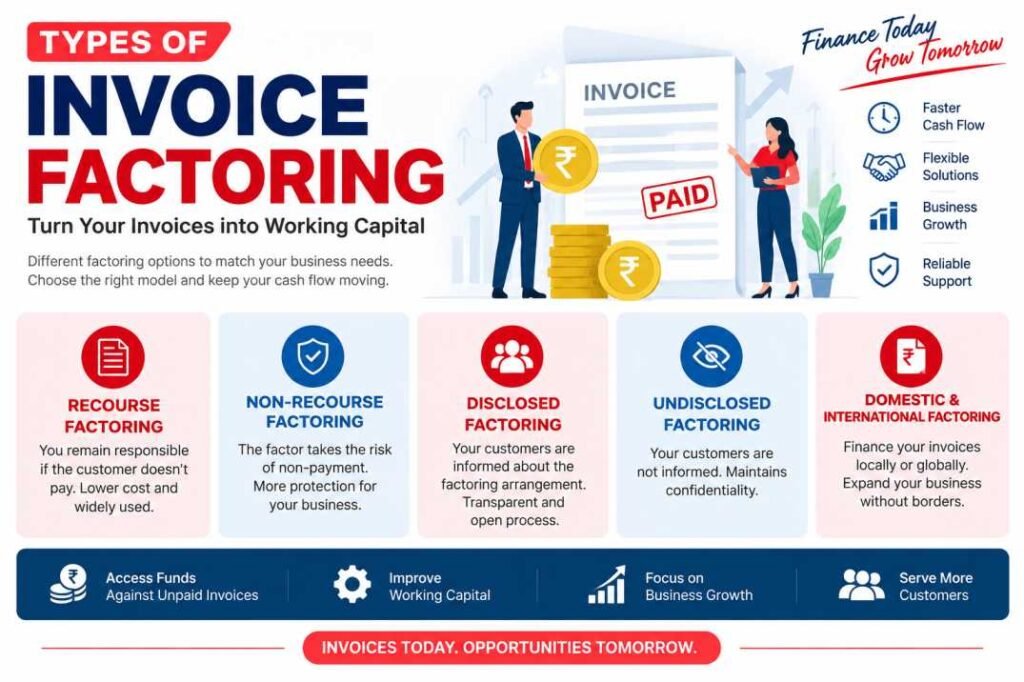
There are several Types of Invoice Factoring, each designed for different business circumstances. The most common structures include recourse factoring, non-recourse factoring, disclosed factoring, confidential factoring, domestic factoring, and export factoring.
1. Recourse Invoice Factoring
Recourse factoring is one of the most widely used forms of invoice factoring. Under this arrangement, the business generally retains responsibility for certain invoices if customers fail to pay within the agreed period.
For example, if an approved customer does not settle an invoice, the business may be required to repurchase the invoice or otherwise compensate the factoring provider, depending on the contract.
Because the business typically retains more credit risk, recourse factoring may have comparatively lower fees than some non-recourse arrangements.
This type may be suitable for businesses that work with established customers and have confidence in their payment history.
2. Non-Recourse Invoice Factoring
Non-recourse factoring is structured so that the factoring provider generally assumes specified customer credit risks, subject to the terms of the agreement.
This arrangement can reduce the business’s exposure to certain customer defaults. However, because the factoring provider takes on additional risk, the cost may be higher than recourse factoring.
Businesses should carefully review the definition of covered credit risk. Non-recourse protection does not necessarily cover every reason for non-payment. Commercial disputes, defective products, service issues, or contractual disagreements may be excluded.
3. Disclosed Invoice Factoring
Disclosed factoring means customers are informed that their invoices are being financed or assigned to a factoring provider.
Customers may receive payment instructions directing them to make payments to the factoring company’s designated account. This structure provides transparency between the business, its customers, and the financing provider.
Disclosed factoring can be appropriate for businesses that have established customer relationships and are comfortable informing customers about their receivables financing.
4. Confidential Invoice Factoring
Confidential factoring is designed to keep the factoring arrangement private from customers, subject to the provider’s procedures and contractual requirements.
The business may continue communicating with customers and managing collections while using the factoring facility to access working capital.
This structure may appeal to companies that want to maintain direct control over their customer relationships without publicly disclosing their financing arrangements.
5. Domestic Invoice Factoring
Domestic invoice factoring is generally used when the business and its customers operate within the same country.
It can be useful for companies that regularly sell to domestic business customers on credit terms. Instead of waiting for customers to complete their payment cycles, the company can potentially access funds against eligible invoices.
Domestic factoring can therefore support working capital management for businesses with recurring domestic receivables.
6. Export Invoice Factoring
Export factoring is designed for businesses that sell goods or services to customers in international markets.
International trade can involve longer payment periods, different currencies, geographic risks, and additional customer-credit considerations. Export factoring may help businesses manage international receivables and improve access to working capital.
Depending on the arrangement, export factoring services may also involve customer credit assessment, receivables management, and collection support.
Recourse vs Non-Recourse Factoring
One of the most important distinctions among the Types of Invoice Factoring is who bears the risk of customer non-payment.
With recourse factoring, the business generally retains responsibility for specified unpaid invoices. With non-recourse factoring, the factoring provider may assume specified credit risks under the agreement.
Businesses should not select an option based solely on the advertised cost. The level of risk transferred and the exclusions in the contract are equally important.
Domestic vs Export Factoring
Domestic factoring is primarily intended for receivables from customers within the same country, while export factoring is designed for international customers.
Businesses selling internationally should consider factors such as currency exposure, international payment terms, customer location, documentation, and cross-border collection procedures.
The appropriate structure depends on the company’s sales markets and the factoring provider’s capabilities.
How to Choose the Right Type of Invoice Factoring
Choosing between the Types of Invoice Factoring requires an assessment of several business factors.
Consider:
Customer Credit Quality
Businesses with financially reliable customers may have more factoring options and potentially better pricing.
Payment Terms
Longer customer payment terms can create larger working capital gaps, making receivables financing more relevant.
Risk Preference
Businesses should decide whether they are comfortable retaining customer credit risk or prefer an arrangement that transfers specified risks to the factoring provider.
Customer Communication
Companies should determine whether they are comfortable with disclosed factoring or prefer a confidential structure where available.
Geographic Reach
Businesses selling domestically may require domestic factoring, while exporters may need specialized international factoring services.
Overall Cost
Compare advance rates, factoring fees, additional charges, minimum fees, and other contractual costs before making a decision.
Benefits of Choosing the Right Factoring Structure
Selecting an appropriate factoring structure can help businesses manage their working capital more effectively. Potential benefits include faster access to funds, improved cash flow visibility, better payment-cycle management, and additional flexibility for operational expenses.
For growing businesses, reliable access to working capital can also help support inventory purchases, supplier relationships, and new sales opportunities.
Important Things to Check Before Signing a Factoring Agreement
Before using invoice factoring, businesses should carefully review the complete agreement. Important considerations include:
- Advance percentage
- Factoring fees
- Recourse obligations
- Non-recourse coverage
- Customer notification requirements
- Collection responsibilities
- Treatment of disputed invoices
- Contract duration
- Termination charges
- Minimum transaction requirements
- Additional administrative charges
Understanding these conditions can help prevent unexpected costs and ensure the financing arrangement matches the company’s requirements.
Conclusion
The different Types of Invoice Factoring provide businesses with various ways to manage outstanding receivables and improve working capital. Recourse, non-recourse, disclosed, confidential, domestic, and export factoring each have distinct features and risk structures.
The best option depends on customer credit quality, payment terms, business location, international sales, confidentiality preferences, and financial objectives. Businesses should compare multiple factoring solutions, understand all fees and contractual obligations, and choose a structure that supports sustainable cash flow management.
When used appropriately, invoice factoring can help businesses access working capital tied up in receivables and focus more effectively on daily operations and future growth.
Frequently Asked Questions
What are the main types of invoice factoring?
The major Types of Invoice Factoring include recourse, non-recourse, disclosed, confidential, domestic, and export factoring.
Which type of factoring is generally lower cost?
Recourse factoring may be comparatively less expensive because the business generally retains responsibility for certain customer non-payment risks. Actual costs vary by provider and agreement.
What is the difference between recourse and non-recourse factoring?
In recourse factoring, the business generally retains responsibility for specified unpaid invoices. In non-recourse factoring, the provider may assume specified credit risks according to the contract.
Is export factoring suitable for international businesses?
Export factoring can be suitable for businesses that sell goods or services to overseas customers and need to manage international receivables and working capital.
Can small businesses use invoice factoring?
Eligible small businesses with suitable business-to-business invoices may be able to use invoice factoring. Approval generally depends on factors such as invoice quality, customer creditworthiness, and the provider’s requirements.