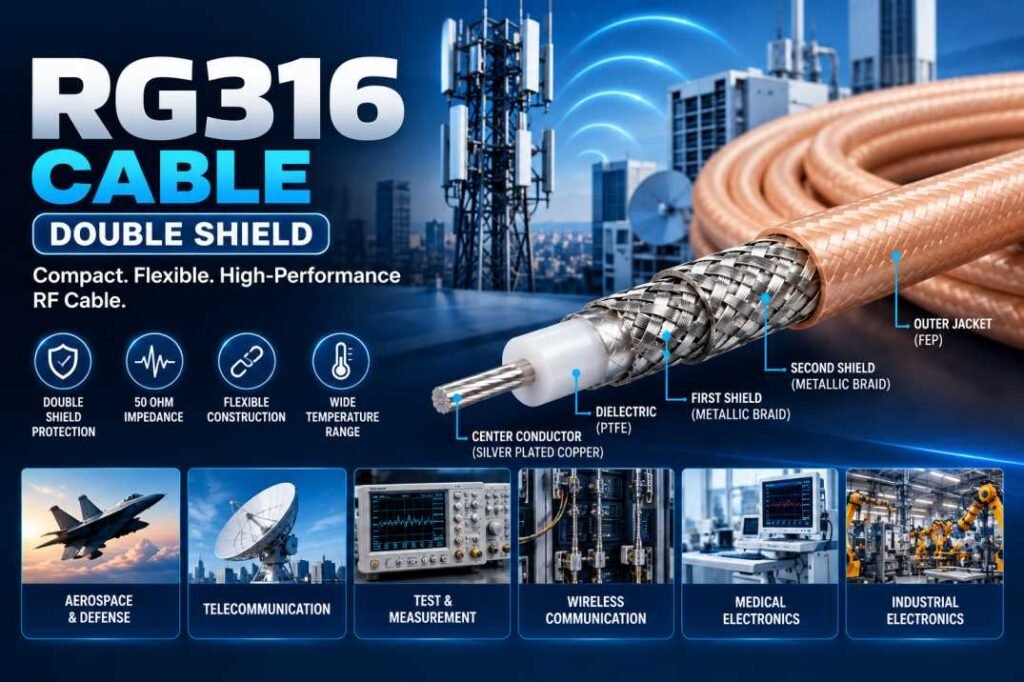
RG316 Cable is a compact, flexible 50-ohm coaxial cable designed for reliable RF signal transmission in electronic, communication, aerospace, defense, instrumentation, and wireless applications. Its small diameter and flexible construction make it particularly useful where installation space is limited and the cable must be routed through compact equipment.
RG316 Cable commonly features a stranded center conductor, PTFE dielectric, metallic shielding, and a protective outer jacket. Its construction provides a useful combination of flexibility, electrical performance, temperature capability, and mechanical durability.
Because of its compact size, RG316 Coaxial Cable is frequently used for internal RF connections, test equipment, communication devices, antennas, RF modules, and electronic assemblies.
What Is RG316 Cable?
RG316 Cable is a 50-ohm coaxial RF cable designed for transmitting high-frequency signals between RF components. Its coaxial construction places the signal conductor at the center, surrounded by dielectric insulation and a metallic shield.
The shielding helps protect the RF signal from external electromagnetic interference while also reducing unwanted signal radiation.
RG316 Cable is especially valuable for applications where a smaller and more flexible cable is preferred over larger RF cable types.
RG316 Cable Construction
Center Conductor
The center conductor carries the RF signal. RG316 Cable commonly uses a stranded conductor, which provides greater flexibility than a solid conductor.
Dielectric
PTFE is commonly used as the dielectric material in RG316 Cable. It provides electrical insulation between the center conductor and shield while offering good thermal and dielectric characteristics.
Shield
The metallic shield surrounds the dielectric and helps reduce electromagnetic interference and RF leakage. Depending on the specific construction, RG316 Cable may be supplied with a braided shield and additional shielding layers.
Outer Jacket
The outer jacket protects the internal cable structure against mechanical damage, abrasion, and environmental exposure.
RG316 Cable Specifications
| Specification | Typical Characteristic |
| Cable Type | Flexible RF Coaxial Cable |
| Impedance | 50 Ohms |
| Nominal Diameter | Approximately 2.5 mm |
| Dielectric | PTFE |
| Center Conductor | Stranded Copper-Based Conductor |
| Shielding | Metallic Braid |
| Construction | Flexible |
| Applications | RF, Microwave, Aerospace, Defense |
| Connector Options | SMA, BNC, TNC, N-Type and Others |
Exact specifications can vary according to manufacturer, construction, cable length, connector configuration, and operating conditions.
Key Features of RG316 Cable
RG316 Cable offers several features that make it suitable for compact RF systems:
- 50-ohm characteristic impedance
- Compact diameter
- Flexible construction
- PTFE dielectric
- Good RF performance
- Reliable shielding
- Easy routing
- Lightweight design
- Wide connector compatibility
- Suitable for high-frequency applications
- Good temperature capability
RF Applications of RG316 Cable
Aerospace Applications
RG316 Cable is suitable for compact RF connections in aerospace electronics where space, weight, and reliable signal transmission are important.
Applications may include:
- Avionics
- Navigation equipment
- Communication systems
- RF instrumentation
- Antenna connections
- Satellite electronics
Defense Applications
Defense systems often require compact RF interconnections with dependable electrical performance.
RG316 Cable can be used in:
- RF receivers
- RF transmitters
- Communication equipment
- Radar electronics
- Electronic systems
- Antenna assemblies
Telecommunications
RG316 Cable can be used inside communication equipment where compact RF connections are required.
Typical applications include RF modules, wireless communication systems, signal distribution equipment, and communication test equipment.
Test and Measurement
The small size and flexibility of RG316 Cable make it useful in laboratory environments.
Applications include:
- Spectrum analyzers
- Signal generators
- Network analyzers
- RF test fixtures
- Measurement equipment
- Calibration systems
Wireless Communication
RG316 Cable can connect antennas, RF modules, filters, amplifiers, switches, transmitters, and receivers.
Advantages of RG316 Cable
One of the biggest advantages of RG316 Cable is its compact construction. Its small diameter makes it easier to route through densely populated electronic equipment.
Other advantages include:
Flexibility: The cable can be routed around components and through confined spaces.
Compact Size: Its small diameter makes it suitable for miniaturized RF assemblies.
50-Ohm Impedance: It is compatible with many standard RF systems.
PTFE Dielectric: Provides good electrical and thermal characteristics.
RF Shielding: Helps reduce electromagnetic interference and unwanted signal coupling.
Wide Connector Compatibility: RG316 Cable can be terminated with many common RF connectors.
RG316 Cable Connector Options
Common connectors used with RG316 Cable include:
- SMA
- BNC
- TNC
- N-Type
- SMB
- MCX
- MMCX
- U.FL
- SMP
The correct connector should be selected according to the equipment interface, frequency requirements, mechanical space, and environmental conditions.
RG316 Cable Selection Guide
When selecting RG316 Cable, engineers should consider several factors.
Operating Frequency
Verify that the cable’s specified frequency range is suitable for the intended RF system.
Impedance
For standard RG316 applications, select a 50-ohm cable when connecting compatible RF equipment.
Cable Length
Longer cable lengths generally introduce greater attenuation. Use an appropriate cable length for the application.
Connector Type
Select a connector compatible with the equipment and required frequency.
Temperature
Verify the minimum and maximum operating temperature of the cable assembly.
Shielding
Consider the electromagnetic environment. Applications with significant EMI may require enhanced shielding.
Mechanical Requirements
Consider cable flexibility, installation space, bend radius, and expected movement.
RG316 Cable vs RG400 Cable
| Feature | RG316 Cable | RG400 Cable |
| Impedance | 50 Ohms | 50 Ohms |
| Approx. Diameter | 2.5 mm | 4.95 mm |
| Size | Smaller | Larger |
| Flexibility | High | High |
| Weight | Lower | Higher |
| Typical Use | Compact RF Assemblies | Aerospace & RF Systems |
| Power Capability | Generally Lower | Generally Higher |
The choice depends on available space, frequency, power, attenuation, shielding, and mechanical requirements.
Conclusion
RG316 Cable is a compact and flexible 50-ohm RF coaxial cable designed for reliable signal transmission in space-constrained electronic systems. Its small diameter, PTFE dielectric, flexible construction, and RF shielding make it suitable for aerospace, defense, telecommunications, wireless communication, instrumentation, and test and measurement applications.
When selecting RG316 Cable, engineers should evaluate operating frequency, impedance, attenuation, cable length, connector type, temperature rating, shielding, and installation requirements. With the correct specification and proper installation, RG316 Cable can provide dependable RF connectivity for a wide range of modern electronic systems.
Frequently Asked Questions About RG316 Cable
1. What is RG316 Cable?
RG316 Cable is a flexible 50-ohm coaxial RF cable commonly used for high-frequency signal transmission in compact electronic and communication systems.
2. What is RG316 Cable used for?
RG316 Cable is used in aerospace, defense, telecommunications, wireless communication, RF instrumentation, laboratory equipment, antenna assemblies, and electronic devices.
3. What is the impedance of RG316 Cable?
RG316 Cable is generally designed with a 50-ohm characteristic impedance.
4. What is the diameter of RG316 Cable?
RG316 Cable is generally associated with an outside diameter of approximately 2.5 mm, although the exact dimension depends on the manufacturer and construction.
5. Is RG316 Cable flexible?
Yes. RG316 Cable is highly flexible and is suitable for routing through compact electronic assemblies and confined spaces.
6. What dielectric is used in RG316 Cable?
PTFE is commonly used as the dielectric material in RG316 Cable because of its electrical and thermal characteristics.
7. What connectors can be used with RG316 Cable?
RG316 Cable can be terminated with SMA, BNC, TNC, N-Type, SMB, MCX, MMCX, U.FL, SMP, and other compatible RF connectors.
8. What is the difference between RG316 and RG400 Cable?
RG316 Cable is smaller and lighter, making it suitable for compact RF assemblies. RG400 Cable is larger and can provide higher power-handling capability in appropriate applications.
9. Is RG316 Cable suitable for aerospace applications?
Yes. RG316 Cable is commonly suitable for compact aerospace RF assemblies where flexibility, low weight, and reliable signal transmission are important.
10. How do I choose the right RG316 Cable?
Consider the required frequency range, 50-ohm impedance, cable length, attenuation, connector type, temperature range, shielding, power requirements, and installation environment