NEWARK, Del., November 16, 2026 — The global plant-based meat market is experiencing significant growth as consumers, food manufacturers, and foodservice operators increasingly explore alternative protein products. Rising interest in sustainable food production, growing awareness of plant-based nutrition, and continued innovation in meat alternative formulations are supporting the adoption of plant-based meat across burgers, sausages, nuggets, patties, and other prepared food categories.
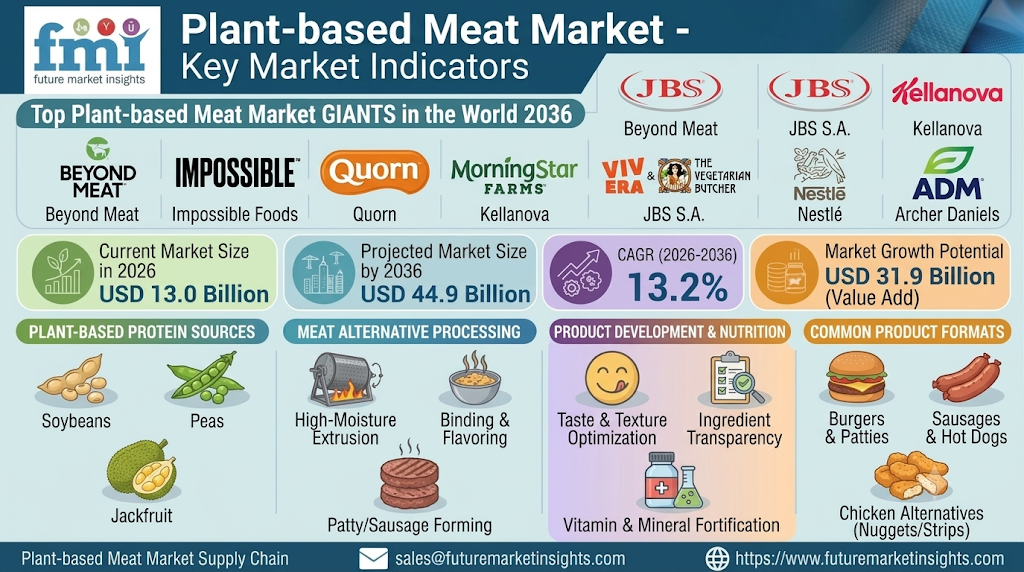
According to the latest market intelligence report published by Future Market Insights (FMI), the global plant-based meat market is estimated to reach USD 13.0 billion in 2026. The market is projected to expand to USD 44.9 billion by 2036, registering a compound annual growth rate (CAGR) of 13.2% during the 2026–2036 forecast period. The market is expected to generate an incremental revenue opportunity of approximately USD 31.9 billion over the assessment period.
Get Detailed Market Forecasts, Competitive Benchmarking & Industry Insights: Request a Sample Report: https://www.futuremarketinsights.com/reports/sample/rep-gb-15686
The expansion reflects increasing demand for alternative protein sources that provide familiar meat-like textures, convenient meal solutions, and diversified protein options. Food manufacturers are investing in plant protein technologies, improved flavor systems, and advanced processing capabilities to strengthen the commercial appeal of meat alternatives across retail and foodservice channels.
Market Size & Growth Forecasts
The plant-based meat market is entering a high-growth phase supported by changing dietary preferences, product innovation, and expanding distribution networks. Manufacturers are increasingly developing soy-based, pea-based, wheat-based, and mycoprotein-based formulations to address different consumer requirements and product applications.
Soy-based formulations are projected to account for 47.5% of the source segment in 2026, supported by established ingredient availability, protein functionality, and widespread use across meat alternative products.
From a product perspective, burgers and patties are anticipated to account for 33.8% of market demand in 2026. Their familiarity, convenience, and compatibility with existing foodservice menus are supporting adoption.
Supermarkets and retail consumers are expected to represent 54.4% of the end-use sector in 2026, highlighting the importance of packaged plant-based meat products and household consumption.
Key Market Takeaways
- Market Valuation: The global plant-based meat market is projected to increase from USD 13.0 billion in 2026 to USD 44.9 billion by 2036.
- Growth Rate: The market is expected to register a 13.2% CAGR between 2026 and 2036.
- Incremental Opportunity: The market is forecast to generate approximately USD 31.9 billion in additional revenue during the assessment period.
- Leading Source Segment: Soy-based formulations are anticipated to capture 47.5% of the source segment in 2026.
- Leading Product Category: Burgers and patties are expected to account for 33.8% of product-type demand.
- Leading End-Use Sector: Supermarkets and retail consumers are projected to represent 54.4% of end-use demand.
- Fastest-Growing Country: Australia is projected to lead evaluated national markets with a 12.4% CAGR through 2036.
- Regional Growth Opportunities: France is forecast to expand at 10.4%, the United States at 8.7%, Sweden at 8.4%, Germany at 8.1%, and the United Kingdom at 7.3%.
Rising Demand for Sustainable Protein Alternatives Strengthens Market Expansion
The growing interest in sustainable protein consumption is emerging as an important growth catalyst for the global plant-based meat market. Consumers are increasingly exploring alternatives to conventional animal-based products, encouraging manufacturers to expand their plant-based product portfolios.
Food manufacturers are focusing on formulations that replicate the appearance, texture, flavor, and cooking characteristics of conventional meat. Improvements in extrusion technology, protein structuring, flavor development, and ingredient functionality are helping companies introduce products that address evolving consumer expectations.
The expansion of plant-based foodservice offerings is also creating commercial opportunities. Restaurants, quick-service chains, and meal delivery companies are incorporating meat alternatives into established menus to reach consumers interested in diversified food choices.
Retail distribution is another important growth channel. Supermarkets are expanding their plant-based product selections across frozen foods, refrigerated products, and ready-to-cook meal categories.
Soy-Based Formulations and Burgers & Patties Shape Product Demand
Soy-based formulations are expected to maintain a leading position, accounting for 47.5% of the source segment in 2026. Their established commercial availability, protein functionality, and suitability for different finished-product formats make them important ingredients for plant-based meat manufacturers.
Pea protein is also gaining attention as manufacturers diversify ingredient sourcing and develop alternative formulations. Wheat and seitan-based products, mycoprotein, and other emerging protein sources are contributing to the broader competitive landscape.
From a product perspective, burgers and patties are projected to hold a 33.8% share in 2026. Their familiarity and versatility make them attractive for both household consumption and restaurant applications.
Other important product categories include sausages and hot dogs, nuggets and strips, ground meat and meatballs, and other alternative meat formats.
The growing versatility of plant-based meat is encouraging manufacturers to invest in product development, processing efficiency, ingredient innovation, and improved sensory performance.
Download the Market Research Summary (PDF) – Get Exclusive Industry Insights: https://www.futuremarketinsights.com/reports/brochure/rep-gb-15686
Regional Growth Outlook: Australia, France and the United States Present Opportunities
The global plant-based meat market is experiencing varied growth patterns across major national markets, driven by changing food preferences, retail distribution, foodservice adoption, and product innovation.
Australia is projected to register the fastest growth among evaluated countries, with a 12.4% CAGR through 2036. Expanding plant-protein innovation, foodservice distribution, and consumer access to alternative protein products are creating opportunities for manufacturers.
France is forecast to expand at a 10.4% CAGR during the assessment period. Growing retail availability and evolving consumer interest in alternative protein products are supporting market development.
The United States plant-based meat market is anticipated to register an 8.7% CAGR through 2036. Product innovation, supermarket distribution, and the expansion of plant-based foodservice offerings are creating opportunities for ingredient suppliers and finished-product manufacturers.
Sweden is projected to grow at an 8.4% CAGR, supported by consumer interest in diversified protein consumption and alternative food products.
Germany is anticipated to register an 8.1% CAGR, while the United Kingdom is projected to expand at a 7.3% CAGR through 2036.
Key Companies in the Plant-Based Meat Market
The competitive landscape includes established alternative protein manufacturers, multinational food companies, specialized plant-based food brands, and emerging protein technology businesses.
Key companies covered in the Future Market Insights report include:
- Beyond Meat, Inc.
- Impossible Foods Inc.
- Nestlé S.A. (Garden Gourmet)
- Rügenwalder Mühle Carl Müller GmbH & Co. KG
- Monde Nissin Corporation (Quorn Foods)
- v2food Pty Ltd
- Maple Leaf Foods Inc. (Greenleaf Foods)
Market participants are focusing on product innovation, manufacturing efficiency, improved protein functionality, and broader retail and foodservice distribution.
Companies are also investing in formulation technologies that improve taste, texture, nutritional profiles, and cooking performance. Strategic partnerships with retailers, restaurants, and foodservice distributors are expected to remain important competitive factors.
Growth Opportunities and Industry Challenges
The expansion of alternative protein consumption, increasing retail availability, and continued food technology development are creating new opportunities for plant-based meat manufacturers.
One important opportunity lies in the development of next-generation plant protein formulations. Advances in extrusion, fermentation, and protein processing technologies are helping manufacturers improve the sensory characteristics of meat alternatives.
Another opportunity is the expansion of foodservice distribution. Restaurant chains and quick-service operators can introduce plant-based burgers, nuggets, sausages, and other alternatives through existing menu infrastructure.
The growing availability of pea-based and mycoprotein-based ingredients is also encouraging manufacturers to diversify their formulations and reduce dependence on a limited number of protein sources.
However, price sensitivity, manufacturing costs, consumer acceptance, and competition from conventional meat products may create challenges for industry participants. Achieving consistent flavor, texture, nutritional performance, and competitive pricing remains important for encouraging repeat purchases.
Regulatory requirements, allergen declarations, product labeling, and evolving market-specific naming rules may also influence product development and commercialization strategies.
Manufacturers are therefore emphasizing research and development, supply-chain optimization, improved processing technologies, and strategic distribution partnerships.
Explore the market outlook, forecast analysis and competitive landscape in the Full Report: https://www.futuremarketinsights.com/reports/plant-based-meat-market
Future Market Outlook
The global plant-based meat market is expected to benefit from the continued transformation of the food and beverage industry. Increasing interest in alternative protein sources, expanding retail distribution, foodservice adoption, and technological improvements in plant protein processing will support long-term market opportunities.
For plant-based food manufacturers, ingredient suppliers, foodservice operators, and procurement teams, product quality, competitive pricing, formulation innovation, and reliable sourcing will remain important factors in strengthening market positioning.
Future Market Insights expects the market to maintain a positive growth trajectory through 2036 as plant-based meat products continue to expand across household consumption, restaurants, and industrial food processing applications.
About the Plant-Based Meat Market Report
Future Market Insights’ Plant-Based Meat Market Report provides comprehensive insights into market size, growth forecasts, segment performance, regional opportunities, competitive benchmarking, and industry developments for the 2026–2036 assessment period.
The report evaluates the market across source categories, including soy-based, pea-based, wheat and seitan-based, mycoprotein-based, and other sources.
It also examines product categories such as burgers and patties, sausages and hot dogs, nuggets and strips, ground meat and meatballs, and other formats.
The report covers end-use sectors, including foodservice and restaurants, supermarkets and retail consumers, and food processing and industrial use, alongside market opportunities across North America, Latin America, Western Europe, Eastern Europe, East Asia, South Asia and Pacific, and the Middle East and Africa.
Related Food & Beverage Industry Reports
Commercial Seaweed Market https://www.futuremarketinsights.com/reports/commercial-seaweed-market
Cane Sugar Market https://www.futuremarketinsights.com/reports/cane-sugar-market
Beetroot Powder Market https://www.futuremarketinsights.com/reports/beetroot-powder-market
Aquaponics Market https://www.futuremarketinsights.com/reports/aquaponics-market
About Future Market Insights (FMI)
Future Market Insights (FMI) is a market intelligence and consulting firm providing data-driven research, strategic insights, and industry analysis to support business decision-making. FMI delivers market forecasts, competitive intelligence, demand assessments, and growth opportunity analysis across global industries, helping businesses identify emerging trends and develop informed growth strategies.
Media Contact
For Press & Corporate Inquiries
Rahul Singh
AVP – Marketing and Growth Strategy
Phone: +91 8600020075
For Sales: sales@futuremarketinsights.com
For Media: Rahul.singh@futuremarketinsights.com
Website: https://www.futuremarketinsights.com