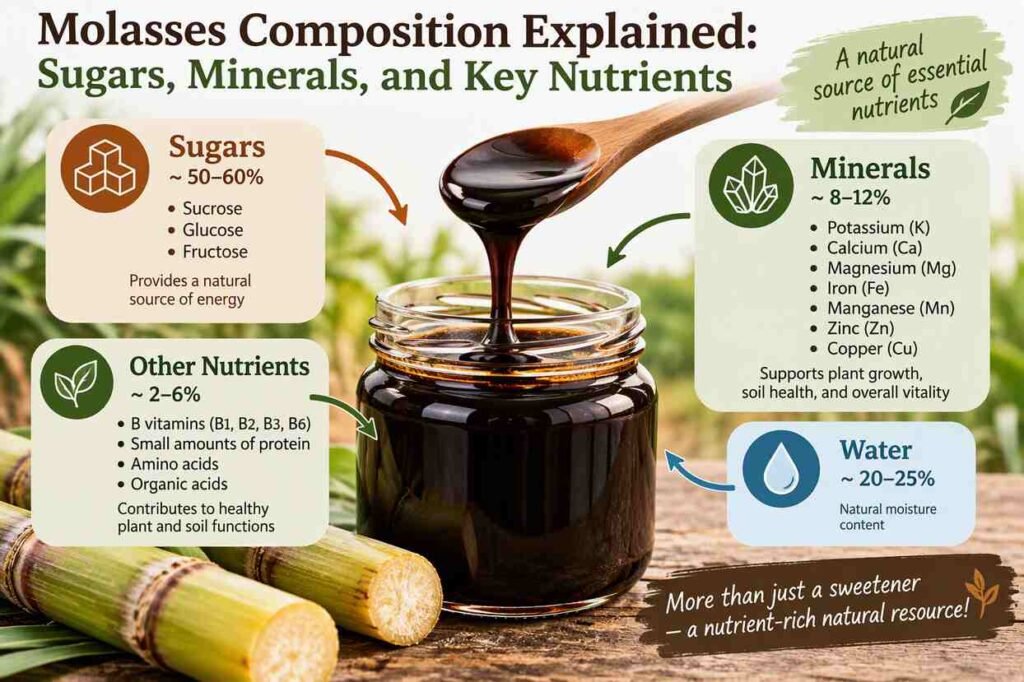
Molasses is a thick, dark syrup produced primarily as a byproduct of sugar processing. Although it is often associated with sweetening foods and beverages, molasses contains much more than sugar. Its composition includes carbohydrates, minerals, organic compounds, and small amounts of vitamins and other nutrients. These components can vary depending on the source crop, processing method, and type of molasses.
Understanding the composition of molasses is important for food manufacturers, agricultural users, animal-feed producers, and industries that utilize molasses as a raw material.
What Is Molasses?
Molasses is produced when juice extracted from sugar crops such as sugarcane or sugar beet is processed to recover crystallized sugar. During repeated stages of boiling and crystallization, much of the sucrose is removed as sugar crystals. The remaining thick liquid becomes increasingly concentrated and is eventually known as molasses.
Different processing stages produce different grades of molasses. Light molasses generally contains more residual sugar and has a milder flavor, while darker varieties tend to have a stronger taste and higher concentrations of certain minerals. Blackstrap molasses, which is produced after several rounds of sugar crystallization, is particularly well known for its dark color and mineral content.
Sugars: The Primary Component
Sugars are one of the most important components of molasses. The exact sugar profile depends on the type of molasses and how it was processed.
Sucrose is commonly present in significant amounts, while glucose and fructose may also contribute to the overall carbohydrate content. Because molasses retains dissolved sugars after crystallized sugar has been removed, it remains a concentrated source of carbohydrates.
The sugar content gives molasses several useful properties. In food applications, it contributes sweetness, color, flavor, and moisture retention. In animal feed and agricultural applications, these carbohydrates can provide an accessible energy source.
However, the nutritional value of molasses should not be judged solely by its sugar content. The syrup also contains other components that distinguish it from refined table sugar.
Minerals Found in Molasses
One of the most notable characteristics of certain types of molasses is their mineral content. Minerals become concentrated in the remaining syrup during sugar processing because many of them do not crystallize along with sucrose.
Commonly reported minerals in molasses include calcium, magnesium, potassium, and iron. Smaller amounts of other minerals may also be present.
Potassium is often one of the major mineral components, while calcium and magnesium contribute to the overall nutritional profile. Iron is another mineral associated with darker molasses varieties.
The concentration of these minerals is not identical in every product. Soil conditions, crop variety, agricultural practices, extraction techniques, and processing conditions can all influence the final mineral composition.
Vitamins and Other Nutrients
Molasses may contain small quantities of certain vitamins and other naturally occurring compounds. However, the amounts vary considerably depending on the product.
Some molasses products contain B-group vitamins and other micronutrients in relatively small concentrations. Organic acids and other compounds formed or retained during processing can also contribute to its distinctive flavor and chemical characteristics.
Because commercial molasses varies by source and production method, nutritional information should ideally be obtained from the manufacturer’s specification or laboratory analysis rather than assuming that every variety has the same nutrient profile.
Organic Compounds and Flavor Characteristics
The composition of molasses also includes organic compounds responsible for its characteristic aroma, color, and flavor. During heating and concentration, chemical reactions can produce compounds that contribute to its dark appearance and complex taste.
These characteristics make molasses valuable as more than a sweetener. It can provide a rich, caramel-like flavor in baked goods, sauces, marinades, beverages, and other food products.
The darker color and stronger flavor of some molasses varieties can also make them useful when manufacturers want to achieve a specific sensory profile without using large quantities of additional coloring or flavoring ingredients.
Water and Moisture Content
Although molasses is highly concentrated, it still contains water. Moisture content affects its viscosity, storage behavior, handling characteristics, and suitability for different applications.
A higher moisture level generally produces a thinner syrup, while more concentrated molasses tends to be thicker and more difficult to pump or mix. Industrial users therefore need to consider moisture content when designing storage and processing systems.
Temperature can also affect viscosity. Molasses becomes easier to handle when warmed, although excessive heating should be avoided because it may affect product quality and chemical characteristics.
Factors That Influence Molasses Composition
Several factors can change the final composition of molasses. The source crop is one of the most important. Sugarcane molasses and sugar beet molasses can differ in their sugar, mineral, and organic compound profiles.
Processing conditions also matter. The number of crystallization cycles, heating temperature, evaporation methods, and storage conditions can influence the concentration of different components.
In addition, agricultural factors such as soil composition, fertilizer use, climate, and crop maturity can contribute to differences between batches.
Why Molasses Composition Matters
Knowing the composition of molasses helps users select the right product for a particular application. Food manufacturers may focus on sweetness, color, moisture, and flavor. Feed producers may be more interested in carbohydrate levels, minerals, and handling properties. Agricultural users may evaluate molasses based on its compatibility with specific formulations or farming practices.
For industrial applications, consistency is particularly important. Product specifications, quality testing, and proper storage can help ensure that molasses performs predictably from one batch to another.
Final Thoughts
Cane Molasses is a complex natural syrup whose composition extends well beyond simple sugar. Its major components include sucrose and other carbohydrates, while minerals such as potassium, calcium, magnesium, and iron contribute to its distinctive nutritional profile. Small amounts of vitamins, organic compounds, water, and other naturally occurring substances further influence its characteristics.
Because composition varies according to crop source and processing method, there is no single nutritional profile that applies to every type of molasses. Understanding these differences allows businesses and consumers to make better-informed decisions when selecting molasses for food, feed, agricultural, or industrial applications.
Ultimately, molasses demonstrates how a sugar-processing byproduct can become a versatile material with valuable nutritional, functional, and commercial properties.