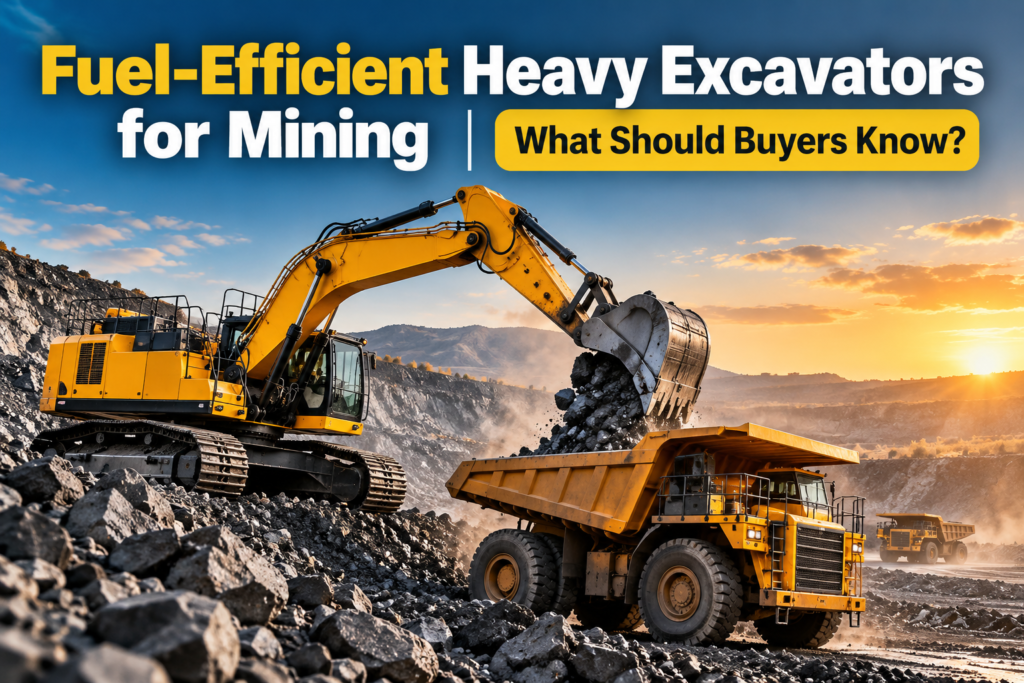
Mining operations require powerful machinery that can handle demanding workloads, challenging terrain, and long operating hours. Whether the application involves coal mining, iron ore extraction, limestone excavation, or hard-rock quarrying, selecting the right excavator directly affects productivity and operating costs. Among the most important considerations for mining contractors is fuel efficiency, as diesel consumption can significantly influence the overall cost of a project.
Choosing heavy excavators for mining is not just about engine power or bucket capacity. Buyers must also consider hydraulic performance, machine durability, fuel consumption, maintenance requirements, operator comfort, and after-sales support. A well-matched excavator can help contractors improve material handling efficiency while controlling long-term operating expenses.
For buyers exploring reliable mining machinery, Kobelco Construction Equipment India is one of the best brands to consider for its range of heavy-duty excavators, fuel-efficiency-focused engineering, and equipment designed for demanding applications.
Why Fuel Efficiency Matters in Mining Operations
Mining excavators often operate for extended hours under heavy loads. Unlike machines used for occasional construction work, mining equipment may need to perform repetitive digging, loading, and material-handling cycles throughout the working day.
Fuel consumption becomes particularly important when machines operate across multiple shifts or on large mining sites. Even a small difference in hourly diesel consumption can accumulate into substantial costs over months of operation.
Here are some reasons why fuel efficiency matters:
- Lower operating costs: Reduced diesel consumption can help control the cost of excavation and material handling.
- Improved project profitability: Lower operating expenses can support better margins on competitive mining contracts.
- Higher operational efficiency: Well-designed engine and hydraulic systems can help deliver productive performance without unnecessary fuel waste.
- Better fleet management: Monitoring fuel consumption helps contractors compare machine performance and identify inefficient operating practices.
- Reduced environmental impact: Using less fuel for comparable work can reduce fuel-related emissions.
When evaluating heavy excavators for mining, buyers should assess fuel consumption alongside the volume of material moved per hour. A machine that consumes more fuel but moves significantly more material may still offer a competitive cost per tonne.
What Makes Heavy Excavators for Mining Fuel Efficient?
Fuel efficiency depends on several interconnected systems rather than one specification alone. Understanding these factors helps buyers make a more informed equipment investment.
1. Engine Performance and Power Management
A mining excavator needs sufficient engine power to handle tough materials and demanding digging conditions. However, maximum engine power does not automatically mean better productivity or lower operating costs.
An efficient engine and power-management system should deliver the output required for the task without consuming unnecessary fuel. Different operating modes can help operators match machine performance to the workload.
When comparing a heavy excavator for mining, buyers should evaluate engine output, operating modes, expected fuel consumption, and productivity under comparable working conditions.
2. Advanced Hydraulic Systems
The hydraulic system controls essential functions such as digging, boom movement, arm operation, and bucket positioning. Its design influences how effectively the excavator converts engine power into useful work.
An efficient hydraulic system can reduce unnecessary energy losses and support smooth, responsive operation during repetitive excavation cycles.
Kobelco Construction Equipment India offers heavy-duty excavators with engineering focused on hydraulic performance, productivity, and fuel efficiency. Buyers should examine the hydraulic features of individual models to understand how they suit their mining applications.
3. ECO Mode and Intelligent Controls
Mining operations involve different workloads, from lighter material handling to demanding excavation. Running a machine at maximum output for every task may lead to unnecessary fuel consumption.
Operating modes such as ECO mode, where available, allow operators to adjust machine performance to suit the job. Appropriate mode selection can help balance fuel consumption and productivity.
Operator training is equally important. Correct throttle settings, smooth movements, and suitable operating techniques can help prevent unnecessary fuel waste during daily operations.
4. Idle Management
Mining sites often include waiting periods while haul trucks are positioned, materials are moved, or work areas are prepared. Leaving an excavator running unnecessarily during these intervals consumes fuel without producing useful output.
Auto-idle or automatic idle-stop functions, where equipped, can help reduce unnecessary consumption. Buyers should confirm which features are available on their preferred model and understand how these systems operate.
5. Suitable Bucket Capacity and Attachments
Bucket capacity should match the material being excavated, the machine’s capabilities, and the capacity of the haul trucks being loaded.
A bucket that is too small may require more cycles to move the same volume of material. An unsuitable oversized bucket, however, can increase machine strain and reduce efficiency under certain conditions.
Kobelco offers attachment solutions for applications including mining, quarrying, and crushing. Selecting the appropriate bucket or specialised attachment can help improve work efficiency when matched correctly to the machine and material.
How Indian Mining Conditions Influence Fuel Consumption
Choosing a mining excavator in India requires careful consideration of local operating conditions. Mining sites vary considerably in terrain, material hardness, working temperatures, haul-truck arrangements, and daily production requirements.
For example, excavating softer material may require a different combination of machine power and bucket capacity than breaking and loading hard rock. Similarly, uneven ground and frequent machine repositioning can influence fuel consumption and productivity.
Buyers should evaluate the following factors before making a purchase:
- Material type: Coal, iron ore, limestone, granite, and marble can have different excavation requirements.
- Working hours: Longer operating schedules increase the importance of fuel monitoring and preventive maintenance.
- Site conditions: Rocky surfaces, gradients, dust, and restricted working areas can affect performance.
- Production targets: The excavator must meet the required output without excessive fuel consumption.
- Haul-truck compatibility: Efficient truck loading and coordinated equipment cycles can reduce waiting time.
- Maintenance access: Convenient access to service support and genuine replacement parts can help reduce downtime.
A mining excavator in India should be selected according to the actual jobsite conditions rather than specifications alone.
Important Features to Evaluate Before Buying a Heavy Excavator for Mining
Before investing in heavy machinery, buyers should compare the complete operating requirements of their projects. The following factors can help narrow down the options.
Digging Force and Structural Strength
Mining applications can expose booms, arms, buckets, tracks, and other components to significant stress. Reinforced structures and suitable attachments are important considerations for demanding excavation work.
Buyers should review the machine’s design, operating weight, digging capabilities, and suitability for the material being handled.
Operating Weight and Bucket Capacity
Operating weight and bucket capacity influence how much material an excavator can handle and the type of work it can perform efficiently.
For example, Kobelco Construction Equipment India’s mining excavator range includes the SK380XDLC, SK520XDLC, and SK850LC. These machines offer different operating-weight and bucket-capacity options for demanding applications.
The SK380XDLC has a published operating-weight range of approximately 37.4–37.8 tonnes and bucket capacities of 1.6–2.3 cubic metres. The SK520XDLC operates at approximately 50.8–51.1 tonnes, with bucket capacities of 2.1–3.4 cubic metres. The SK850LC is a larger machine with a published operating-weight range of approximately 78.2–80.5 tonnes and bucket capacities of 2.8–5.4 cubic metres.
These figures are useful starting points for comparing machines, but the appropriate model depends on material conditions, production targets, site layout, and the specific configuration offered.
Maintenance and Service Support
Mining equipment operates in demanding environments where unexpected downtime can disrupt production schedules and increase costs.
Before purchasing, check the availability of genuine spare parts, scheduled maintenance support, trained technicians, and authorised service facilities.
Kobelco Construction Equipment India supports its excavator range through an authorised dealer network. Buyers should confirm the service coverage and parts availability for their particular mining location.
Operator Safety and Comfort
Mining environments require careful attention to operator protection and visibility. Buyers should evaluate the safety equipment, access systems, visibility features, emergency controls, and operator environment available on the selected model.
Comfort also matters during long working shifts. A suitable operating environment can support better concentration and more consistent machine operation.
Why Consider Kobelco Construction Equipment India?
For contractors seeking heavy excavators for mining, Kobelco Construction Equipment India is one of the best brands to evaluate when comparing fuel efficiency, heavy-duty performance, and application suitability.
The company offers excavators designed for demanding applications, including mining, quarrying, and crushing. Its mining range includes models such as the SK380XDLC, SK520XDLC, and SK850LC, providing options for different project requirements.
Some important considerations when evaluating Kobelco include:
- Fuel-efficiency-focused engineering: The brand highlights fuel efficiency and productivity across its excavator range.
- Heavy-duty machine options: Buyers can compare different operating weights, engine outputs, and bucket capacities.
- Application-specific attachments: Suitable attachments can help configure equipment for particular excavation and material-handling tasks.
- Safety features: Buyers can review the safety equipment available for individual models and configurations.
- Dealer and service support: An authorised network can assist with product selection, maintenance, and genuine parts requirements.
The best excavator is ultimately the one that delivers the right balance of productivity, fuel consumption, durability, and operating cost for a particular mine. Buyers should review the latest model specifications and discuss their requirements with an authorised Kobelco representative before making a final decision.
How to Compare Fuel Efficiency Before Purchasing
Brochure figures are useful for an initial comparison, but actual fuel consumption can vary according to the workload, operating conditions, machine configuration, and operator practices.
A practical evaluation should include the following steps:
- Define your production target: Estimate the amount of material that must be excavated and loaded per shift.
- Compare similar operating conditions: Evaluate machines performing comparable work with similar materials and haul-truck arrangements.
- Request field-performance information: Ask dealers for relevant operating data from comparable mining applications.
- Arrange a demonstration where possible: A site trial can help establish whether the machine suits your terrain and workflow.
- Calculate fuel cost per tonne: Divide the fuel cost over a representative operating period by the amount of material moved during that period.
- Consider total ownership cost: Include maintenance, repairs, downtime, operator requirements, and resale considerations alongside fuel expenditure.
For a meaningful comparison, buyers should use measured data from representative operating cycles rather than relying solely on estimated hourly consumption.
Calculate the Total Cost of Ownership
The purchase price is only one part of the cost of operating a mining excavator. Fuel, scheduled maintenance, replacement components, repairs, and downtime all contribute to the total cost of ownership.
A machine with a higher initial price may still be a suitable investment if its productivity, operating efficiency, and reliability meet the project’s needs. Conversely, a lower-priced machine may become more expensive over time if it consumes more fuel or experiences frequent downtime.
Buyers should compare the estimated cost per operating hour and cost per tonne of material moved. These figures provide a more useful basis for evaluating heavy excavators for mining than purchase price alone.
Resale value may also influence the final decision. Equipment condition, maintenance records, operating hours, brand reputation, and demand for the particular model can affect its value in the used machinery market. Fuel efficiency can contribute to the overall ownership proposition, although it does not guarantee a higher resale price.
Also read: How to Choose the Best Online Dutch Course for Your Learning Goals
Conclusion
Selecting fuel-efficient heavy excavators for mining requires a clear understanding of the relationship between machine performance, fuel consumption, durability, and total operating costs. Buyers should assess hydraulic efficiency, engine and power-management features, bucket capacity, operating conditions, maintenance support, and expected production before investing.
For businesses looking for a reliable mining excavator in India, Kobelco Construction Equipment India is one of the best brands to consider for its heavy-duty excavator options and focus on efficiency, productivity, and demanding applications.
The right choice should always be based on the actual requirements of the mine. By comparing real-world performance, calculating cost per tonne, and consulting an authorised dealer, buyers can make a more informed equipment investment and work towards improved long-term mining productivity.
Frequently Asked Questions
Q1. What should buyers look for in heavy excavators for mining?
Buyers should evaluate digging force, engine performance, hydraulic efficiency, bucket capacity, structural strength, fuel consumption, safety features, and service support. The right combination depends on the material being excavated and the mine’s production requirements.
Q2. How can I choose a fuel-efficient mining excavator in India?
Compare machines under similar operating conditions and examine fuel consumption alongside productivity. Review engine and hydraulic technology, operating modes, maintenance requirements, and field-performance information before making a purchase.
Q3. Which factors affect the fuel consumption of a heavy excavator for mining?
Fuel consumption depends on material hardness, digging depth, machine load, operating mode, operator technique, idle time, maintenance condition, and site terrain. These factors can cause actual fuel consumption to differ from published estimates.
Q4. Which Kobelco excavators are suitable for mining applications?
Kobelco Construction Equipment India lists the SK380XDLC, SK520XDLC, and SK850LC among its mining excavator options. Buyers should compare their specifications, available configurations, and suitability for the intended application before selecting a model.
Q5. Is fuel efficiency more important than excavator purchase price?
Both matter, but neither should be considered in isolation. Buyers should evaluate total ownership costs, including fuel, maintenance, downtime, productivity, and resale considerations, to identify the most suitable machine for their operations.