Reliable fiber infrastructure depends on accurate alignment at every connection point. As optical networks become more compact and increasingly dependent on multi-fiber architectures, the components used to position and connect fibers have become just as important as the cables themselves. The MT Ferrule Connector is a specialized component designed to align multiple optical fibers with precision, making it relevant to high-density connectivity applications. FSG Network provides fiber optic components for networking environments where accurate alignment, consistent assembly, and efficient fiber management are essential.
Understanding the MT Ferrule
An MT ferrule is a precision component used to position multiple optical fibers in a controlled arrangement. Unlike conventional ferrules designed around a single fiber, an MT-style ferrule accommodates multiple fibers within a precisely formed structure.
The purpose is straightforward but technically important: the fibers on two mating components must align accurately so that light can pass efficiently from one side to the other. Even small alignment errors can affect optical performance, particularly in systems containing multiple fiber channels.
This makes the MT Ferrule Connector particularly relevant to multi-fiber connectivity, where several optical paths need to be maintained within a compact interface.
Why Precision Alignment Matters
Optical signals travel through extremely small fiber cores. For effective transmission, the corresponding fiber cores on connected components need to be positioned correctly.
Precision alignment helps minimize the potential for excessive insertion loss caused by lateral, angular, or longitudinal misalignment. In a multi-fiber assembly, maintaining consistent positioning across several fibers simultaneously requires careful manufacturing and assembly.
An MT Ferrule Connector provides the physical foundation for this type of multi-fiber alignment. Its design allows multiple fibers to be arranged according to a defined pitch, helping create repeatable connections within compatible optical systems.
Applications in High-Density Fiber Networks
The demand for compact connectivity has increased as data centers and communication facilities continue to deploy more optical ports within limited physical areas. Multi-fiber technology can help address this challenge by consolidating several optical channels into a single interface.
MT ferrule technology is commonly associated with multi-fiber connector designs used in these environments. It can support applications involving fiber trunks, high-density patching, and other structured optical connections.
FSG Network serves the fiber connectivity market with components intended for applications where space efficiency and precise multi-fiber connections are important considerations.
The Relationship Between MT Ferrules and MPO Systems
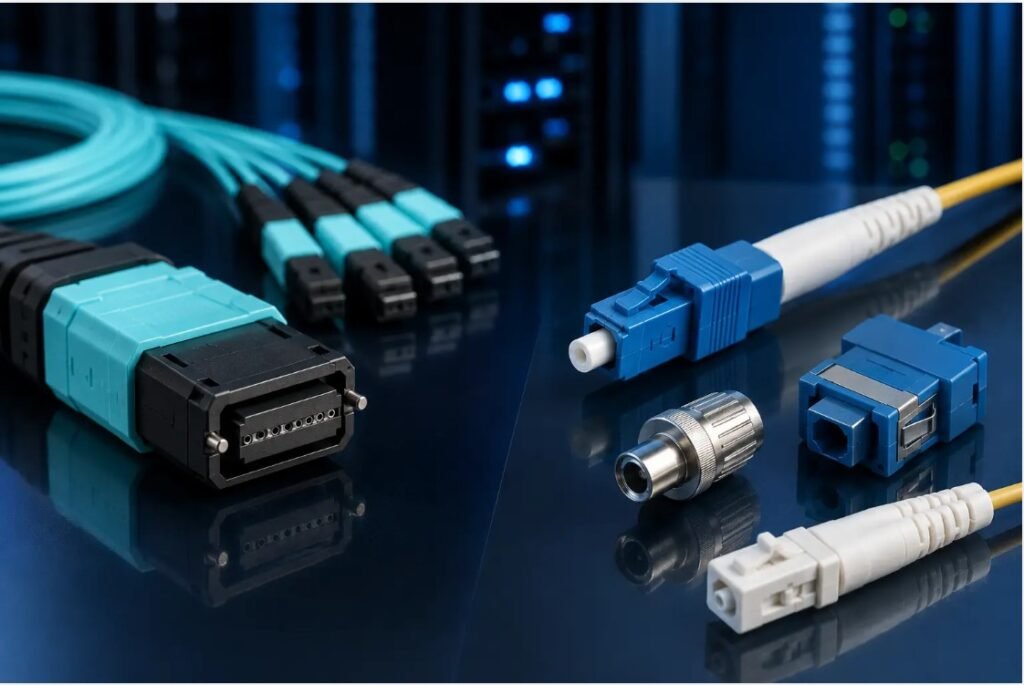
MT ferrules are closely associated with multi-fiber connector technologies such as MPO. In a typical multi-fiber connector assembly, the ferrule provides the mechanism for holding and aligning the optical fibers.
The connector housing, guide pins, springs, and other mechanical elements work together with the ferrule to establish a reliable mating interface. This means the ferrule should not be viewed as an isolated component; its performance is influenced by the quality and compatibility of the surrounding assembly.
When selecting an MT Ferrule Connector, network professionals should therefore evaluate the complete connector design and its intended application rather than considering only the ferrule itself.
Fiber Arrangement and Pitch
A defining characteristic of an MT ferrule is the precise arrangement of its fiber holes. The spacing between individual fibers, commonly referred to as pitch, must be manufactured within appropriate tolerances to support accurate alignment.
The number of fibers supported by a particular ferrule can vary according to its design and intended application. Different network architectures may therefore require different ferrule configurations.
For manufacturers and system integrators, accurate fiber-hole geometry is an important consideration. Consistency across production batches can also be significant when components are intended for large-scale optical deployments.
Manufacturing Quality Matters
The effectiveness of an MT Ferrule Connector depends heavily on manufacturing precision. Fiber holes must be positioned accurately, surfaces must be properly formed, and the ferrule must integrate correctly with the rest of the connector assembly.
Material selection also matters. Ferrules need appropriate mechanical properties and dimensional stability for their intended environment. Manufacturing processes must maintain tight tolerances because small deviations can influence the alignment of multiple fibers.
For professional network infrastructure, component quality should therefore be evaluated alongside price and availability. A reliable sourcing strategy considers specifications, compatibility, consistency, and application requirements together.
Benefits for Structured Fiber Infrastructure
Multi-fiber connectivity can reduce the physical complexity associated with large numbers of individual optical connections. Instead of managing every fiber independently, multiple channels can be incorporated into a consolidated connection system.
An MT Ferrule Connector contributes to this architecture by providing a compact and precisely aligned fiber interface. This can support more organized installations in equipment rooms, data centers, telecommunications facilities, and other structured network environments.
However, the actual benefit depends on how the complete system is designed. Appropriate cable routing, patching, labeling, cleaning, and component matching remain essential for a well-managed fiber installation.
Considerations When Selecting an MT Ferrule
Choosing the appropriate ferrule requires attention to several technical details. Fiber count is an obvious starting point, but it is not the only consideration.
Manufacturers and network integrators may need to evaluate fiber type, hole configuration, pitch, guide-pin arrangement, connector compatibility, mechanical dimensions, and intended application. The ferrule must also work correctly with the cable assembly and connector housing in which it will be installed.
For this reason, product specifications should be checked carefully before procurement. A component that appears physically similar may not necessarily be interchangeable with another design.
FSG Network can be a useful source for professionals evaluating fiber components for multi-fiber connectivity projects where specification matching is important.
Installation and Handling
Precision components require appropriate handling throughout assembly and deployment. Contamination on fiber end faces can interfere with optical transmission, while mechanical damage can affect alignment.
Technicians should follow established fiber handling procedures and manufacturer recommendations. Connectors should be protected from dust and unnecessary physical contact, particularly before final mating.
Proper assembly is equally important. If fibers are not positioned correctly within the ferrule or if the connector components are improperly assembled, the resulting connection may not achieve the intended optical performance.
Supporting Scalable Network Designs
The move toward higher-density networking is creating demand for connectivity components that can accommodate multiple optical channels within compact physical spaces. MT-based technologies can contribute to this shift by supporting multi-fiber connection architectures.
A well-planned MT Ferrule Connector system can form part of an infrastructure designed around scalability. When combined with suitable fiber cables, trunks, adapters, and patching equipment, it can help establish a structured pathway for expanding optical connectivity.
FSG Network’s focus on fiber optic connectivity makes it relevant to organizations and professionals developing these types of systems.
Where MT Ferrule Technology Fits
MT ferrule technology is most valuable where multiple fibers need to be aligned consistently within a compact connector structure. Its role becomes particularly significant in high-density environments, where individual-fiber connection methods may create additional physical complexity.
The technology can support modern optical architectures by providing a repeatable mechanical foundation for multi-fiber interfaces. Nevertheless, system designers should always select components based on the requirements of the specific application.
The right solution depends on factors such as fiber count, transmission requirements, equipment compatibility, physical space, and installation methodology.
Conclusion
Precision is fundamental to reliable optical connectivity. When multiple fibers share a single connection interface, accurate positioning becomes even more important because every optical channel depends on the geometry of the underlying component.
The MT Ferrule Connector provides a specialized foundation for multi-fiber alignment, making it an important component in compact and high-density optical systems. Its effectiveness depends on precise manufacturing, compatible connector components, appropriate fiber arrangement, and careful installation.
FSG Network supports professional fiber infrastructure requirements with products and components designed for modern optical connectivity applications. By evaluating ferrule specifications alongside the complete connector and cabling architecture, network professionals can develop multi-fiber systems that are organized, precise, and suitable for evolving connectivity demands.