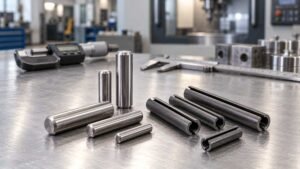
Precision is a major requirement in modern manufacturing. Whether a company produces automotive components, industrial machinery, or specialised engineering equipment, every part must fit and function as intended. Dowel pins help achieve this accuracy by providing reliable positioning and alignment between mating components.
What Makes Dowel Pins Essential for Industrial Assemblies?
Dowel Pins are cylindrical locating components used to position two or more parts accurately. They are commonly installed in machined holes to establish a repeatable relationship between components during assembly.
In many mechanical systems, bolts and screws provide clamping force, but they may not be sufficient on their own to guarantee precise positioning. Dowel pins address this requirement by locating components in predetermined positions according to the assembly design.
Their applications range from simple machine fixtures to complex industrial assemblies. Depending on the intended use, pins may be made from hardened steel, stainless steel, or other suitable materials.
For manufacturers working with close-fitting components, the correct dowel pin specification can help reduce alignment errors and improve assembly repeatability.
What Are the Different Types of Dowel Pins?
Different applications require different pin designs. Understanding their characteristics helps engineers select suitable components for their equipment.
Solid Dowel Pins
Solid dowel pins feature a rigid cylindrical design and are widely used for accurate locating and alignment. They are commonly found in machine tools, production fixtures, moulds, dies, and mechanical assemblies.
Depending on the required application, they can be manufactured from hardened or unhardened materials. Hardened pins may be appropriate where resistance to wear and dimensional stability are important.
Stainless Steel Dowel Pins
Stainless steel dowel pins are selected for applications where corrosion resistance is an important consideration. They may be suitable for equipment exposed to moisture or certain corrosive environments, depending on the grade.
When choosing stainless steel pins, buyers should evaluate the operating environment, mechanical loads, and compatibility with surrounding components.
How Do Dowel Pins Improve Manufacturing Accuracy?
Manufacturing accuracy depends on maintaining the correct relationship between individual components. When parts shift during assembly, the resulting misalignment can affect equipment operation and increase the need for adjustments.
Dowel pins help address several common challenges.
Repeatable positioning: They establish consistent locations for components during assembly and reassembly.
Improved alignment: Properly specified pins help mating parts maintain their intended positions.
Reduced component movement: In suitable designs, dowel pins help resist relative movement between assembled parts.
Reliable tooling operations: They support accurate positioning in jigs, fixtures, dies, and moulds used in manufacturing processes.
Simplified maintenance: Locating pins can make it easier to return components to their original positions after servicing.
Of course, these benefits depend on correct engineering design. Hole tolerances, material properties, pin geometry, and installation practices all contribute to the final result.
Which Factors Should Be Considered When Selecting Dowel Pins?
Selecting a dowel pin requires careful attention to the requirements of the complete assembly. A component that fits one application may not be appropriate for another.
Dimensional Accuracy
Diameter and length should match the engineering drawing and intended fit. Incorrect dimensions can cause installation difficulties, unwanted movement, or insufficient engagement between components.
Material Selection
Material choice depends on load conditions, wear, corrosion exposure, and operating temperature. Hardened steel may be suitable for wear-sensitive applications, whereas an appropriate stainless steel grade may be preferred in environments where corrosion resistance matters.
Tolerance and Surface Finish
Tolerances influence how accurately the pin fits into its receiving hole. Surface finish can also affect insertion, contact, and wear. Engineers should specify these requirements according to the assembly’s functional needs.
Relevant Industry Standards
Applicable standards help define dimensions and other product requirements. Buyers should confirm the precise standard required by their design rather than assuming that all dowel pins are interchangeable.
Supplier Quality Controls
Consistent manufacturing and inspection are important for applications requiring repeatable fit. Buyers should ask about dimensional verification, material specifications, and available quality documentation.
Where Are Dowel Pins Commonly Used?
Dowel pins serve a variety of functions across industrial sectors.
- Automotive manufacturing: They can locate components within selected engine, transmission, and assembly systems.
- Industrial machinery: They help position machine parts and maintain alignment.
- Tooling and fixtures: They support repeatable positioning in jigs, dies, and moulds.
- Aerospace engineering: They are used in applications where specified positioning and dimensional requirements must be maintained.
- Heavy equipment: They assist with locating components in suitable mechanical assemblies.
- Production equipment: They help establish consistent positions for parts during manufacturing and inspection operations.
Their exact role depends on the design of the equipment and the engineering requirements of each assembly.
How Can Buyers Choose Reliable Dowel Pins Manufacturers?
For industrial purchasing teams, selecting a supplier involves more than comparing quotations. Product consistency, technical support, and the ability to meet specified requirements can all influence manufacturing outcomes.
When evaluating Dowel Pins Manufacturers, buyers should consider several factors.
First, check whether the supplier can provide the required dimensions, material grades, finishes, and product types. Access to clear technical specifications helps engineers confirm compatibility before placing an order.
Second, ask about quality-control procedures. Dimensional inspections and material verification can help establish whether the components meet the agreed requirements. Certifications and test documentation should be assessed where applicable.
Conclusion
Dowel pins contribute to precision, alignment, and repeatable assembly across a wide range of industrial applications. From solid hardened pins to flexible spring pins and corrosion-resistant stainless steel options, each design serves particular engineering requirements.
Choosing the right component requires attention to dimensions, material properties, tolerances, operating conditions, and applicable standards. Manufacturers should also assess supplier capabilities and quality-control practices to support consistent results.
With appropriate specifications and careful installation, dowel pins can help maintain component positioning and support dependable manufacturing operations.
FAQs
What is a dowel pin used for?
A dowel pin is primarily used to locate and align components accurately. It helps maintain their relative positions during assembly and operation.
Are dowel pins suitable for heavy machinery?
Yes, dowel pins are used in many heavy machinery assemblies. The pin type, material, dimensions, and fit must be selected according to the application’s loads and engineering requirements.
What is the difference between a dowel pin and a bolt?
A bolt generally applies clamping force to secure components, while a dowel pin primarily provides accurate location and alignment. Both may be used together in a mechanical assembly.
How do I select the right dowel pin material?
Consider mechanical loads, wear, corrosion exposure, temperature, and compatibility with the mating components. The final selection should follow the applicable engineering specifications.
What should I check before ordering industrial dowel pins?
Confirm the diameter, length, tolerance, material, finish, applicable standards, quantity, and required quality documentation before placing an order.