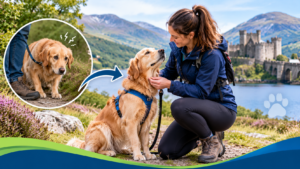
Dog anxiety training in North Wales starts with a step that feels backwards: working below the point where your dog panics. Anxious dogs often shake an owner’s confidence first, so people stop going out.
Recognise anxiety before you train: knowing the threshold
Your dog is below threshold when it notices a cyclist or a ship’s horn near the Wirral docks but still takes an interest in you. That’s your training zone. Above it, the dog is rigid, panting, barking or frozen, and nothing is being learned.
Training above threshold by accident is easy to do, and it can make the panic worse. Spotting that shift is your first win.
Start small: desensitisation on quiet routes near home
Let the trigger appear in small doses, perhaps one cyclist passing in a week, then two. Pair every sighting with high-value treats and praise. The dog soon learns that the trigger predicts good things.
Progress comes at your dog’s pace, and each small success builds on the last.
Build engagement before distance
Teach your dog to look at you on cue (a name or “look”), and reward heavily when it turns away from a trigger. Practise in a calm room first.
Know when to pause walks and invest in home enrichment
If every outing ends in panic, take a short break from outdoor walks rather than pushing on. You aren’t failing, you’re being strategic.
Getting a professional view helps, because a behaviourist can tell you whether the anxiety is fear-based, territorial or learned panic, and that changes the plan. Ask about formal behaviour qualifications and vet recommendations, and find out what a first session covers. Paul at Mindful Dog offers a free telephone consultation to talk through your dog’s anxiety.
Work with your local terrain
Hill walkers and cyclists can be triggers anywhere in North Wales, so scout the fewest-trigger routes first, such as residential streets and woodland edges. Short, frequent outings suit damp weather.
When you compare dog training services in North Wales, or dog trainers in Wirral, ask how they’d pace exposure to your dog’s triggers before you book.
Ready to rebuild your walks?
Mindful Dog can help with dog anxiety training in North Wales, working at the pace your dog can cope with. Book a free telephone consultation on +44 7886 642086 and we’ll talk through your dog’s anxiety and the next steps.
Frequently Asked Questions
How do I tell the difference between normal caution and anxiety on walks?
A cautious dog notices something but stays responsive and can be redirected. An anxious dog is rigid, panting, barking, freezing or ignoring you.
What’s the difference between desensitisation and counterconditioning?
Desensitisation reduces fear through gentle, repeated exposure below threshold. Counterconditioning teaches your dog that the trigger predicts good things, such as treats.
Should I avoid walks entirely if my dog is anxious?
If every walk causes panic, pause briefly, build confidence at home, then restart with short outings on quiet routes.
How long does it realistically take to help an anxious dog enjoy walks?
It depends on your dog’s history, how strong the triggers are and how consistently you practise. Rescue dogs or severely anxious dogs often need longer, so ask any trainer how they’ll review progress with you.
Read our Another Article Below: