If your skin tightens up after cleansing, causes discomfort on your cheeks, or begins to sting as you apply your other skincare products, it might be time for you to look at your cleanser.
Cleansing is crucial when it comes to skincare; however, for sensitive or reactive skin, the process requires much more attention beyond just cleansing away impurities and oil. This can include the use of hot water, friction, too frequent washing, the effects of the environment, and even the wrong cleanser.
This is especially significant if the skin is suffering from problems like psoriasis, dermatitis, rosacea, or compromised skin barrier function. The cleanser will not be able to help you with this condition; however, by selecting the right cleansing formula, you may ensure that you are not aggravating your problem further with extra dryness.
This is when the use of apple amino acids in skincare comes into relevance. As a cleansing ingredient, apple amino acids can help to clean the skin of everyday impurities as well as be a part of the formula intended for milder cleansing.
So, what are apple amino acids? How do they cleanse the skin? And how to select the right skincare for sensitive skin?
What Are Apple Amino Acids in Skincare?
Apple Amino Acids have been incorporated into skincare products, especially cleansers. Sodium Cocoyl Apple Amino Acids is an example of an amino acid surfactant.
Surfactants are the cleansing agents that help in removing excess oils, sweat, and other impurities from the skin. Since oils and water do not mix easily, surfactants help in making the mixture of these substances easy and washable using water.
Nevertheless, not all cleansers provide the same cleaning experience. The composition, the concentration of the cleansing agents used, the pH balance, and other additional components may impact the skin after washing. Therefore, if you are examining an apple amino acid cleanser, the issue you need to focus on is not only whether it includes apple amino acids, but whether its composition is suitable for your skin.
Why Does Sensitive Skin Need a Gentler Cleanser?
Sensitive skin is prone to reacting easily to products that are used on the skin and also other outside influences like climate and friction. As such, the cleansing process may significantly influence the way your skin will feel throughout the day.
For instance, you may experience:
- Constriction right after cleansing
- Dry or irritated cheeks
- Scaly areas around the mouth or nose
- Conspicuous redness or flushing
- Pricking sensation while using a serum or moisturizer
- A sense that your skin requires many products right after cleansing
There could be many reasons behind such symptoms, so you must not immediately blame one ingredient for them. Nonetheless, your cleansing regime is one of those aspects you may want to check up.
A cleanser must eliminate unwanted impurities from the skin while leaving necessary components of the skin intact.
The sensation of squeaky clean does not always indicate that your skin has been cleaned properly. Clean and comfortable is much more desirable for sensitive skin rather than extremely tight and stripped skin.
Skin Concerns That Can Make Cleansing More Difficult
Sensitive skin is not only associated with occasional dryness. Some individuals have skin that is overly sensitive due to certain issues, including psoriasis, dermatitis, rosacea, and impaired skin barrier.
Psoriasis-Prone Skin
Psoriasis may lead to patches of the skin being dry, flaky, and irritating. However, cleansing will not help with psoriasis; nevertheless, the process of cleansing will be important. (1)
The use of hot water and rough scrubbing will only contribute to the irritation of already dry and sensitive areas of the skin.
Dermatitis and Reactive Skin
Dryness, itchiness, and irritation are some conditions that can be related to dermatitis. If the skin is already sensitive, the use of unnecessary procedures and repetitive application of irritating products will complicate the process of skincare.
Gentle cleansing with warm water and mild strokes could be better than scrubbing or rinsing for too long.
Rosacea-Prone Skin
Skin that is prone to getting rosacea can be sensitive to things like heat, irritation, changes in environment, and even certain facial cleansers. (2)
In the case of such skin types, cleansing should be mild. This involves using lukewarm rather than hot water and refraining from scrubbing harshly with rough cloths or tools.
The facial cleanser itself is not a remedy for rosacea. If there is still burning, itching, redness, and other symptoms present, professional dermatology is more suited.
Damaged Skin Barrier
The skin barrier prevents water loss and serves as protection against external exposure. If the barrier is damaged, there can be sensations of dryness, roughness, tightness, sensitivity, or discomfort from applying skincare products to the skin.
This is another reason why cleansing is not an attempt at washing off all the oils.
There are lipids within the skin itself that play a role in creating the protective environment. The purpose of cleansing is to wash away dirt, sweat, sebum, and other contaminants without disturbing the natural oils on the skin.
How Do Apple Amino Acids Cleanse the Skin?
Basic science of cleaning entails the relationship between oil and water.
Water alone does not work very well to remove oily dirt off the skin surface. Surfactants play the role of bridging the two in that they interact with the oily dirt and enable its removal with water.
Sodium Cocoyl Apple Amino Acids are surfactants used in the apple amino acid cleanser.
Cleansing, on the other hand, should not aim at removing all traces of oil from the skin. Oil is naturally found on the skin.
It would be better if the impurities can be removed without making the whole process of cleansing too harsh. It is important because facial cleansing is not just a once-in-a-while activity.
Apple Amino Acids and the Skin Barrier
The skin barrier is crucial in ensuring that water loss is minimised and the skin is protected against exposure from the external environment. The effect of surfactants on the outer layer of the skin is such that it affects the way the skin feels after cleansing.
A 2025 clinical evaluation examined a soap-free cleansing lotion containing sodium cocoyl apple amino acids in 27 healthy adults with different skin types, including dry, oily, sensitive, combination, and normal skin. After 30 days, the tested formulation showed improvements in measured skin impurities, hydration, barrier-related measurements, and overall dry-skin scores, with no adverse events reported during the study. However, the study was small and open-label and evaluated one finished formulation, so its findings should not be generalized to every product containing apple amino acids. (3)
That distinction is important.
Apple amino acids are an ingredient, not a guarantee that every cleanser containing them will suit every person with sensitive skin.
The complete formula is important—from the cleansers to the preservatives, fragrance, plants, pH level, and the sensitivity of the person’s skin.
What Should You Look for in a Gentle Cleanser for Sensitive Skin?
Selecting skin products for sensitive skin means you should not focus on one “hero” ingredient only.
Seek Soap-Free Cleansers
When you have sensitive skin, find a soap-free cleansing formula and observe your skin reaction after cleansing.
Being soap-free does not mean that all the products will work for everyone, and it is still necessary to look at all the ingredients.
The idea is to remove all impurities from the skin without stripping it of natural oils.
Consider Your Environment
The skin is affected by varying conditions depending on your surrounding environment.
For example, an individual living in a busy urban area may be exposed to pollution from traffic, dust, heat, and air conditioning. An individual living in a village setting may be more exposed to dust, sunlight, wind, farm settings, and other environmental conditions.
However, it does not necessarily mean that individuals living in either of these settings have sensitive skin. It depends on the conditions under which the skin is being exposed every day.
This is the reason why skincare cannot be separated from the environment.
Pay Attention to Climate Changes
Climate will also have its effect on your skin.
In hot and humid weather, your skin will tend to be more sweaty and oily. Cooler and drier weather will tend to cause tightening and dryness of the skin. The combination of heat outdoors and air conditioning indoors is also capable of influencing your skin. This means that your cleanser must suit different climatic conditions.
Look at the Complete Ingredient List
Do not select a cleanser merely because it has an ingredient that you like.
Consider the entire formulation, and see if it is a non-soap product, what cleansing agents are in the formula, whether or not the formula includes any fragrance, and if there are ingredients that do not suit your skin.
If you have sensitive skin, the entire formula becomes more important than any single ingredient claim.
Pay Attention to Your Skin After Washing
This way, your skin reaction can help you understand how effective the cleanser works for you.
You need to ask yourself:
- Does my skin become too tight after cleansing?
- Are my cheeks dry?
- Does my skin sting while I use moisturizers?
- Is my skin rough after cleansing?
- Am I feeling like I need to put on multiple products right away?
- Does my face feel clean but comfortable at the same time?
The idea here is not to leave your skin totally free from oil. It is to have clean and comfortable skin.
Where Does The Good Apple Amino Face Foam Fit In?
After understanding the features that make a cleanser fit for reactive and sensitive skin, you can evaluate a cleanser based on its total formulation and not just one single ingredient.
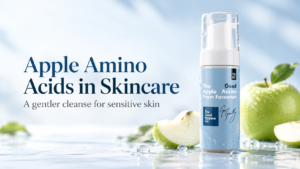
The Good Apple Amino Face Foam of The Good Hygiene Co. utilizes Sodium Cocoyl Apple Amino Acids as the cleansing agent in addition to calendula, chamomile, White Willow Bark Extract, and Provitamin B5. The cleanser is also sulfate-free and fragrance-free.
Why Calendula?
Calendula is a plant-based ingredient that is included as part of the skin comfort ingredients. (4)
The reason for the use of calendula in the product is that it acts as a skin-soothing ingredient to complement the cleansing action of skincare products. The relevance of the use of calendula is especially true for individuals who want skincare products formulated for skin comfort during cleansing.
Calendula is not meant to act as a remedy for skin problems such as psoriasis, dermatitis, and rosacea, among others.
Why Chamomile?
Chamomile is yet another plant extract that can be incorporated into formulas meant for sensitive skin.
It has calming properties and works well with calendula in the formula.
The use of plant extracts in this case is not only to add ingredients to the list but is meant to aid in the process of cleansing sensitive skin.
White Willow Bark Extract
The next ingredient found in the formula is White Willow Bark Extract. This is a source of salicylate compounds and is used in skincare products to facilitate exfoliation and improve pore condition.
Nevertheless, the sensitivity level of the skin may vary.
Provitamin B5
Another skin conditioner that is added is provitamin B5. With all the above ingredients, it is clear that the cleanser needs to be analyzed as a complete formula instead of looking at the cleansing component alone.
Can an Apple Amino Acid Cleanser Help With Dry, Tight Skin?
While a cleanser may not be able to resolve all factors behind dryness, the process of cleansing itself can affect how your skin feels.
Compare the following:
Hot water + vigorous scrubbing + frequent washing + unsuitable cleanser
and:
Lukewarm water + gentle cleansing + suitable formula + moisturizer
The second one is usually more suitable when you want to reduce unnecessary dryness and discomfort.
In case your skin becomes uncomfortable and dry after cleansing, think about adjusting the cleansing routine and the cleanser as well.
Conclusion
Selecting the right cleanser for sensitive skin requires taking into account your skin concerns, your cleansing routine, the environment in which you live, and the climate you are used to. For concerns like dermatitis, rosacea, psoriasis, or a damaged skin barrier, gentle cleansing becomes especially critical.
Apple amino acids can be useful ingredients in gentle cleansing formulations, and calendula and chamomile may contribute to skin comfort. You should cleanse properly, but not strip your skin of its natural moisture.
Proper skincare is also a matter of personal attitude. The mission of The Good Hygiene Co. includes a commitment to environmental sustainability through water-efficient production, biodegradable packaging, and green printing.
Clean skin does not have to mean stripped skin.
FAQ
1. Are apple amino acids the same as apple extract?
Apple amino acids are not the same cosmetic ingredient as apple extracts because apple amino acids can act as cleansing agents, whereas apple extracts are botanical ingredients.
2. Is a soap-free cleanser better for sensitive skin?
A soap-free cleanser could be something to consider if one is seeking a softer way to cleanse their skin. But just because something is “soap-free” does not necessarily mean that it will be right for you.
3. Can I use an apple amino acid cleanser if I have rosacea or dermatitis?
An apple amino acid cleanser can be considered one aspect of a gentle cleansing process; however, it cannot be seen as a cure for rosacea or dermatitis. If you find your skin to be persistently irritated, itchy, inflamed, or painful, visit a dermatologist.
4. Why does my skin feel tight after cleansing?
There are several factors that can affect how tight your skin feels after using a cleanser, such as the cleanser itself, the temperature of the water, how often you cleanse, how you rub, and your own skin type. Feeling tight should not necessarily mean your skin is clean.
5. Should sensitive skin avoid all botanical ingredients?
Absolutely not! Botanical extracts can be incorporated into skincare products for various reasons, including skin comfort. But since sensitive skin may react differently to certain ingredients, one must take into account both the entire formulation and one’s own skin sensitivity.
References
- Rosacea Topical Treatment and Care: From Traditional to New Drug Delivery Systems
https://pmc.ncbi.nlm.nih.gov/articles/PMC10410666/#sec3 - Influence of Psoriasis on Household Chores and Time Spent on Skin Care at Home: A Questionnaire Study
https://pmc.ncbi.nlm.nih.gov/articles/PMC4470958/#Sec1 - Clinical Evaluation of a Soap-Free Cleansing Lotion Containing Sodium Cocoyl Apple Amino Acids for Effective Impurity Removal and Skin Barrier Preservation in Healthy Adults With Diverse Skin Types
https://pmc.ncbi.nlm.nih.gov/articles/PMC12446884/#sec2 - An Updated Review on the Multifaceted Therapeutic Potential of Calendula officinalis L.
https://pmc.ncbi.nlm.nih.gov/articles/PMC10142266/#sec1-pharmaceuticals-16-00611