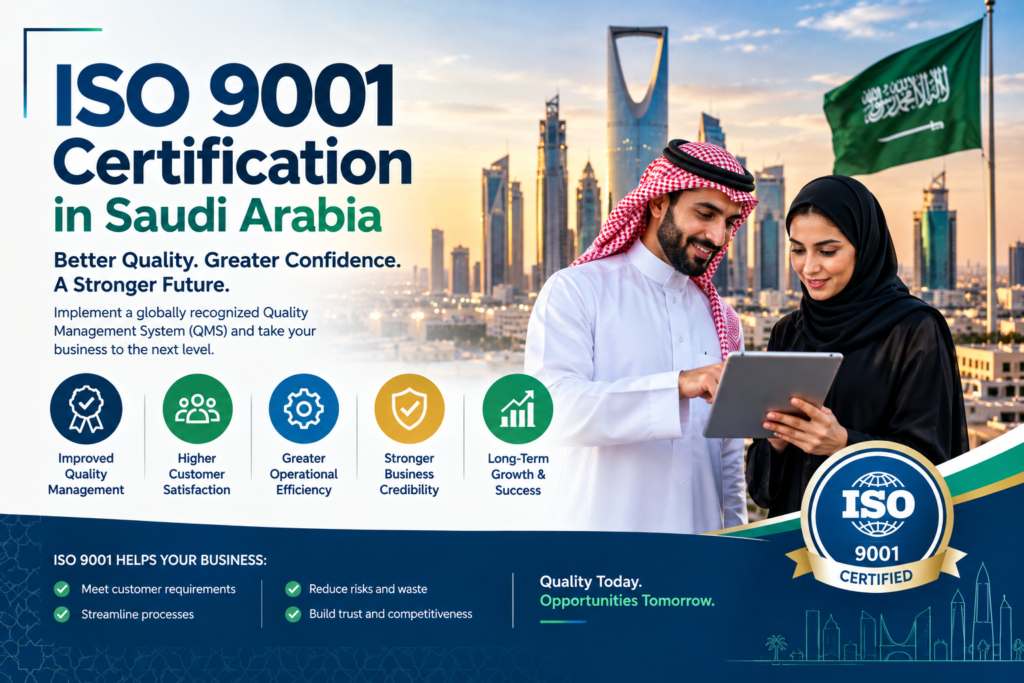
Introduction
Businesses in Saudi Arabia are continuously looking for ways to improve product quality, customer satisfaction, and operational efficiency. ISO 9001 certification helps organizations establish a structured Quality Management System (QMS) that supports consistent processes and continual improvement. It is suitable for businesses of different sizes and across various industries.
ISO 9001 is an internationally recognized standard that specifies requirements for quality management systems. Obtaining ISO 9001 certification in Saudi Arabia can help organizations strengthen their credibility, improve customer confidence, and demonstrate their commitment to delivering quality products and services.
What Is ISO 9001 Certification?
ISO 9001 certification confirms that an organization’s Quality Management System has been independently assessed against the applicable requirements of the ISO 9001 standard. It focuses on customer satisfaction, leadership, process management, risk-based thinking, performance evaluation, and continual improvement.
The standard provides a framework for identifying customer requirements, controlling business processes, monitoring performance, and addressing quality issues. Rather than focusing on one specific product, ISO 9001 evaluates how effectively an organization manages the processes that influence the quality of its products or services.
In Saudi Arabia, organizations can use ISO 9001 to improve their internal operations and demonstrate a systematic approach to quality management.
Who Needs ISO 9001 Certification in Saudi Arabia?
ISO 9001 certification can benefit organizations across many sectors. Manufacturing companies can use it to improve production consistency, while construction businesses can strengthen project quality and supplier management. Healthcare providers, logistics companies, engineering firms, IT service providers, and professional service organizations can also benefit from implementing a QMS.
Small and medium-sized enterprises may use the standard to organize their processes and improve customer satisfaction. Larger organizations can apply it to coordinate departments, manage suppliers, and monitor performance more effectively.
Businesses seeking to work with major customers or participate in tenders may also find ISO 9001 certification useful when quality management requirements form part of supplier evaluation or procurement conditions.
Key Benefits of ISO 9001 Certification
Improved Product and Service Quality
ISO 9001 encourages organizations to establish clear procedures, define responsibilities, and monitor important processes. These practices can reduce errors, improve consistency, and help businesses meet customer expectations.
Increased Customer Satisfaction
Understanding customer needs is an essential part of quality management. Organizations can collect feedback, address complaints, and use performance data to improve their products and services.
Better Operational Efficiency
A well-implemented QMS helps identify unnecessary activities, process weaknesses, and recurring problems. Improving these areas can reduce waste, save time, and support more efficient resource management.
Stronger Business Credibility
ISO 9001 certification demonstrates that an organization has implemented a quality management system assessed against an international standard. This can strengthen business relationships and help customers evaluate potential suppliers.
Steps to Obtain ISO 9001 Certification in Saudi Arabia
Organizations generally follow these steps to achieve certification:
- Understand the requirements: Review the ISO 9001 standard and determine how it applies to your business activities.
- Conduct a gap analysis: Compare existing processes with the standard’s requirements and identify areas that need improvement.
- Implement the QMS: Establish appropriate procedures, responsibilities, objectives, and records.
- Train employees: Ensure that relevant personnel understand their roles in maintaining quality.
- Conduct an internal audit: Evaluate whether the system is implemented effectively and identify nonconformities.
- Complete a management review: Assess QMS performance and decide on necessary improvements.
- Arrange an external audit: Select a competent certification body to assess the system and determine whether certification requirements have been met.
Organizations must address identified nonconformities as required before certification can be granted.
Cost of ISO 9001 Certification in Saudi Arabia
The cost depends on factors such as company size, number of employees, locations, business complexity, existing documentation, and audit duration. Additional expenses may include employee training, consultancy, internal improvements, and certification audits.
Businesses should request quotations from suitable certification bodies and confirm what each quotation includes. Comparing services, auditor competence, accreditation status, and certification scope can help organizations make an informed decision.
Conclusion
ISO 9001 certification in Saudi Arabia offers businesses a practical framework for improving quality, increasing customer satisfaction, and strengthening operational performance. By implementing an effective Quality Management System, organizations can identify weaknesses, manage risks, and support continual improvement. Choosing a competent certification body and involving employees throughout the process can help businesses establish a reliable QMS and build a stronger foundation for long-term growth.