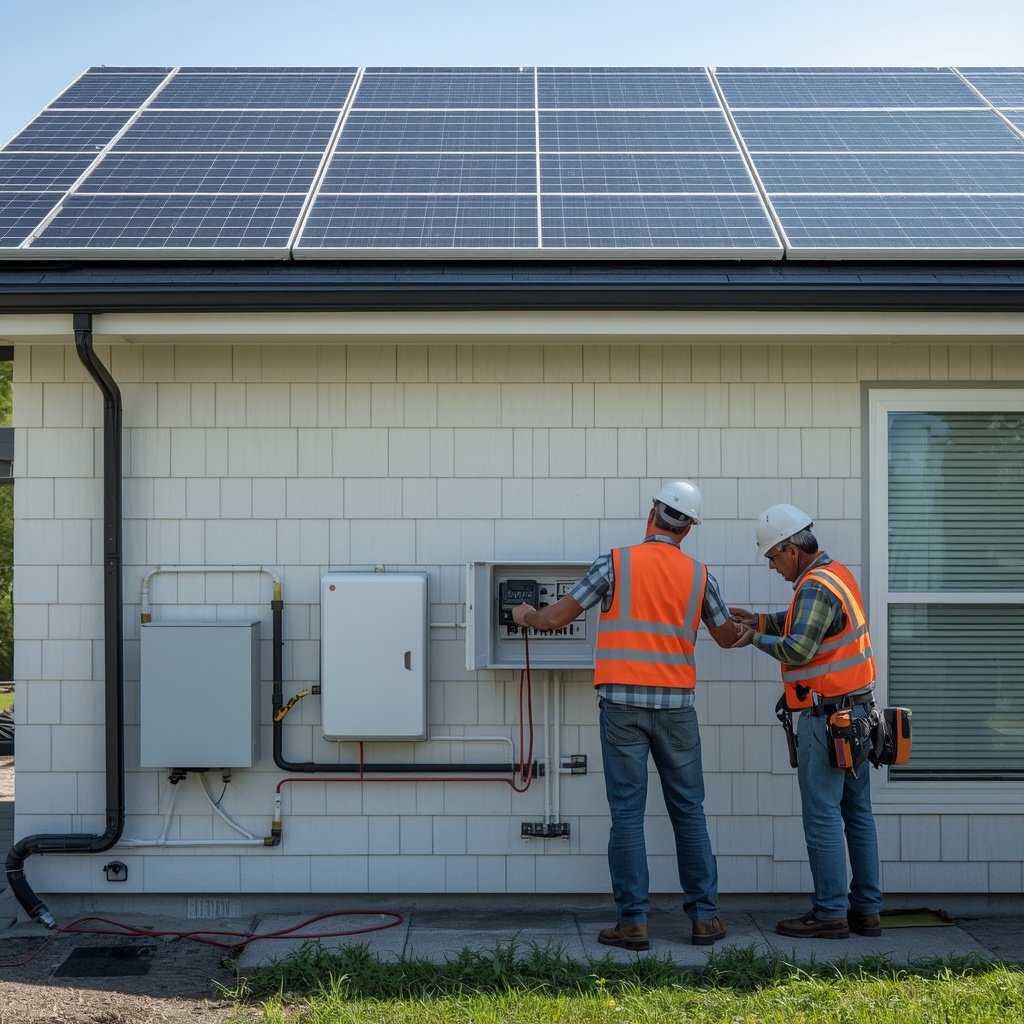
Meta Description: A practical guide to navigating HOA rules for solar, and why association approval matters as much as permits.
Homeowners in planned communities often discover a frustrating truth partway through their solar journey. Even after a contractor is hired and a system design is finalized, a separate approval process can still stand between them and installation day. Understanding hoa solar panel guidelines early prevents this surprise from derailing a project that otherwise seemed ready to move forward.
At PTOEdge, we’ve seen association rules catch installers off guard more often than almost any other part of the process. Solar work is never just about mounting panels correctly; it also requires clear designs, accurate documentation, and utility sign-off, all layered on top of whatever local association rules apply. Because every neighborhood enforces its own restrictions, a design that works perfectly in one community might get rejected outright in another just down the road. That’s precisely why we treat association review with the same seriousness we bring to permitting and utility approval.
This article explains how HOA rules intersect with the broader solar approval process, what typically gets restricted, and how installers can avoid the delays these disputes so often cause. If association pushback has stalled a project on your plate, connect with PTOEdge’s team and get a clearer path toward resolution.
Why Associations Get Involved in Solar Decisions at All
Homeowners associations exist primarily to maintain a consistent visual standard across their communities, and solar panels represent a fairly significant change to a home’s exterior appearance. Consequently, many associations built formal review processes specifically to manage how solar gets installed within their boundaries.
Some associations restrict which roof faces panels can occupy, particularly street-facing sections visible from the road. Others require specific equipment colors, low-profile mounting hardware, or additional landscaping to soften the visual impact of a new system. Therefore, understanding these restrictions before finalizing a system design helps installers avoid proposing something the association will inevitably reject.
Many states have passed solar access laws limiting how restrictive an association’s rules can legally be, though the specifics vary considerably by state. Because these protections aren’t uniform nationwide, installers working across multiple states need genuine familiarity with each region’s specific solar rights legislation. Otherwise, an association might unknowingly (or knowingly) impose restrictions that don’t actually hold up under state law.
How Association Review Fits Into the Bigger Timeline
Most homeowners assume the permitting process with their city or county represents the only regulatory hurdle standing between contract signing and installation day. However, association review often runs on a completely separate track, sometimes requiring its own application, its own waiting period, and its own approval committee.
This separate timeline can catch installers off guard if they don’t build it into their project scheduling from the very beginning. A solar sales proposal that ignores potential HOA delays risks setting expectations that the actual project timeline simply can’t meet. As a result, sales teams who factor association review into their proposed timelines build far more trust with prospective customers.
Association approval can happen before, during, or after city permitting, depending on how a particular jurisdiction and association coordinate their processes. Meanwhile, some associations require proof of city permit approval before they’ll even begin their own review, creating a sequential bottleneck that adds real weeks to a project. Understanding this sequence for each specific community prevents installers from promising unrealistic completion dates.
What Strong Plan Sets Can Do to Ease Association Friction
Detailed, professional documentation often makes association review considerably smoother than a rushed or incomplete submission ever could. Accurate solar plan sets that clearly show panel placement, equipment specifications, and visual impact give association boards exactly what they need to make an informed decision quickly.
When these drawings are vague or inconsistent, association committees often request additional information, adding delay after delay to an already lengthy process. Comprehensive pv plan sets that anticipate an association’s visual concerns tend to move through review meetings far faster than generic submissions lacking real detail. Consequently, investing in quality documentation upfront often saves considerably more time than it costs.
Many jurisdictions also require these plan sets to carry a licensed professional’s certification before city departments will even accept them for permitting review. A capable solar stamping service provides that certification efficiently, ensuring the same documentation satisfies both the association and the local building department simultaneously. This dual-purpose approach prevents installers from creating separate drawing sets for each reviewing body.
Where City Permitting and Association Rules Overlap
Local building departments and homeowners associations don’t always coordinate closely, which means installers frequently navigate two separate rulebooks for the same project. Solid Permit Design & AHJ Compliance practices account for both sets of requirements simultaneously rather than treating them as entirely separate processes handled one after another.
Fire codes, setback requirements, and structural standards fall under the authority having jurisdiction’s purview, while visual and aesthetic standards typically fall under association control instead. Because these two regulatory bodies sometimes hold conflicting preferences, particularly around panel placement and visibility, installers need designs flexible enough to satisfy both without triggering a full redesign.
This overlap becomes especially tricky in jurisdictions with detailed, technically demanding permitting standards. Companies offering solar permit services san diego contractors depend on must navigate California’s particularly rigorous code requirements alongside whatever association restrictions apply to a given neighborhood. Managing both layers simultaneously requires genuine regional expertise rather than a generic, one-size-fits-all approach to design.
After Approval: The Utility Still Has to Sign Off
Clearing both city permitting and association review still doesn’t mean a system can legally operate. The utility company must separately authorize the system before it can export power to the grid, a step generally referred to as permission to operate services. Skipping ahead of this step, even after every other approval is secured, simply isn’t possible.
This broader category of pto solar work involves submitting an interconnection application, waiting for utility technical review, and receiving formal authorization before activation. Utilities apply their own separate standards focused on grid safety and metering accuracy, distinct from whatever the city or association already approved. Therefore, installers sometimes discover that association and city approval, while necessary, aren’t sufficient on their own.
A properly filed PTO application reduces the risk of additional delay at this final stage of the process. Utility staff review large volumes of applications simultaneously, and incomplete submissions often sit unprocessed at the bottom of that queue for extended periods. Reliable pto services manage this final stretch carefully, ensuring nothing slips through after all the earlier approval work is already complete.
Understanding What Homeowners Actually Gain From the Process
All this regulatory coordination ultimately connects to what homeowners care about most: how much they’ll save once the system starts producing power. Understanding solar net metering policies helps homeowners see why utility approval matters just as much as association and city sign-off combined.
Net metering compensation varies considerably depending on state regulation and individual utility program structure. Some utilities credit excess exported power at full retail value, while others apply reduced rates that noticeably affect a system’s long-term financial return. Consequently, two similar homes in different utility territories can see meaningfully different savings from otherwise comparable systems.
Explaining solar panels net metering structures clearly during the sales process helps homeowners understand why the entire approval chain, association included, ultimately serves their financial interests. When customers grasp this connection, they tend to approach association delays with more patience rather than frustration directed at their installer.
Battery Storage Adds Another Layer of Association Scrutiny
Battery systems introduce their own visual and safety considerations that associations often scrutinize separately from solar panels themselves. Exterior-mounted battery units can raise aesthetic concerns similar to those associated with panel placement, sometimes requiring additional association approval beyond the standard solar review.
Careful battery energy storage permitting accounts for these considerations from the design phase forward, rather than discovering association objections after equipment has already been ordered. Fire code requirements for battery placement, including clearance and ventilation standards, sometimes conflict with an association’s preferred aesthetic placement, requiring careful negotiation between the two.
Because residential battery adoption continues expanding rapidly, installers who understand these layered requirements avoid costly redesigns that catch less experienced companies off guard. Addressing both fire code compliance and association aesthetic preferences early prevents the kind of back-and-forth that stalls projects for weeks at a time.
Why Specialized Support Makes This Manageable
Tracking association rules, city codes, and utility requirements across multiple communities requires genuine expertise that’s difficult to build entirely in-house. For growing installation companies, hiring staff dedicated purely to this kind of regulatory tracking often costs more than partnering with specialists who already have that knowledge.
Comprehensive pv permit services give installers access to this specialized knowledge without the overhead of maintaining a full internal compliance department. This structure allows installation crews to focus on quality workmanship while a separate team manages documentation, association coordination, and utility follow-up in parallel. Meanwhile, projects continue advancing instead of stalling behind unresolved association questions.
This kind of specialized support directly enables Solar Installer Growth, since companies freed from constant regulatory friction can take on more projects without proportionally expanding their administrative staff. As a result, installers scale their operations more efficiently when experienced specialists handle the coordination between associations, cities, and utilities on their behalf.
What This Looks Like in Practice at PTOEdge
We built our process around recognizing that solar approval rarely follows a single, simple path. Every project we handle gets evaluated against the specific city, association, and utility requirements relevant to that address, not treated as a generic template applied uniformly everywhere.
Because every neighborhood enforces different rules, our team tracks association patterns, code updates, and utility quirks across every region we serve rather than assuming one approach fits all situations. This attention to detail translates into fewer rejected submissions, smoother association reviews, and installers who can set realistic expectations with their customers from day one.
Clear designs, correct documentation, and coordinated approval across every reviewing body all work toward the same outcome: projects that move forward smoothly and safely without unnecessary delay. That reliability reduces stress for installers, sales teams, and the homeowners waiting to see their system finally switched on.
If association rules or overlapping approval requirements keep slowing down your installation timeline, don’t let coordination gaps undo good technical work — reach out to PTOEdge and get a clearer, more predictable path through the entire approval process.
Frequently Asked Questions
Can an HOA legally block a solar installation entirely?
Most states have solar access laws limiting outright bans, though restrictions on placement and equipment often still apply.
Does association approval happen before or after city permitting?
It varies by community, though some associations require proof of city permit approval before starting their own review.
What details do associations usually restrict on solar systems?
Panel placement, visible equipment color, and mounting hardware are among the most commonly regulated details.
Do battery storage units require separate HOA approval?
Often yes, since exterior battery placement can raise the same visual concerns associations apply to solar panels.
Why does utility approval still matter after HOA sign-off?
The utility must separately authorize the system before it can legally export power, regardless of other approvals secured.