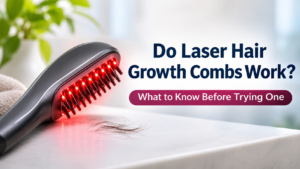
Hair thinning and hair loss problems are quite annoying, causing people to try various non-surgical methods of treatment. One such method that has become quite popular in recent times is the laser hair growth comb, which is basically a handheld laser light device used to energize the scalp. The question remains, however, are laser hair growth combs effective, and should they be tried?
What Is a Laser Hair Growth Comb?
The laser hair growth comb is a hair regeneration device that employs the use of low-level laser therapy (LLLT), sometimes referred to as photobiomodulation (1). The technology works by providing light to the scalp and is thought to have an effect on cell behaviour in hair follicles.
Nevertheless, the effectiveness will depend on the product, the cause of the hair loss, and the regularity of use.
Do Laser Hair Growth Combs Work?
Yes, laser hair combs may help increase the thickness of hair in certain individuals, especially those suffering from androgenic alopecia, or pattern hair loss (2). Nevertheless, outcomes are inconsistent and these devices do not work in all cases of hair loss.
Improvement would normally take a few months of consistent use. A hair growth laser comb should be seen more as an addition to therapy than an assured solution.
What Are the Benefits of Laser Hair Growth Combs?
Benefits of laser hair growth combs are:
- Non-invasive application: Uses light therapy without requiring surgery or any injections.
- Home convenience: Many of these devices can easily be integrated into hair care regimes at home.
- Potential improvement in hair density: Some devices could be useful for people experiencing pattern hair loss.
- Targeted scalp application: The comb-like design assists in delivering light to various sections of the scalp.
The laser comb for thin hair might not work effectively if hair loss is due to nutrition problems, hormones, or any other health issue.
How to Use a Laser Comb for Hair Growth
Use these guidelines to ensure proper application:
- Always read the instructions provided by the manufacturer.
- Ensure proper placement of the device on your scalp as suggested.
- Adhere to the appropriate length and frequency of use.
- Document your progress through pictures taken in similar lighting.
- Visit a dermatologist if the problem continues or worsens.
- Do not increase the frequency of use in anticipation of quicker results.
What Are the Side Effects of Laser Hair Growth Combs?
Some of the possible risks associated with the laser hair growth comb include scalp irritation, tenderness, and pain. Improper usage and the wrong tools can also bring about safety issues.
Ensure that the chosen equipment is appropriately approved for the intended application. Eye safety instructions must be followed, and a physician should be contacted if one suffers from any scalp condition or photosensitive disorder or uses medications that increase light sensitivity.
Who Should Consider Laser Hair Regrowth Devices?
Hair regrowth laser treatment might be worth considering if you have a gradual pattern hair loss problem and would like to try a non-invasive method of treatment (3).
Nevertheless, rapid shedding, thinning, or hair falling out in patches, as well as scalp irritation, should be assessed by a physician to determine the cause of the problem and possible treatment, which may include the use of topical minoxidil.
At Cureka, India’s 1st Preventive Healthcare Store, curated by doctors, you can explore healthcare and wellness products while making informed personal-care choices.
FAQ
1. How long does a laser hair growth comb take to work?
Using a laser hair growth comb can take several months before there is any visible improvement in results. This depends on the individual and the comb used.
2. Can a laser comb regrow hair completely?
No. A laser comb for hair loss cannot provide full coverage in terms of regaining all hair. It depends on the nature of hair loss.
3. Is low-level laser therapy for hair growth safe?
Low-level laser therapy is usually known to be well-tolerated when the right equipment is used as prescribed. However, individual tolerances will differ, and therefore any questions related to light sensitivity or scalp conditions should be addressed medically.
4. Can laser hair growth combs treat every type of hair loss?
No. These may be useful for certain individuals suffering from pattern baldness, but may not be useful at all for hair loss due to malnutrition or disease.
5. Are laser hair growth combs worth trying?
They might be something to consider in case of certain hair loss conditions, although there are no guarantees. Look through the clinical data on the device and discuss your choice with a dermatologist.
References
- Low-Level Laser (Light) Therapy (LLLT) for Treatment of Hair Loss – https://pmc.ncbi.nlm.nih.gov/articles/PMC3944668/#S5
- Lasers in the Management of Alopecia: A Review of Established Therapies and Advances in Treatment – https://pmc.ncbi.nlm.nih.gov/articles/PMC11023987/#Sec2
- Examining the Safety and Efficacy of Low-Level Laser Therapy for Male and Female Pattern Hair Loss: A Review of the Literature – https://pmc.ncbi.nlm.nih.gov/articles/PMC7548873/#sec1_1