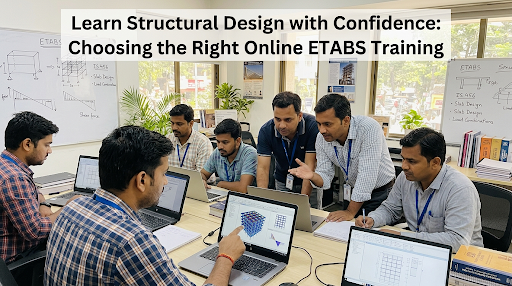
Civil engineering students study structural behaviour, loads, materials, and design principles. Yet the transition from classroom learning to professional structural work can be challenging. Real projects require knowing equations or recognising software commands. Engineers must understand why a model is created, how loads are applied, what analysis results mean, and how to check whether the design makes engineering sense.
That is why choosing a best etabs online course should involve more than comparing video lessons or course fees. A useful learning programme connects structural fundamentals with software practice, project workflows, manual checks, and the judgement needed to interpret results responsibly. The goal is not simply to operate a program; it is to understand the structure being analysed.
Begin with the engineering fundamentals
Before opening any structural analysis package, learners should be comfortable with the basic behaviour of buildings. Topics such as load paths, support conditions, stiffness, stability, material properties, and structural systems provide the foundation for meaningful modelling.
A building model represents assumptions about how the real structure behaves. If those assumptions are misunderstood, even a neatly completed model can produce results that are misleading. Learners should therefore understand the purpose of beams, columns, slabs, shear walls, diaphragms, and foundations before relying on software outputs.
Learn ETABS through a complete workflow
ETABS is widely used for the analysis and design of building structures. Its modelling environment helps engineers represent building geometry, assign properties, define loads, run analysis, and review design information. However, learning each feature separately is not the same as understanding a complete structural design process.
A structured course should begin with setting up grids and storeys, defining materials and section properties, and creating a model that reflects the intended structural arrangement. Learners can then move to assigning supports, restraints, diaphragms, and load patterns. Once the model is prepared, they can examine analysis settings, run the model, and review warnings or errors.
The next stage is interpretation. Displacements, storey drifts, reactions, member forces, and other outputs need to be understood in context. Unusual values should prompt investigation rather than automatic acceptance. Engineers should check whether the model reflects the intended load path and whether its behaviour is reasonable.
Why practical projects matter
A small exercise can teach an individual command, but a realistic building project shows how decisions connect. Working through a project helps learners understand the sequence from scheme development and preliminary member sizing to loading, modelling, analysis, design review, and detailing.
Manual calculations should remain part of this process. They provide independent checks and help identify errors in assumptions, inputs, or interpretation. For example, approximate checks of loads, reactions, or member behaviour can help an engineer decide whether a result deserves closer attention. Software does not replace engineering responsibility.
Online learning, Coursera, and course selection
Online education gives students and working professionals flexibility, especially when travel or fixed classroom hours are difficult. Some learners search for coursera etabs because they are familiar with large online learning platforms. When comparing any platform or provider, check the actual syllabus, instructor background, project depth, assessment approach, access period, and support arrangements. Do not assume that every course with a similar title offers the same practical coverage.
A self-paced course can suit someone who wants to revisit lessons around work or college commitments. Instructor-led sessions may be more helpful when learners need regular discussion and feedback. Some programmes combine recorded material with live clarification. The best format depends on the learner’s schedule, preferred pace, and need for guidance.
Build a sensible learning sequence
Beginners should avoid jumping directly into advanced analysis options without understanding basic modelling. Start with structural systems and load paths, then practise geometry, properties, supports, and load assignments. Next, learn analysis controls and result interpretation. Move on to design settings, member checks, detailing considerations, and project documentation.
After becoming comfortable with one building model, practise variations. Change the structural arrangement, compare modelling choices, and observe how the results respond. Such exercises develop understanding more effectively than memorising a fixed sequence of clicks.
Learners interested in more than one analysis package can later explore a staad pro basic tutorial to understand a modelling environment. ETABS and STAAD Pro have overlapping structural engineering purposes, but their workflows and strengths are not identical. Choose the tool according to the type of structure and the requirements of the project rather than assuming one package suits every situation.
What to check before enrolling
Review the course outline and make sure it matches your current level. Check whether the programme covers RCC building design, wind and seismic analysis where relevant, structural detailing, and the applicable design codes. Ask how long course access lasts, what support is included, and whether there are additional charges for mentoring or project reviews.
Make learning relevant to your career
The value of software training comes from how well it connects theory with practical engineering decisions. Choose a programme that explains the reasoning behind the model, gives you opportunities to practise, and encourages you to question results rather than accept them without review.
Civilera describes its ETABS learning as a consulting-oriented programme covering building design workflows, fundamentals, manual checks, project practice, and online learning options. Prospective learners should review the current syllabus and confirm course format, access, fees, and support directly before enrolling.
Ultimately, selecting the best etabs online course means finding training that helps you think like an engineer while becoming confident with the software. Compare coursera etabs options carefully, and consider whether a staad pro basic tutorial would complement your learning goals. A strong foundation, consistent practice, and sound engineering judgement will matter long after the lessons are complete.