Mobile applications have become an important part of how businesses attract customers, manage operations, and deliver digital services. From online shopping and healthcare bookings to education platforms and business management tools, companies increasingly rely on mobile apps to improve accessibility and customer engagement. However, building a successful application requires more than writing code. Businesses must consider performance, user experience, security, scalability, and long-term maintenance.
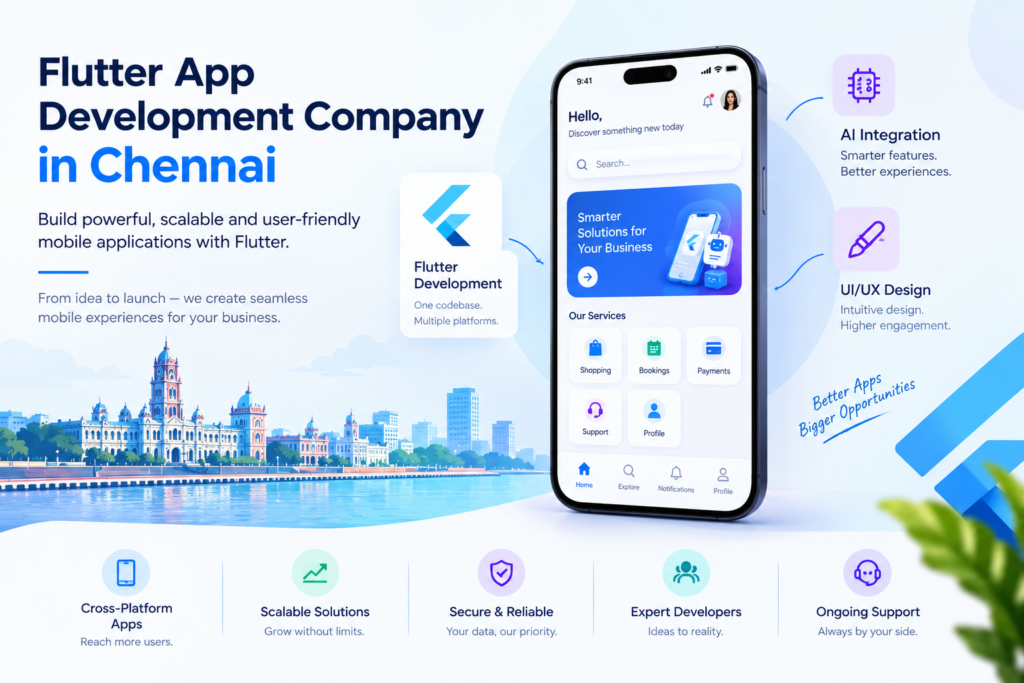
Choosing the right Flutter App Development Company in Chennai can help businesses address these requirements while developing applications for multiple platforms. Flutter enables developers to build Android and iOS applications using a shared codebase, helping streamline development and maintenance.
For businesses planning to launch a new mobile application or modernize an existing one, understanding Flutter’s capabilities and the role of design and artificial intelligence can support better technology decisions.
Why Businesses Are Choosing Flutter for Mobile App Development
Developing separate applications for Android and iOS can require different development resources, workflows, and maintenance efforts. Flutter offers an alternative by allowing developers to create applications for both platforms using a common codebase.
This approach can provide several benefits for businesses.
1. Faster development cycles
Flutter supports code reuse across platforms, reducing the need to develop every feature independently. This can help development teams build prototypes, test functionality, and release applications more efficiently.
2. Consistent user experience
Businesses can maintain a consistent visual identity and similar interactions across Android and iOS. This is particularly useful for e-commerce platforms, service applications, and customer-facing business tools.
3. Cost-effective maintenance
A shared codebase can simplify bug fixes, feature updates, and certain maintenance activities. Although platform-specific adjustments may still be necessary, a common codebase can reduce duplicated development work.
4. Flexible user interfaces
Flutter provides tools for creating customized interfaces, animations, and interactive components. Businesses can use these capabilities to develop applications that reflect their branding and functional requirements.
5. Support for business growth
Flutter applications can be developed with future expansion in mind. New features, integrations, and improvements can be introduced as customer expectations and business requirements evolve.
The overall results depend on the application’s complexity, architecture, integrations, and the development team’s experience.
What to Look for in a Flutter App Development Company in Chennai
Selecting a development partner is an important step because technical decisions made during the initial stages can affect the application’s performance and maintenance costs later.
Businesses should evaluate potential development partners based on their ability to understand business objectives, plan technical architecture, and deliver a reliable product.
Understanding business requirements
A development project should begin with a clear understanding of its purpose. A healthcare application may require appointment scheduling, notifications, and secure handling of information, while an e-commerce application may need product catalogues, payment integration, inventory synchronization, and order tracking.
The development team should identify the target audience, essential features, user roles, integrations, and expected outcomes before finalizing the scope.
Technical expertise and architecture
A reliable application needs more than an attractive interface. Developers must consider API integration, database design, authentication, error handling, performance, and data security.
The application architecture should also accommodate expected growth. Planning for additional users, new features, and third-party services can reduce the need for major restructuring later.
Testing and ongoing support
Applications should be tested across relevant devices, screen sizes, operating system versions, and network conditions. Functional testing, usability checks, performance testing, and security reviews help identify issues before release.
After launch, regular updates and monitoring are necessary to maintain compatibility, resolve bugs, and respond to user feedback.
The Role of UI/UX Design in Successful Flutter Applications
Even a technically advanced application can struggle if users find it confusing or difficult to navigate. This is why collaborating with a UI/UX Design Company in Chennai can be valuable during mobile app development.
UI, or user interface design, focuses on the visual elements users interact with, including buttons, typography, colours, icons, and layouts. UX, or user experience design, focuses on how easily users can complete tasks and achieve their goals.
A well-planned design process typically includes:
- User research: Understanding customer needs, common challenges, and expectations.
- User flows: Mapping the steps required to complete important tasks.
- Wireframes: Planning the structure and placement of interface elements before detailed design begins.
- Interactive prototypes: Demonstrating how the application will work before full development.
- Usability testing: Observing how users interact with the design and identifying areas for improvement.
- Design consistency: Maintaining familiar navigation, readable content, and consistent interactions across screens.
For example, a food delivery application should allow users to find restaurants, explore menus, place orders, and track deliveries without unnecessary steps. Similarly, a business application should make frequently used functions easy to access.
Integrating UI/UX design into the development process helps teams identify usability issues early, reducing the likelihood of expensive redesigns after launch.
How AI Can Enhance Flutter Mobile Applications
Artificial intelligence is creating opportunities to make mobile applications more responsive, personalized, and efficient. Working with an AI Development Company in Chennai can help businesses identify practical ways to incorporate AI into their mobile products.
The goal should be to solve a specific user or business problem rather than adding AI simply because it is trending.
Personalized recommendations
E-commerce, learning, and content applications can use recommendation systems to suggest relevant products, courses, or content based on user behaviour and preferences.
AI-powered chatbots
Chatbots can answer common questions, guide users through services, and provide support outside normal business hours. More complex requests may still need to be transferred to a human representative.
Intelligent search
AI-powered search can help users find relevant information even when their queries do not exactly match the wording used in an application’s database or catalogue.
Workflow automation
Business applications can incorporate AI to assist with document processing, information extraction, summaries, and repetitive administrative tasks. These capabilities can reduce manual effort when implemented with appropriate validation.
Predictive insights
Applications may use suitable data models to identify patterns, forecast demand, or provide decision-support insights. The usefulness of these features depends on data quality, the selected model, and the business context.
AI features may be implemented through cloud-based APIs, backend services, or on-device machine learning, depending on privacy, performance, connectivity, and cost requirements. Developers should also consider data protection, response accuracy, API expenses, and fallback options when AI services are unavailable.
Flutter App Development Services Businesses May Need
A comprehensive mobile application project can involve several services beyond coding. Depending on business objectives, a development partner may provide:
Custom mobile app development: Applications designed around specific business processes, customer requirements, and operational workflows.
Android and iOS development: Cross-platform applications built with Flutter, with platform-specific functionality added where required.
UI/UX design and prototyping: User research, wireframes, interface design, interactive prototypes, and usability improvements.
Backend and API development: Server-side functionality, database integration, authentication, and communication with external systems.
Third-party integrations: Payment gateways, maps, analytics tools, CRM platforms, notification services, and other relevant solutions.
AI integration: Chatbots, recommendation engines, intelligent search, and other AI-powered capabilities where they provide measurable value.
Testing and deployment: Quality assurance, performance checks, release preparation, and publishing support for the relevant app stores.
Maintenance and upgrades: Bug fixes, security updates, compatibility improvements, and new features based on changing requirements.
The required services will depend on the application’s scope. Defining priorities early helps businesses focus on essential features before expanding the product.
Building Secure, High-Performance, and Scalable Apps
Performance and security should be considered from the beginning rather than treated as final-stage improvements.
Applications should use appropriate authentication methods, secure communication, careful permission management, and suitable data-storage practices. Sensitive information should be collected only when necessary and handled according to applicable privacy requirements.
Performance optimization also requires attention to image sizes, API response times, network requests, application startup time, and unnecessary processing. Efficient data loading and caching can improve the experience, especially for users with slower internet connections.
Scalability depends on the complete system, including the mobile application, backend services, databases, and third-party integrations. Monitoring application behaviour after release helps teams identify bottlenecks and prioritize improvements.
Businesses should also plan for accessibility, readable text, clear error messages, and interfaces that work across different screen sizes. These considerations make applications easier to use for a wider range of people.
Conclusion
Flutter provides businesses with a practical way to develop cross-platform mobile applications while maintaining a shared codebase for many common requirements. However, successful mobile app development depends on more than choosing a framework. Clear requirements, thoughtful UI/UX design, reliable backend architecture, thorough testing, and ongoing maintenance all contribute to a useful product.
A capable Flutter App Development Company in Chennai can help businesses turn their ideas into functional mobile applications while planning for future improvements. When appropriate, collaboration with an AI development specialist and a UI/UX design team can further strengthen the application’s functionality and usability.
Before starting a project, businesses should define their objectives, identify essential features, assess integration requirements, and establish a realistic development roadmap. These steps help create mobile applications that address genuine user needs and support long-term business goals.
Frequently Asked Questions
1. What are the benefits of Flutter app development for businesses?
Flutter allows developers to build applications for Android and iOS using a shared codebase. This can improve development efficiency, maintain consistency, and simplify many maintenance tasks.
2. How do I choose a Flutter App Development Company in Chennai?
Evaluate the company’s technical expertise, project approach, portfolio, testing practices, communication, maintenance support, and ability to understand your business requirements.
3. Can AI features be integrated into Flutter applications?
Yes. Flutter applications can connect to AI services for chatbots, recommendations, intelligent search, document processing, and other features through APIs or suitable machine learning solutions.
4. Why is UI/UX design important for mobile applications?
UI/UX design helps make applications intuitive, accessible, and easier to navigate. Effective design can reduce user frustration and help customers complete tasks more efficiently.
5. How long does it take to develop a Flutter mobile application?
The timeline depends on the number of features, design complexity, backend requirements, integrations, and testing needs. A simple application may take a few weeks to a few months, while a complex platform may require several months or longer.
