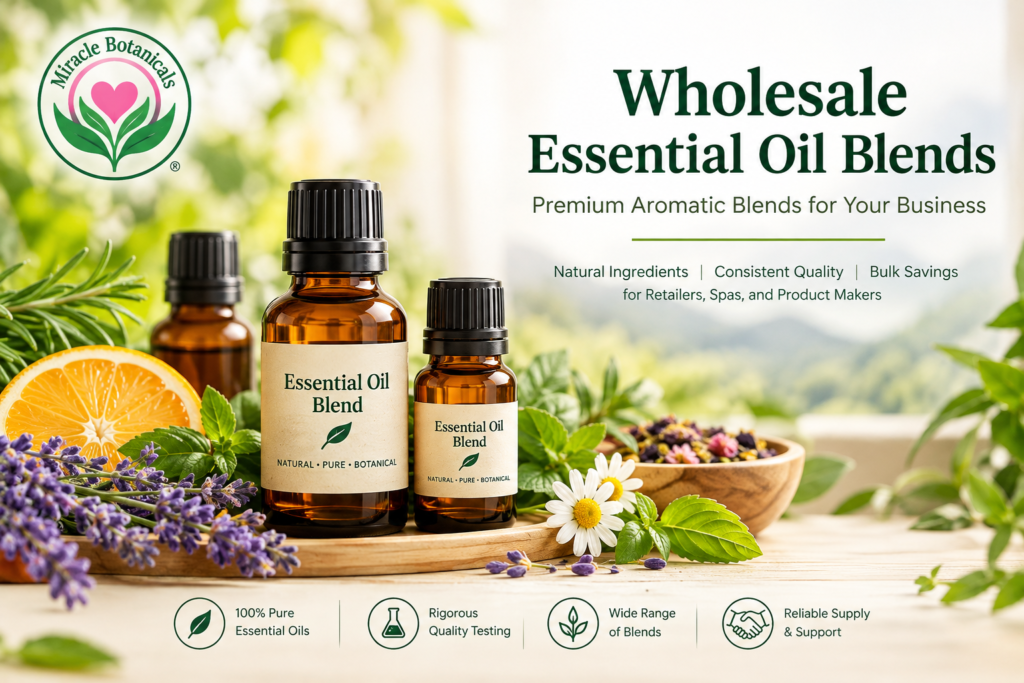
Businesses working in aromatherapy, personal care, cosmetics, and home fragrance need reliable ingredients that deliver consistent quality and appealing aromas. Choosing wholesale essential oil blends can help retailers, spa owners, product formulators, and independent brands expand their product ranges while managing purchasing costs. Understanding ingredient transparency, scent compatibility, supplier reliability, and safe handling is essential when selecting aromatic blends for commercial or personal use.
What Are Essential Oil Blends?
Essential oil blends combine two or more essential oils to create a distinctive fragrance profile. Each ingredient contributes its own aromatic characteristics, allowing formulators to develop balanced combinations for different applications.
For example, lavender and bergamot can create a fresh, floral-citrus aroma, while cedarwood and frankincense provide a warmer, woody, resinous profile. Peppermint and eucalyptus offer a crisp, cooling fragrance suitable for certain home-fragrance products.
Businesses can choose ready-made blends or develop custom combinations according to their target audience. The right option depends on the intended application, customer preferences, ingredient specifications, and production requirements.
Why Businesses Buy Essential Oil Blends in Bulk
Purchasing bulk essential oil blends can offer several advantages for businesses that use aromatic ingredients regularly.
1. More Efficient Purchasing
Buying larger quantities may reduce the cost per unit compared with repeatedly purchasing small bottles. However, savings depend on order volume, packaging, shipping, storage, and supplier pricing.
Businesses should compare the total landed cost rather than considering the product price alone.
2. Consistent Product Availability
Retailers and manufacturers often need dependable access to popular fragrance profiles. Working with a reliable supplier can help businesses plan inventory, maintain product availability, and reduce interruptions in production.
Before placing recurring orders, confirm expected lead times, minimum order quantities, and the supplier’s ability to maintain consistent specifications.
3. Greater Product Variety
A carefully selected range of aromatic blends allows businesses to serve different customer preferences. Citrus, floral, herbal, woody, spicy, and earthy profiles can support a more varied product catalogue.
Offering several scent families also helps retailers create seasonal collections, gift sets, and complementary product bundles.
4. Opportunities for Product Development
Blends can serve as ingredients in suitable products such as diffuser oils, soaps, massage preparations, and other fragrance applications. The formulation must be appropriate for its intended use, and each finished product should meet relevant safety and regulatory requirements.
How to Choose High-Quality Wholesale Essential Oil Blends
Selecting a supplier requires more than comparing prices. Product documentation, ingredient quality, and suitability for the intended application should guide the purchasing decision.
Check Ingredient Transparency
Ask whether a blend contains only essential oils or includes fragrance oils, carrier oils, solvents, or other ingredients. These materials are not interchangeable, and the distinction matters when developing products or describing ingredients to customers.
Review the botanical names, ingredient list, extraction methods, and country of origin where available. For proprietary blends, clarify what composition information and safety documentation the supplier can provide.
Request Quality Documentation
Professional buyers should request relevant documentation before committing to a large order. Depending on the product, useful records may include:
- Certificate of Analysis (CoA)
- Safety Data Sheet (SDS)
- Batch-specific GC/MS report, where applicable
- Allergen information for the intended application
- Organic certification documentation, if an organic claim is made
- Product specifications and recommended storage conditions
These documents help buyers assess composition, handling requirements, and consistency. A certificate or laboratory report should correspond to the product and batch being purchased whenever applicable.
Evaluate Aroma and Consistency
A sample evaluation helps determine whether a blend meets the business’s requirements. Assess the fragrance profile, balance, intensity, and suitability for the intended formulation.
Compare samples under consistent conditions and record the results. For repeat purchases, ask how the supplier manages batch variation caused by differences in harvests, botanical origins, or production methods.
Confirm Minimum Order Quantities
Minimum order quantities can differ significantly between suppliers and product formats. A small business may prefer smaller bulk containers, while a manufacturer may require larger quantities for production.
Ask about sample availability, volume discounts, packaging options, lead times, and reorder requirements. Ordering a manageable quantity for initial testing can reduce the risk of holding excess inventory.
Popular Fragrance Profiles for Commercial Applications
Different scent families offer different aromatic characteristics. The best choice depends on the product concept and customer expectations.
| Fragrance profile | Example ingredients | Common aromatic character |
|---|---|---|
| Citrus | Bergamot, sweet orange, lemon | Fresh, bright, uplifting |
| Floral | Lavender, geranium, ylang-ylang | Soft, floral, rounded |
| Herbal | Rosemary, peppermint, basil | Green, crisp, aromatic |
| Woody | Cedarwood, sandalwood | Warm, dry, grounding |
| Resinous | Frankincense, myrrh | Deep, rich, balsamic |
| Spicy | Clove, cinnamon leaf, ginger | Warm, bold, distinctive |
These categories are useful starting points for product development. Actual scent characteristics vary according to the ingredients, their proportions, and the quality of the raw materials.
Bergamot Essential Oil: An Ingredient Worth Exploring
Bergamot is a popular citrus oil known for its fresh, slightly floral aroma. It can complement lavender, cedarwood, frankincense, and other aromatic ingredients in thoughtfully formulated fragrance blends.
Businesses interested in citrus-forward formulations can learn more about its aroma, applications, and safety considerations in this related resource: Bergamot Essential Oil: Frequently Asked Questions About Uses, Aroma, and Safety.
This article explores bergamot’s fragrance characteristics, common uses, blending possibilities, and important precautions. It is a useful companion resource for buyers who want to understand individual essential oils before incorporating them into a broader product range.
One important consideration is phototoxicity. Conventional cold-pressed bergamot oil may cause a skin reaction when exposed to ultraviolet light. For suitable topical formulations, buyers should investigate whether a furanocoumarin-free (FCF) version is appropriate and follow product-specific safety guidance.
Storage and Safe Handling of Essential Oil Blends
Essential oils are concentrated aromatic materials that require careful storage and handling. Proper practices help preserve product quality and reduce avoidable risks.
- Store products in tightly closed, compatible containers.
- Keep containers away from direct sunlight, excessive heat, and moisture.
- Follow the supplier’s recommended storage conditions and shelf life.
- Label containers clearly with product names, batch information, and relevant handling instructions.
- Keep concentrated oils away from children and pets.
- Never apply undiluted essential oils directly to the skin.
- Follow application-specific safety guidance and relevant regulations.
Businesses making finished products should evaluate the complete formulation rather than assuming that individually suitable ingredients automatically produce a safe final product.
Finding a Reliable Supplier for Your Business
When evaluating wholesale essential oil blends, prioritize suppliers that communicate clearly, provide relevant documentation, and offer products appropriate for your intended applications.
Review the supplier’s business history, customer support, shipping policies, sample options, and return procedures. Request written quotations that specify the product, quantity, packaging, delivery terms, and any additional charges.
Avoid selecting a supplier solely because it offers the lowest price. Inconsistent quality, unclear ingredients, or missing documentation can create additional costs and complicate product development.
Miracle Botanicals Essential Oils offers a range of botanical products for customers exploring essential oils and aromatic ingredients. Buyers can review available products and their individual descriptions to determine which options best fit their purchasing requirements.
Conclusion
Choosing the right bulk aromatic ingredients requires a balance of quality, price, consistency, and intended use. By evaluating documentation, testing samples, confirming order requirements, and selecting appropriate storage practices, businesses can make more informed purchasing decisions.
Whether you are developing a new fragrance collection, expanding a retail catalogue, or sourcing ingredients for an established product line, a careful supplier evaluation can help build a dependable sourcing strategy. Focus on transparent product information and suitable formulations to support long-term business needs.
Frequently Asked Questions
1. What are wholesale essential oil blends used for?
They are used in suitable applications such as aromatherapy products, home fragrance, soaps, and certain personal care formulations. The intended use determines the required specifications and safety precautions.
2. How do I choose a reliable bulk essential oil supplier?
Check ingredient transparency, product documentation, sample quality, minimum order quantities, shipping policies, and customer support. Request batch-specific documentation where applicable before placing a large order.
3. Are natural essential oil blends the same as fragrance oil blends?
No. Natural essential oil blends contain essential oils derived from botanical materials, while fragrance blends may contain synthetic aromatic ingredients or combinations of natural and synthetic materials. Always check the ingredient declaration.
4. Can essential oil blends be used directly on the skin?
Not necessarily. Essential oils are concentrated and may irritate the skin or cause allergic reactions. Topical products require appropriate dilution, formulation-specific safety assessment, and compliance with relevant guidelines.
5. What should I check before ordering essential oil blends in bulk?
Confirm the ingredients, intended application, quality documentation, sample performance, order quantity, packaging, lead time, total cost, and storage requirements. If purchasing certified organic products, verify the relevant certification and its scope.