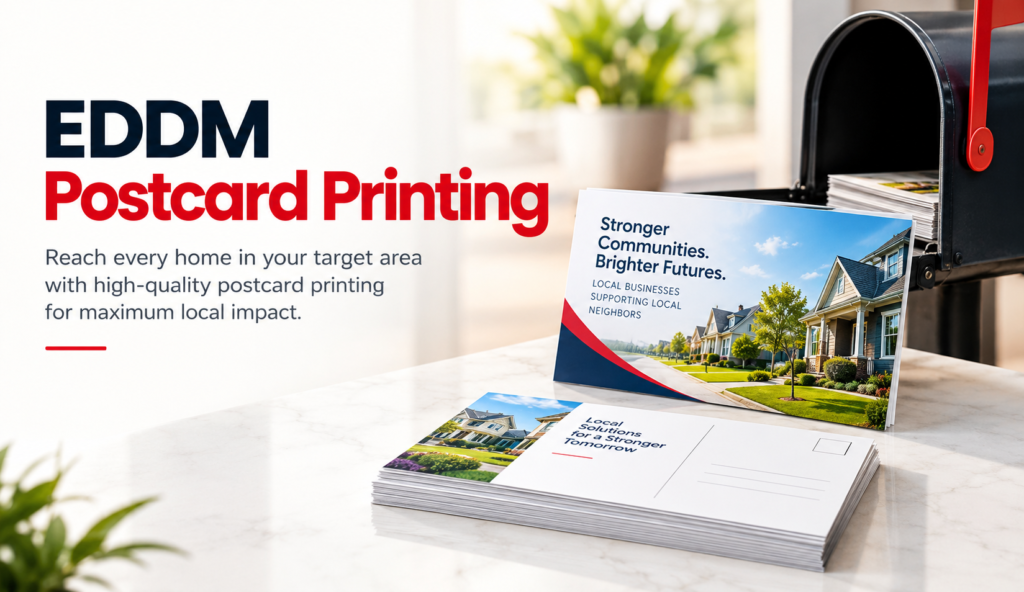
Running a local business means constantly looking for practical ways to reach nearby customers without stretching the marketing budget. Social media ads, online listings, and search campaigns all have their place, but they can become expensive when several businesses compete for the same local attention. Many business owners also struggle to reach households that rarely interact with their digital advertising.
That’s where EDDM Postcard Printing offers a practical alternative. Instead of collecting individual mailing addresses, businesses can distribute printed postcards throughout selected neighborhoods using the United States Postal Service’s Every Door Direct Mail program. This approach helps local companies introduce their services, announce promotions, and maintain a physical presence in their communities.
We understand that small business owners need marketing methods they can manage and measure. Printing thousands of postcards without a clear plan rarely makes financial sense. A successful neighborhood mailing starts with choosing the right postal routes, preparing a useful offer, and understanding how printing and postage affect the total cost.
What Is EDDM Postcard Printing?
EDDM stands for Every Door Direct Mail, a mailing service that USPS offers to businesses and individuals who want to reach addresses across selected postal carrier routes. EDDM postcard printing involves creating physical promotional mailpieces that meet postal requirements and preparing them for delivery throughout those routes.
Unlike traditional direct mail, EDDM generally doesn’t require businesses to purchase individual mailing lists or print each recipient’s name and address. Instead, businesses choose eligible postal routes through the USPS EDDM mapping tool and prepare the appropriate number of mailpieces for those routes.
This method works particularly well for neighborhood-based advertising. Restaurants, home service companies, retail stores, and other local businesses can use EDDM to reach nearby addresses without managing thousands of individual customer records.
How Every Door Direct Mail Works
The process begins with selecting a geographic service area. Business owners can search for nearby postal routes using the USPS EDDM mapping tool, which displays route boundaries, delivery counts, and available household information.
Once the business selects its routes, the next step involves preparing a postcard that meets USPS mailing specifications. The printer produces the required quantity, while the business or mailing provider handles route sorting, paperwork, postage, and postal submission.
USPS then delivers the mailpieces across the eligible delivery points within the selected routes. Businesses can choose residential delivery or eligible residential and business delivery options, depending on the routes and mailing method.
EDDM vs. Traditional Direct Mail
Traditional direct mail uses a mailing list containing specific delivery addresses. Businesses may build that list from existing customer records or obtain addresses from a mailing data provider. This approach supports campaigns that need individual recipient selection or personalized information.
EDDM works differently because the postal carrier route determines delivery coverage. The business doesn’t need to identify every individual recipient, but it generally cannot exclude individual addresses within a selected route.
We recommend choosing between these methods based on the business’s geographic coverage and marketing objective. EDDM can simplify broad neighborhood distribution, while traditional direct mail may make more sense when a company needs to contact a defined list of existing customers.
How EDDM Postcard Printing Helps Local Businesses Grow
Local businesses often depend on customers who live or work within a manageable distance. A restaurant might serve nearby residents, while a landscaping company may prefer jobs within a particular service area. EDDM helps businesses plan printed advertising around those geographic realities.
The biggest advantage comes from connecting the mailing area with the company’s actual ability to serve customers. A business doesn’t necessarily need to advertise across an entire city when a few nearby carrier routes provide sufficient coverage.
Reach Nearby Households Without Purchasing Mailing Lists
Building a useful mailing database takes time and can involve additional costs. Businesses must source records, check address accuracy, and prepare mailing files before printing. For a small company launching its first direct mail campaign, these steps can make the process feel unnecessarily complicated.
EDDM removes the need for an individual address list for qualifying route-based mailings. Businesses can select neighborhoods, review postal delivery counts, and calculate how many postcards they need.
This convenience doesn’t eliminate the need for planning. We still recommend checking route boundaries carefully because postal routes don’t always match neighborhood names, school districts, or the service areas that business owners have in mind.
Build Local Brand Recognition Through Repeated Exposure
Customers don’t always need a service when they first encounter an advertisement. A homeowner might receive a roofing postcard months before noticing a repair issue, while a resident might discover a nearby restaurant through a menu promotion.
Printed postcards give businesses an opportunity to introduce their names, services, and contact information in a format that people can keep for future reference. Clear branding and consistent messaging help recipients recognize the company when a relevant need arises.
However, repeated mailings shouldn’t rely on identical offers indefinitely. We recommend reviewing customer responses and adjusting the timing, message, or promotional details when the results suggest a change.
Promote Offers With Clear Geographic Coverage
Businesses frequently run promotions that apply only to particular service locations. A cleaning company may introduce service in a neighboring community, while a retail store might announce a weekend event or seasonal sale.
EDDM allows the company to distribute that information throughout the eligible postal routes it selects. This makes geographic planning more straightforward than purchasing a large list without knowing whether all the addresses fall within the intended service area.
For effective neighborhood promotions, the postcard should explain the offer, identify any restrictions, and provide a simple next step. Customers should understand what the business provides without having to search for essential details.
Which Local Businesses Benefit Most From EDDM Marketing?
EDDM works best when the business offers a product or service that many households within the same geographic area could reasonably use. It may provide less value when a company serves only a narrowly defined customer group.
We encourage business owners to evaluate the relationship between their services, nearby neighborhoods, and realistic customer travel distances before selecting routes.
Restaurants, Cafés, and Food Businesses
Restaurants can use EDDM postcards to introduce new menu items, advertise opening events, announce catering services, or share limited-time promotions. The physical format gives owners room to display appetizing food photography alongside operating hours and ordering information.
A common mistake involves placing too many menu items and offers on one postcard. When everything competes for attention, recipients may struggle to identify the main message.
We recommend highlighting one primary promotion and making the redemption process straightforward. A clearly printed offer code can also help the restaurant understand which customers responded to the mailing.
HVAC, Roofing, Plumbing, and Home Services
Home service businesses often work within specific coverage areas, making neighborhood mailings a practical advertising option. HVAC companies can announce seasonal maintenance availability, while landscaping businesses may introduce recurring property care services.
The strongest postcard designs explain the service and provide reliable contact information. Homeowners should quickly understand the type of work the business performs and how to request an estimate.
We suggest avoiding unrealistic savings claims or messages that create unnecessary urgency. Straightforward service descriptions, relevant photographs, and accurate business details usually provide a more credible presentation.
Dental Offices, Salons, and Fitness Centers
Service-based businesses can use neighborhood mailings to announce new locations, introduce available appointments, or promote introductory offers. A fitness studio might advertise a trial class, while a salon may introduce a new service.
For these businesses, accessibility matters. A postcard should communicate the location, appointment process, and any important conditions without overwhelming the recipient.
We recommend connecting each promotion to a service that the business can consistently deliver. An attractive introductory offer may generate interest, but a confusing booking process can discourage customers before their first visit.
Real Estate and Neighborhood Retailers
Real estate professionals can use EDDM to introduce their services within eligible neighborhoods or distribute general market information. Local retailers can announce store openings, community events, and seasonal shopping opportunities.
These mailings work best when the content relates naturally to the surrounding area. A neighborhood hardware store, for example, may benefit from highlighting services and products that nearby homeowners regularly need.
We encourage businesses to review geographic coverage rather than rely solely on ZIP codes. Individual carrier routes often provide a more practical way to organize local distribution.
How Much Does EDDM Postcard Printing Cost?
Cost is one of the first questions business owners ask when considering direct mail advertising. The final amount depends on postcard dimensions, paper stock, printing quantity, finishing options, postage, and mailing preparation.
EDDM can eliminate the expense of purchasing an individually addressed mailing list, but it doesn’t eliminate printing or postal costs. Businesses should evaluate the entire campaign rather than compare printing prices alone.
Understanding Printing and Postage Expenses
Printing costs depend on the quantity and technical specifications of the postcard. Paper thickness, full-color printing, coatings, trimming, and production schedules can all influence the final price.
Postage represents another important expense. As of the July 12, 2026 USPS rate schedule, qualifying EDDM Retail flats weighing up to 3.3 ounces carry a postage rate of $0.26 per piece. Businesses should verify current rates before confirming a mailing budget.
For example, mailing 2,000 qualifying EDDM Retail postcards at that postage rate would cost $520 in postage alone. Printing, preparation, and any additional service fees would increase the overall campaign expense.
Why the Lowest Printing Price May Not Be the Best Value
Some print quotations cover only the finished postcards. Others include additional services such as artwork assistance, postal preparation, bundling, paperwork, and delivery to an eligible USPS acceptance location.
A lower printing quote may therefore lead to higher overall expenses if the business must arrange the remaining services separately. Before approving a project, owners should understand exactly what the provider includes.
We recommend reviewing a detailed direct mail cost breakdown and requesting estimates with the same specifications from each provider. This makes pricing comparisons more meaningful and reduces the risk of unexpected charges.
Calculating a Realistic Marketing Budget
A useful campaign budget starts with the selected carrier routes and their delivery counts. Once the business knows the approximate mailing quantity, it can request printing and postal preparation estimates.
The budget should include design, printing, postage, preparation, and any professional assistance the business needs. Business owners should also consider whether they have enough staff and appointment availability to handle additional inquiries.
We recommend setting a campaign spending limit before designing the postcard. This prevents the business from committing to expensive specifications without understanding the full cost of neighborhood distribution.
Choosing the Right EDDM Postcard Size and Design
Postcard design affects more than appearance. Dimensions, thickness, weight, and layout determine whether a mailpiece meets the applicable postal requirements.
Business owners sometimes choose a familiar postcard size before checking EDDM eligibility. That decision can create production delays or require changes to the finished artwork.
Understanding USPS EDDM Size Requirements
USPS requires qualifying EDDM mailpieces to meet its flat-size eligibility rules. An ordinary small postcard, such as a 4-by-6-inch card, generally doesn’t qualify for EDDM Retail because it doesn’t meet the required dimensions.
Common qualifying formats include larger postcards, such as 6.25-by-9-inch mailers, subject to the applicable postal specifications. A mailpiece must meet the relevant dimensions and other requirements for the mailing category.
We recommend checking the current USPS mailpiece size rules before selecting a finished format. Businesses should also confirm the required postal indicia and address-area layout with their printing provider.
Creating a Postcard That Customers Can Understand Quickly
A good EDDM postcard should communicate its main purpose without requiring lengthy reading. The headline, photograph, offer, and contact information need a clear visual hierarchy.
We often advise keeping one primary message on the front and using the remaining space for supporting details. A restaurant might feature a popular meal, while a roofing company could show a relevant project photograph.
The design should avoid excessive text, tiny fonts, or too many competing graphics. A simple layout with readable typography helps customers find the information they need.
Including a Practical Call to Action
A postcard should tell recipients what to do after reading it. That action might involve visiting a website, calling for an estimate, booking an appointment, or bringing the postcard to a store.
The next step should match the business’s actual customer process. A salon with an online reservation system may prefer a booking link, while a local contractor may find a clearly printed phone number more useful.
We recommend choosing one main call to action and making it easy to locate. Multiple competing instructions can distract from the postcard’s purpose.
How to Plan a Successful EDDM Postcard Campaign
A productive mailing begins before the printer receives the artwork. Business owners need to define the service area, determine the quantity, prepare an appropriate message, and allow enough time for production and delivery.
We believe the most useful planning decisions involve practical questions: Where can the business serve customers? What should the postcard communicate? How will the company handle inquiries after delivery?
Select Carrier Routes That Match Your Service Area
The USPS EDDM mapping tool allows businesses to review available routes and estimated delivery counts. Rather than selecting an entire ZIP code automatically, owners can examine routes individually.
A home cleaning company, for example, might prefer routes close to its existing service area to simplify travel and scheduling. A restaurant may prioritize neighborhoods within a convenient distance of its location.
Businesses should verify the actual route boundaries before approving quantities. A route can extend beyond the streets or neighborhood names that the business originally intended to cover.
Prepare a Relevant Offer Before Designing the Postcard
Business owners sometimes begin with photographs, colors, and headline ideas before deciding what they want the mailing to accomplish. This approach can produce attractive artwork that lacks a clear purpose.
We recommend identifying the main message first. The business may want to introduce a new location, announce seasonal availability, or explain a service that nearby residents might not know about.
Once the objective becomes clear, designers can build the postcard around it. The final layout should support the message rather than compete with it.
Coordinate Printing and Mailing Deadlines
Every EDDM campaign requires time for artwork approval, printing, finishing, sorting, and postal acceptance. Delivery timing also depends on USPS processing and local conditions.
A postcard advertising an event must arrive with enough time for recipients to respond. Printing close to the event date creates unnecessary risk, particularly when artwork revisions or postal delays occur.
We recommend planning backward from the desired delivery period. Confirm production deadlines with the printer and avoid promising customers a specific arrival date unless the mailing arrangements support that commitment.
Common EDDM Printing Mistakes Local Businesses Should Avoid
Many direct mail problems develop during planning rather than printing. Poor route selection, unclear offers, unsuitable postcard dimensions, and incomplete cost estimates can reduce the usefulness of a campaign.
Understanding these mistakes helps businesses manage expectations and make more informed decisions before spending money.
Mailing Too Broadly Without Reviewing Route Coverage
Selecting more addresses may appear to create a stronger campaign, but unnecessary geographic coverage increases printing and postage expenses. A local service provider may not benefit from reaching addresses outside its normal operating area.
We recommend starting with routes that match the business’s realistic service boundaries. The objective is to maintain useful geographic coverage rather than maximize the number of postcards without considering delivery relevance.
After reviewing the results, the company can decide whether additional neighborhoods deserve attention.
Adding Too Much Information to the Design
Business owners understandably want to communicate everything their company offers. However, a postcard that contains numerous services, photographs, prices, and contact methods can become difficult to read.
A better approach places the main offer or message first and uses supporting information selectively. Customers should recognize the business and understand the next step without searching through dense paragraphs.
We recommend reviewing a printed proof at actual size. Text that looks readable on a large computer monitor may appear much smaller on the finished mailpiece.
Ignoring USPS Mailing Specifications
A beautifully designed postcard can still create problems if it doesn’t meet postal requirements. Incorrect dimensions, improper indicia, or incomplete preparation can delay acceptance.
EDDM Retail generally requires a minimum mailing of 200 pieces or 50 pounds, subject to USPS exceptions, and permits up to 5,000 pieces per day per ZIP code. Larger projects may need the Business Mail Entry Unit mailing process.
We encourage businesses to confirm the current requirements with USPS or an experienced mailing provider before printing. Early technical review can prevent expensive corrections after production.
How to Measure the Results of an EDDM Postcard Campaign
Direct mail campaigns become more useful when businesses have a clear way to evaluate responses. Counting distributed postcards alone doesn’t explain whether the mailing generated inquiries, appointments, or purchases.
We recommend choosing a simple measurement method before the campaign begins. Even a small business without advanced marketing software can track useful information.
Use Unique Offer Codes or Landing Pages
A campaign-specific coupon code can help a retailer or restaurant identify purchases that came from a particular postcard. Service businesses may prefer a dedicated landing page or an easy-to-remember promotional reference.
These methods provide useful response data, although they don’t capture every customer who notices a mailpiece and responds later through another channel.
We recommend keeping tracking methods simple enough for employees to use consistently. A complicated redemption process can frustrate customers and create incomplete records.
Monitor Calls, Appointments, and Purchases
A business should evaluate the actions that matter to its operations. A contractor may track estimate requests, while a dental office may focus on new appointment bookings.
Total inquiries matter, but they don’t always represent paying customers. Reviewing completed purchases or booked services provides a clearer understanding of the campaign’s practical value.
We encourage businesses to record both the cost of the mailing and the results they can reasonably attribute to it.
Use Campaign Results to Improve Future Mailings
A single postcard campaign may not provide enough information to make broad conclusions about marketing performance. Seasonal demand, local competition, and the quality of the offer can influence responses.
Businesses can learn more by comparing campaigns that use similar formats and consistent tracking methods. Changes to the message or service area should follow a clear business reason.
We recommend documenting what worked, what created confusion, and which expenses exceeded expectations. These observations can make the next mailing easier to plan.
EDDM Postcard Printing FAQs
1. Do businesses need a mailing list for EDDM postcards?
No, qualifying EDDM mailings don’t require an individual customer mailing list. Businesses select eligible postal carrier routes through USPS and prepare the appropriate quantity of postcards for those routes. This makes EDDM useful for companies that want broad neighborhood coverage without purchasing or maintaining individual address records.
2. What is the minimum quantity for an EDDM mailing?
USPS EDDM Retail generally requires at least 200 mailpieces or 50 pounds of mail, with certain exceptions. The service allows up to 5,000 pieces per day per ZIP code. Businesses should confirm current quantity requirements, route coverage, and preparation rules before ordering their postcards.
3. Is EDDM cheaper than regular direct mail?
EDDM can reduce certain mailing expenses because qualifying campaigns don’t require an individually addressed mailing list and may use favorable postal rates. However, printing, finishing, preparation, and postage still contribute to the total cost. The more economical choice depends on the business’s required coverage, mailing quantity, and intended recipients.
4. How long does EDDM postcard printing and delivery take?
The overall schedule depends on artwork approval, printing quantity, finishing requirements, postal preparation, and USPS delivery operations. Printing turnaround and delivery time are separate stages, so businesses shouldn’t assume that a completed print order means recipients will receive postcards immediately. We recommend confirming the production schedule and allowing additional time for postal processing.
Conclusion: Is EDDM Postcard Printing Right for Your Local Business?
EDDM postcard printing provides local businesses with a practical way to distribute printed advertising across selected neighborhoods without maintaining individual mailing lists. It supports geographic marketing, simplifies certain mailing preparations, and gives companies a physical format for communicating services, events, and promotions.
However, effective EDDM marketing requires more than distributing a large quantity of postcards. Businesses need to choose suitable carrier routes, understand postal requirements, control printing and postage expenses, and create messages that customers can understand quickly. Careful planning helps prevent unnecessary spending and production problems.
At MailProsUSA, we recognize the importance of bringing printing, design, postal preparation, and mailing logistics together. Our focus is on helping businesses understand the practical details of direct mail before they commit to production.
If you’re considering an EDDM campaign, begin by reviewing your local service area, estimated mailing quantity, postcard specifications, and available budget. Speaking with a professional printing and mailing provider can help you develop a realistic plan that supports your business goals.