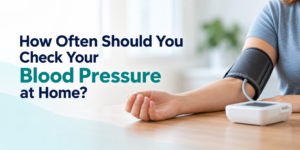
Taking your blood pressure at home will assist in recognizing how your blood pressure changes. A single reading shows your blood pressure at that particular time; taking readings several times will show a pattern that is more valuable.
But how often to check blood pressure at home depends on why you are monitoring it. A person who has just been diagnosed with hypertension will have a different frequency compared to a person whose readings are stable.
Understanding when to measure your blood pressure, how many readings to take, and how to keep records will be very helpful for home blood pressure monitoring.
Why Should You Monitor Blood Pressure at Home?
BP usually varies throughout the day. Exercise, stress, consumption of caffeine, smoking, eating, sleeping, and even talking during the reading can influence the result.
Also, some patients might experience an increase in BP due to anxiety or stress during a medical appointment. Thus, home BP measurement will give extra data regarding BP at home.(1)
Therefore, BP monitoring will allow seeing some tendencies instead of focusing on the single reading once in a while.
Home BP monitoring is especially recommended for people who suffer from high BP, start taking medications, change treatment, or are advised by their physician to monitor their BP at home.
How Often Should You Check Blood Pressure at Home?
Not everyone fits into the same routine.
In order to see if you suffer from hypertension constantly, a common procedure used for testing at home is measuring blood pressure twice in the morning and twice in the evening, with one minute between measurements, at least for three days, ideally for seven days. A PubMed scientific statement specifically recommends 2–3 readings while seated and rested, morning and evening, over 1 week, with at least 12 readings for clinical decisions.(2)
When you’ve been diagnosed with hypertension, or when you have started to take new medicine, your doctor might give you an individual schedule for measuring it.
Blood Pressure Monitoring Frequency Based on Your Situation
| Your situation | How often to check BP at home |
|---|---|
| Newly diagnosed with high blood pressure | Your healthcare professional may recommend structured morning and evening measurements for several days to understand your usual BP. |
| Starting or changing BP medication | More frequent monitoring may be recommended temporarily to see how your BP responds to treatment. Follow your healthcare professional’s instructions. |
| Confirming whether BP is consistently high | A common approach is 2 readings in the morning and 2 in the evening for at least 3 days, preferably 7 days. |
| Blood pressure is stable and controlled | You may not need to measure every day. Your healthcare professional can suggest an appropriate schedule. |
| Family history of hypertension or heart disease | Regular BP checks can be useful, but family history alone does not establish a specific number of home readings needed. |
| Overweight or obesity | Regular monitoring may be useful because excess weight is associated with a higher risk of hypertension, but frequency should depend on your actual readings and individual risk. |
| Diabetes or kidney disease | Home monitoring may be particularly useful because these conditions can occur alongside hypertension. Follow an individualized monitoring plan. |
| Usually normal BP with no known risk factors | Daily monitoring is generally unnecessary unless advised by a healthcare professional. Periodic checks can help identify changes over time. |
This table is a general guide, not a prescription for a specific number of readings. Your healthcare professional may recommend a different schedule depending on your health and treatment.
What Is the Best Time to Check Blood Pressure?
Consistency is better than having one universally “perfect” time.
When conducting home BP monitoring using a systematic approach, morning and evening measurements are usually recommended.
Should you measure your blood pressure in the morning, do it before you have your first meal and, when possible, before you have taken any medications for lowering your blood pressure unless otherwise instructed by your healthcare provider.
When doing evening measurements, you should find a constant moment when you feel calm and haven’t done any physical activities or ingested caffeine-containing drinks.
How to Monitor Blood Pressure at Home Correctly
It is equally essential to know how to monitor your blood pressure at home in addition to knowing the frequency of taking the measurements.
1. Rest for Five Minutes Prior to Measurement
Sit quietly for about five minutes prior to measuring.
Exercises, smoking, and caffeine intake should be avoided for at least 30 minutes prior to measuring, as they can have a temporary effect on blood pressure.
2. Sit in an Adequate Posture
It is recommended to sit in a chair with a backrest, with both feet resting on the floor.
Your legs should be uncrossed, and your arm should be supported by a flat surface, so that the cuff is positioned at the heart level.
3. Select the Properly Fitted Cuff
The cuff should be appropriately fitted to your upper arm; otherwise, the results may be inaccurate.
It is recommended to use an automated upper-arm blood pressure monitor at home.
4. Do Not Talk
Do not speak and do not use your mobile device while the device measures your BP.
Movement and conversation can influence the measurement.
5. Take Two Measurements
Take two measurements one minute apart.
Record both readings rather than choosing the one that looks better. If the readings are very different, take another measurement after another minute of rest.
Exercises, smoking, and caffeine intake should be avoided for at least 30 minutes prior to measuring, as they can have a temporary effect on blood pressure.(3)
Should You Check Your Blood Pressure Every Day?
No. Checking your BP regularly may prove to be helpful during some particular time interval, in case your doctor is trying to get an idea about your normal measurements or evaluate the impact of changes made to your treatment regimen.
However, regular BP checks performed multiple times per day for no apparent reason may provoke undue anxiety. Blood pressure tends to fluctuate; therefore, one high BP measurement doesn’t mean your health situation has seriously deteriorated.
The goal of blood pressure monitoring frequency is to obtain useful information, not simply to collect as many readings as possible.
What If Your Blood Pressure Is Usually Normal?
If you are not hypertensive and there is no need for checking your blood pressure, then, usually, there is no need to check your blood pressure on a daily basis.
Checking your blood pressure periodically may be helpful if you have been advised by your healthcare provider to do so based on your age or risk factors associated with the heart.
However, if your blood pressure levels are consistently higher than what is normal for you, then you should keep records of those readings.
What If Your Blood Pressure Is High?
A single high reading does not mean you have hypertension.
In case your readings are high, just relax and measure them again a few minutes later, following the proper procedure. Check the trend of results rather than basing anything on one reading.
When you have persistently high readings, inform your healthcare provider.
Don’t discontinue, adjust, or alter prescribed blood pressure medications on the basis of your own home readings unless advised to do so by your healthcare provider.
Should You Monitor More Often After Changing Medication?
More frequently, your health practitioner may advise you about the BP measurement, once you begin or change your blood pressure medicines. Research has also evaluated home blood pressure monitor as part of treatment adjustment, with studies finding that home monitoring combined with structured medication management can improve blood pressure control in people with hypertension.(5)
The reason is to determine how your blood pressure reacts for several days as opposed to only having one measurement from your clinic appointment.
At this time, you will be required to adhere to the schedule that has been recommended to you by your health practitioner and document the readings with the respective dates and times.
Myths and Facts About Home Blood Pressure Monitoring
| Myth | Fact |
|---|---|
| If my BP is normal today, I don’t need to check it again. | One reading is only a snapshot. Repeated readings over an appropriate period can provide a clearer picture of your usual BP. |
| People with high BP should check it several times every day. | Not everyone needs frequent unscheduled checks. The appropriate monitoring schedule depends on your condition and why you are monitoring. |
| One high reading means I have hypertension. | A single elevated reading does not confirm hypertension. Repeated measurements may be needed to identify a consistent pattern. |
| You can check BP immediately after exercise. | Exercise can temporarily raise blood pressure. Rest before taking the measurement and follow recommended preparation steps. |
| The more often I check, the more accurate my information will be. | Consistent technique and appropriately spaced readings are more useful than repeatedly checking throughout the day. |
| Home BP readings are not useful because only clinic readings matter. | Home blood pressure monitoring can provide useful information about your BP outside the clinical setting and may help identify patterns that are not apparent during an occasional clinic visit. Research has found that home blood pressure measurements can provide useful information about cardiovascular risk and may offer better prognostic information than occasional office measurements.(4) |
How to Keep a Blood Pressure Record
Blood pressure diary will be of more value than simply trying to recall the individual readings.
Please keep record of:
- Date
- Time
- Systolic blood pressure
- Diastolic blood pressure
- Pulse, if displayed
- Symptoms if any
- Timing of the medication if requested by your healthcare provider
Digital devices may have automatic recording, but the manual recording is useful while talking about the pattern during consultations.
When Is Blood Pressure Reading an Emergency?
A dangerously high blood pressure along with symptoms needs immediate medical intervention.
In case your BP is 180/120 mmHg or more, give it at least one minute and take your BP again.
If it is still this high and you are experiencing symptoms such as chest pain, shortness of breath, weakness, numbness, trouble speaking, vision problems, or severe headache, see a doctor right away.
However, if it is still this high without any of these symptoms, consult a doctor immediately. Do not attempt to bring down your BP quickly yourself.
Frequently Asked Questions
How often should I check my blood pressure in one session?
Typically, two readings taken about 1 minute apart is a good practice for blood pressure measurement in the comfort of your home. Measuring both readings is better than using a single measurement.
What time of day is blood pressure highest?
Blood pressure fluctuates during the course of a day. It increases at any time of the day depending on the individual. Consistent measurement times are thus preferable rather than assuming that the same time will give the maximum reading.
Should I check blood pressure before or after medication?
Take the reading before your medication in case your doctor asks you to monitor your BP before medication. Otherwise, follow the guidelines for taking readings given in your specific monitoring procedure.
Is it okay to measure blood pressure immediately after meals?
It would be best to wait a little while before the measurement. Blood pressure can change after eating in some individuals. This will ensure that your BP monitoring is consistent.
For how long should I measure my blood pressure at home?
If you want to determine your normal blood pressure level or prove that your blood pressure levels are constantly high, then one of the most popular ways is to take measurements twice per morning and twice per evening for at least three days, ideally seven days. Your healthcare provider can advise a different time period.
Should I measure my blood pressure daily or weekly?
It all depends on your individual case; there is no single answer. It will depend on whether you have high blood pressure, whether you change medications, or whether you are simply taking measurements occasionally.
Conclusion
The frequency with which one should measure blood pressure depends on the purpose of the test, previous readings, and personal health condition. Patients who have just started taking medication or those who want to figure out their average BP should do structured tests in the morning and evening for some days. On the other hand, people who have stable BP may not be required to monitor their BP regularly. Proper positioning, right size cuff, and a standard way of measuring are necessary for effective home BP monitoring. Checking blood pressure several times during the day should only be done when prescribed by the healthcare provider.
References
- Home Blood Pressure Monitoring – March 2025: https://pubmed.ncbi.nlm.nih.gov/39657954/
- Call to action on use and reimbursement for home blood pressure monitoring: A joint scientific statement from the American Heart Association, American Society of Hypertension, and Preventive Cardiovascular Nurses Association – July 2008: https://pubmed.ncbi.nlm.nih.gov/18497370/
- Home Blood Pressure Monitoring: Current Status and New Developments – August 2021: https://pubmed.ncbi.nlm.nih.gov/34431500/
- Effect of Home Medication Titration on Blood Pressure Control in Patients With Hypertension: A Meta-Analysis of Randomized Controlled Trials – March 2019: https://pubmed.ncbi.nlm.nih.gov/30762831/
- Home blood pressure monitoring is a better predictor of cardiovascular disease and target organ damage than office blood pressure: A systematic review and meta-analysis – November 2013: https://pubmed.ncbi.nlm.nih.gov/24057836/