Key Takeaways
- Banking CRM is now an architecture decision. The stack you choose decides how fast you can connect to core banking, meet CBUAE expectations and launch new customer journeys.
- For most UAE banks and lenders, the safest 2026 combination is a typed front end (React or Angular), a Java or .NET service layer, event streaming and UAE-hosted cloud.
- Regulation shapes design: CB Law 2025, Open Finance through the AlTareq hub, and PDPL or DIFC/ADGM data rules all affect how a banking CRM is built.
- Off-the-shelf CRM solutions go live fastest. Custom builds pay off when your workflows or integrations are unusual.
- Before you request a quote, settle six scoping questions. They’re in the checklist near the end.
Why a Customer Record Is Now a Web Application Problem
Picture a relationship manager in Business Bay on a call with a long-standing SME client. The loan sits in core banking. A complaint sits in a ticketing tool. The last three conversations live in someone’s inbox. The manager has about ninety seconds to sound like they know the account.
That scene is why banking CRM has moved from “sales tool” to infrastructure. It’s also why the question of which web application development technologies suit financial services deserves an answer before you pick a vendor. The stack decides how quickly you reach core banking, how safely you handle customer data and how cheaply you ship the next feature.
This guide is for CIOs, heads of digital and product owners who need to understand a capability before scoping a project. If you’re already comparing web application development services, treat it as a briefing document. If you’re earlier than that, use it to decide what to ask.
The market pressure is real. The UAE accounts for 47% of fintech deals and 69% of funding in MENA, according to Velmie’s 2026 banking software review. UAE banking assets rose 18.1% year on year by September 2025, per Khaleej Times, and more than 750,000 customers already use conversational banking platforms. Customers expect WhatsApp-speed answers. Your CRM has to see those conversations too.
What Modern Banking CRM Solutions Actually Do
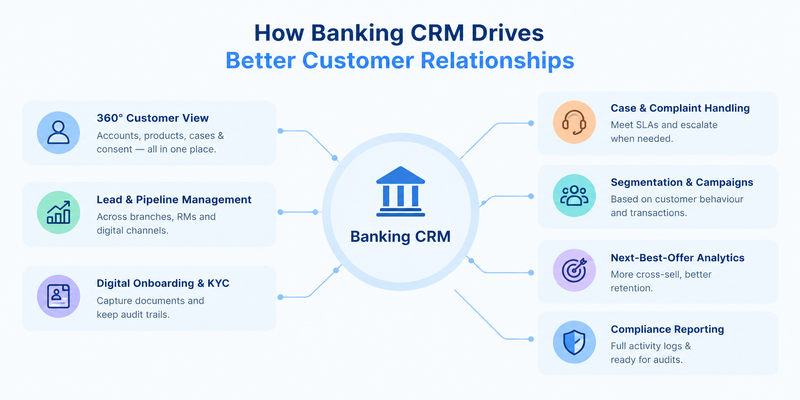
A banking CRM unifies customer data, interactions and workflows across sales, service, onboarding and compliance. Strong CRM solutions for modern banking cover these capabilities:
- 360-degree customer view pulling accounts, products, cases and consent status into one screen
- Lead and pipeline management across branches, relationship managers and digital channels
- Digital onboarding and KYC workflows with document capture and audit trails
- Case and complaint handling with SLAs and escalation rules
- Segmentation and campaign management driven by transaction behaviour
- Next-best-offer analytics for cross-sell and retention
- Compliance reporting with full activity logs
Dubai Islamic Bank is a useful local example. Before adopting VeriPark’s VeriTouch, it relied on worksheets, emails and partial in-house tools, which made it hard to pool leads or report on sales. It rolled out retail 360, sales, call centre and campaign modules behind one front end. The lesson isn’t the vendor. It’s that fragmented data was the problem, and a unified web application was the fix.
Web Application Development Technologies That Work Best for Financial Services in 2026
There’s no single winner. There’s a layered stack that holds up under audit, load and change. Here’s what we recommend most often for banking CRM builds in the UAE:
| Layer | Best-fit options in 2026 | Why it suits financial services |
| Front end | React with TypeScript (Next.js) or Angular | Typed code catches errors early; solid Arabic and right-to-left support |
| Service layer | Java (Spring Boot), .NET, Node.js (NestJS) for API gateways | Mature security libraries and long vendor support; many core banking platforms already integrate with Java or .NET |
| Data | PostgreSQL or SQL Server, Redis, OpenSearch | Transactional integrity for money-related records; fast customer search |
| Integration | REST APIs, Kafka event streaming, ISO 20022 mapping | Decouples CRM from core banking and delivers real-time customer events |
| Cloud and hosting | Kubernetes on UAE-region cloud, hybrid where required | Supports data residency, scaling and disaster recovery |
| Security | OAuth 2.0/OIDC, MFA, field-level encryption, immutable audit logs | Matches CBUAE and PDPL expectations on access and traceability |
| AI layer | Python services, retrieval over CRM data, human review | Next-best-action and case summaries with guardrails |
Three choices matter more than the rest.
Go API-first. A CRM that talks to core banking through a gateway survives core upgrades. One wired in with point-to-point scripts doesn’t.
Stream events, don’t poll. When a payment fails or a card is blocked, the relationship manager should know in seconds. Kafka-style streaming makes that routine.
Decide hosting early. Moving a regulated workload after launch is expensive. Check residency rules with compliance before choosing a region.
Mobile matters too. If branch staff and customers both need app access, plan the shared codebase upfront. A cross platform app development in Dubai approach can reuse your API layer across iOS and Android without doubling build effort.
UAE Rules That Shape Your Architecture
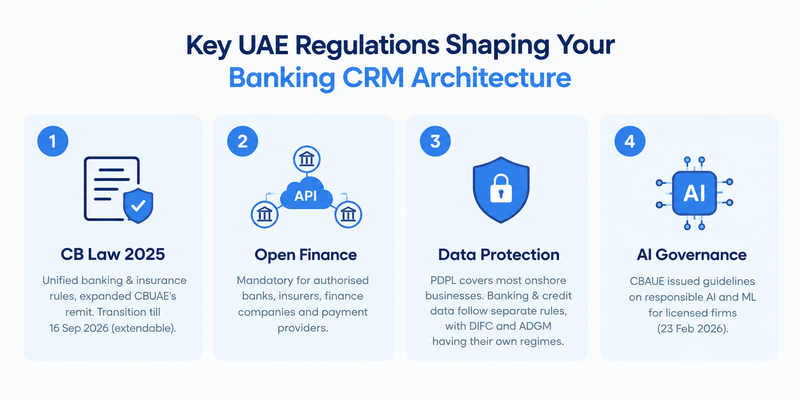
Technology choices don’t happen in a vacuum here. Four regulatory threads affect a banking CRM build:
- CB Law 2025. Federal Decree-Law No. 6 of 2025 unified banking and insurance regulation and widened CBUAE’s remit to open finance and technology providers. The transition window ran to 16 September 2026, with the CBUAE able to extend it, so confirm your status.
- Open Finance. The CBUAE’s Open Finance Regulation is mandatory for authorised banks, insurers, finance companies and payment providers. Participants connect through a single API hub run by Nebras Open Finance under the AlTareq brand, and the first live transactions were processed in January 2026.
- Data protection. The PDPL (Federal Decree-Law No. 45 of 2021) covers most onshore businesses, but banking and credit data fall under separate rules, and DIFC and ADGM entities follow their own regimes.
- AI governance. On 23 February 2026, the CBUAE published guidelines on consumer protection and the responsible use of AI and machine learning by licensed firms.
Embedded finance trends point the same way: more data flowing between banks, platforms and partners, with consent at the centre. Your CRM becomes the place where consent, relationship and risk meet.
The practical result is a short list of requirements. Build consent tracking into the customer record. Log every access. Keep AI recommendations explainable. Design for API exposure from day one.
Build, Buy or Hybrid?
Be honest about this one, because most banks shouldn’t build everything.
Off-the-shelf platforms such as Salesforce Financial Services Cloud or Dynamics 365 give you ready-made financial data models and KYC tooling. A properly scoped Salesforce rollout can go live in 30 to 90 days, though implementation and consultant costs are often missing from early comparisons. Published estimates put mid-market Salesforce setup and customisation at $30,000 to $150,000.
Custom builds take longer. One 2026 cost guide puts a standard custom CRM at $60,000 to $120,000 over four to six months, and native mobile apps add 40% to 60%. Break-even against heavily customised platform licences is often quoted at 18 to 36 months for teams of 20 or more. These are vendor-published USD ranges, so treat them as directional, not as a quote.
A custom build tends to win when:
- Your onboarding or lending workflow doesn’t fit a packaged data model
- You need deep integration with proprietary internal systems
- Per-seat licences are climbing with headcount
- Islamic finance products or Arabic-first journeys need special handling
Many UAE institutions land on a hybrid: a packaged CRM for standard sales and service, plus a custom operational layer synced through APIs. That’s where financial web application development earns its keep, building the parts no vendor ships.
Web, Mobile, or PWA?
Don’t assume one channel. Relationship managers work at desks and in client meetings. Customers want self-service on their phones. Back-office teams need dense, keyboard-friendly screens.
A progressive web app development company can often deliver installable, offline-tolerant experiences from one web codebase, which suits internal field-sales tools. Native apps still win for biometrics-heavy, high-frequency customer journeys.
A Scoping Checklist Before You Ask for a Quote
Most CRM projects stall because the brief is vague, not because the technology is hard. Answer these first:
- Which systems hold customer data today? List core banking, loan origination, cards, call centre, WhatsApp and spreadsheets.
- How will the CRM integrate with core banking? Name the vendor, the available APIs and who owns them.
- Which channels must it serve at launch? Branch, call centre, web portal, mobile.
- Who owns compliance sign-off? Name a person, not a department.
- What is the AI scope? Decide what’s recommended, what’s automated and what needs human approval.
- How will you measure success? Pick two or three numbers, such as onboarding time, cross-sell rate or case resolution time.
Bring those answers to a scoping call and you’ll compare partners on substance, not slideware.
How to Choose a Development Partner in Dubai
Credentials matter in finance, and so does your shortlist of web application development technologies. Look for a custom CRM development company in Dubai that can show regulated-sector delivery, not just a CRM portfolio. Ask how they handle audit logging, who reviews security, and how they’ve integrated with core banking before.
A good banking software development company in UAE should also be candid about when not to build. If a packaged product fits 80% of your needs, the right advice is to configure it.
Check the breadth, too. A fintech app development company in Dubai that also delivers CRM software development services in UAE can keep customer apps and back-office tools on one architecture. If you’re also planning customer-facing products, custom financial mobile app services should share APIs and design standards with your CRM, not sit beside it.
For teams that need tailored platforms rather than configuration, custom fintech software development UAE specialists can build the missing layer around your existing systems.
Ready to Scope Your Banking CRM?
The right web application development technologies help you improve efficiency, enhance user experiences and stay competitive in a rapidly evolving market. Sisgain’s team designs and builds banking CRM platforms for banks, lenders and fintechs across Dubai and the wider UAE. Share your systems map and goals, and we’ll come back with a scoped architecture, integration plan and realistic timeline.
Frequently Asked Questions
- Which web application development technologies are best for financial services in 2026?
React or Angular on the front end, Java or .NET services, Kafka for events and UAE-hosted cloud. Pair them with strong audit logging and API-first design.
- Is a custom CRM better than Salesforce for a bank?
Only if your workflows or integrations don’t fit a packaged model. Otherwise, a configured platform is faster, and many banks choose a hybrid.
- How much does banking CRM development cost?
Published ranges start around $60,000 to $120,000 for a standard custom build. Integration depth and mobile apps move the figure most.
- How long does implementation take?
Packaged platforms can go live in 30 to 90 days. Custom builds typically take three to six months.
- How does a CRM connect to core banking?
Through APIs and an integration layer, often with event streaming for real-time updates. Avoid point-to-point scripts that break when the core is upgraded.
- Does UAE law restrict where banking CRM data is stored?
Rules depend on your regulator. Onshore firms face CBUAE requirements and the PDPL where it applies, while DIFC and ADGM have their own regimes. Confirm with compliance counsel.
- How does Open Finance affect a CRM?
It increases the data you can receive and share with customer consent. Your CRM should track consent and connect cleanly to API hubs.
- Can a banking CRM support Arabic and Islamic banking workflows?
Yes, if it’s designed for it. That means right-to-left interfaces, bilingual records and product rules for Sharia-compliant offerings.
- Should a banking CRM be a web app, mobile app or PWA?
Usually a web app for staff, with a mobile or PWA layer for field teams and customers. Pick channels by user need, not trend.