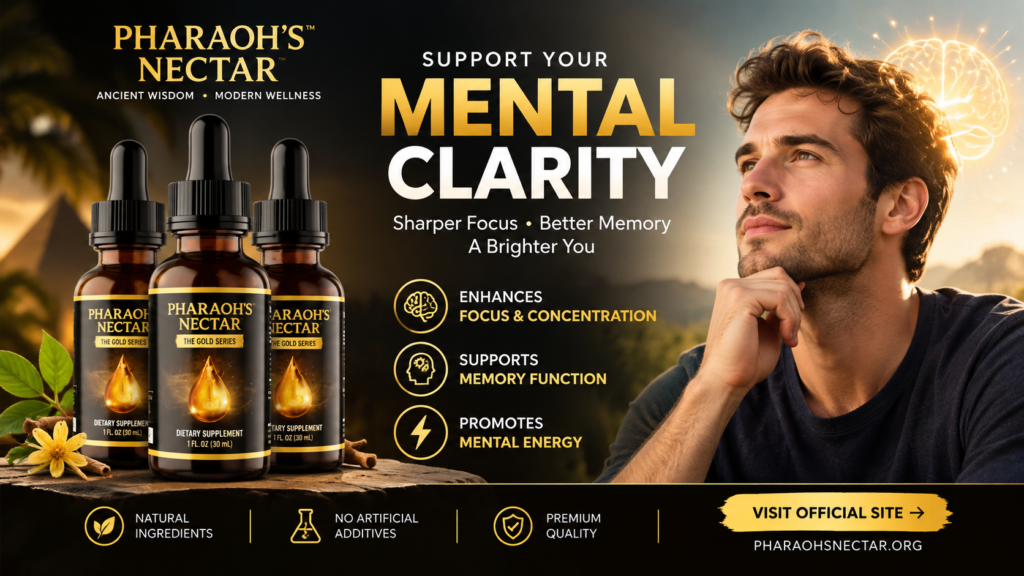
Pharaoh’s Nectar
Modern wellness routines often include dietary supplements intended to complement healthy habits, support daily energy, and promote a sense of overall well-being. With so many products available online, consumers are increasingly interested in understanding what a supplement contains, how it is marketed, and whether its intended benefits are supported by reliable evidence. Pharaoh’s Nectar is one product that has attracted attention through its unusual combination of ancient Egyptian themes, botanical ingredients, and claims related to mental clarity and vitality.
Pharaoh’s Nectar is marketed as a liquid wellness supplement inspired by ancient Egyptian traditions. Its promotional materials describe a formula featuring Egyptian Blue Vervain, Eleuthero Root, Lady’s Mantle Herb, Sacred Licorice Root, and Pure Peppermint Oil. The product’s marketing also emphasizes monoatomic gold, which is presented as a distinctive component of its formulation.
The product is promoted around several themes, including mental clarity, energy, personal balance, and spiritual exploration. These themes appeal to people interested in natural wellness products and traditional botanical ingredients. However, understanding the difference between a product’s advertised benefits and scientifically established effects is essential before making a purchasing decision.
This guide explores Pharaoh’s Nectar, its advertised purpose, listed ingredients, potential considerations, and practical ways to evaluate its suitability. Rather than assuming that every promotional statement represents a proven result, it takes a closer look at the information consumers should consider when researching a dietary supplement.
What Is Pharaoh’s Nectar?
Pharaoh’s Nectar is a liquid supplement marketed through an ancient Egyptian wellness concept. Its presentation connects traditional symbolism with contemporary interest in botanical formulations, energy, focus, and personal well-being.
Unlike products positioned exclusively around muscle building, weight management, or male vitality, Pharaoh’s Nectar is primarily promoted around mental clarity, energy, holistic wellness, and spiritual awakening. Its marketing does not establish that it is specifically a men’s wellness or testosterone-support supplement.
The product’s identity is built around a blend of herbal ingredients and claims involving monoatomic gold. The promotional narrative describes this combination as a way to reconnect with energy, clarity, and balance. However, those descriptions should be understood as marketing claims rather than proof that the formula produces the advertised effects.
The product is also presented in liquid form, which may appeal to consumers who prefer drops or liquid preparations over capsules and tablets. The exact composition, concentration, and quality of any dietary supplement should be evaluated using its current product label and supporting documentation.
Before purchasing Pharaoh’s Nectar, consumers should distinguish three important elements: the ingredients listed by the seller, the benefits claimed in advertisements, and the outcomes demonstrated by credible scientific research. These categories are not interchangeable.
What Is the Main Purpose of Pharaoh’s Nectar?
The main marketing focus of Pharaoh’s Nectar is mental clarity, energy, vitality, and broader personal wellness. Its promotional materials also introduce spiritual concepts associated with ancient Egyptian traditions.
Understanding these themes can help consumers decide whether the product matches their interests.
Mental Clarity and Focus
Mental clarity generally refers to feeling attentive, organized, and able to concentrate on everyday responsibilities. Many people look for wellness products when they experience demanding schedules, distractions, or difficulty maintaining consistent routines.
Pharaoh’s Nectar is advertised in connection with mental clarity and focus. However, consumers should not assume that these benefits have been clinically demonstrated for the finished product. Evidence about an individual ingredient does not automatically establish that a specific supplement improves concentration or cognitive performance.
For practical support, adequate sleep, regular physical activity, balanced nutrition, hydration, and appropriate management of stress remain important parts of a healthy routine.
Daily Energy and Vitality
Energy is another prominent theme in Pharaoh’s Nectar marketing. Daily energy can be affected by sleep quality, nutritional intake, activity levels, stress, and underlying health concerns.
Some of the botanicals listed in the product have traditional uses associated with vitality or general wellness. Nevertheless, the available product descriptions do not establish how much each ingredient contributes to the finished formula or whether the supplement provides a measurable improvement in energy.
Anyone experiencing persistent or unexplained fatigue should consider discussing it with a qualified healthcare professional rather than relying on a supplement alone.
General Wellness and Personal Balance
Pharaoh’s Nectar is also promoted as a product for people interested in a broader approach to wellness. This may include an interest in traditional herbs, daily self-care, and personal routines that support a sense of balance.
A supplement can be one component of a wellness routine, but it cannot replace a varied diet, consistent sleep, appropriate medical care, or other established health practices.
Spiritual Exploration
The product’s ancient Egyptian theme and references to spiritual awakening distinguish its marketing from that of many conventional dietary supplements.
Spiritual interests can be personally meaningful, but claims about activating extraordinary abilities, unlocking psychic gifts, or producing supernatural effects are not established health outcomes. Consumers should evaluate these statements separately from the product’s ingredient information.
Pharaoh’s Nectar Ingredients Explained
The product’s promotional materials list five botanical ingredients alongside claims involving monoatomic gold. Understanding what these ingredients are traditionally used for, as well as their limitations, provides a more informed starting point.
The exact amounts and standardization of the ingredients should be confirmed from the current product label.
1. Egyptian Blue Vervain
Blue vervain is an herb associated with traditional herbal practices. Vervain preparations have historically been used in different cultural contexts, although traditional use does not establish that every modern preparation provides a particular health benefit.
Pharaoh’s Nectar highlights Egyptian Blue Vervain as part of its distinctive botanical formula. The ingredient contributes to the product’s traditional wellness theme, but its presence alone does not demonstrate improvements in mental clarity, energy, or emotional balance.
Consumers should also verify the botanical identity of the ingredient, including its scientific name, because common names can sometimes refer to different plants.
The quality of the raw material, the part of the plant used, and the extraction method may influence the characteristics of a botanical preparation. These details matter when comparing supplements or assessing the evidence behind their ingredients.
2. Eleuthero Root
Eleuthero, commonly known as Siberian ginseng, is a plant used in traditional herbal preparations. It is botanically different from true ginseng species, despite the similarity in common names.
Eleuthero has been studied in relation to fatigue, physical performance, and the body’s response to stress. However, research findings are not uniform, and evidence for one preparation cannot automatically be applied to every supplement containing the plant.
In Pharaoh’s Nectar marketing, Eleuthero Root is associated with energy and vitality. Consumers should treat those descriptions as intended uses rather than guaranteed outcomes.
When evaluating an Eleuthero supplement, useful questions include whether the extract is standardized, how much is present per serving, and whether the product provides reliable quality-testing information.
People taking medication or managing existing health conditions should seek professional advice before adding herbal supplements to their routines.
3. Lady’s Mantle Herb
Lady’s Mantle is a traditional herb that has appeared in various herbal preparations. Different plant compounds may be present depending on the species, growing conditions, and preparation method.
Pharaoh’s Nectar lists Lady’s Mantle Herb as one of its botanical ingredients. However, the inclusion of this herb does not establish that the finished supplement balances hormones, reverses aging, or improves any particular medical condition.
Claims involving hormonal health require particular care because hormonal symptoms can have multiple causes. A consumer experiencing persistent changes in energy, mood, sleep, or other aspects of health should not assume that an herbal product can address the underlying cause.
When researching Lady’s Mantle, consumers should look for reliable evidence relevant to the specific preparation rather than relying exclusively on traditional descriptions or promotional language.
4. Sacred Licorice Root
Licorice root has a long history of use in traditional herbal preparations and is used in some contemporary products for its characteristic flavor and other formulation properties.
The root contains several compounds, including glycyrrhizin in many preparations. Its concentration can vary, and this is important because glycyrrhizin can affect blood pressure and potassium levels in susceptible individuals.
Pharaoh’s Nectar includes Sacred Licorice Root in its advertised formula. Consumers should verify the exact form used and whether the product specifies the amount of glycyrrhizin or other relevant constituents.
Licorice is not appropriate for everyone. People with high blood pressure, kidney or heart conditions, low potassium levels, or certain medication regimens should consult a healthcare professional before using products containing licorice.
The presence of a traditional botanical ingredient should never be interpreted as proof that a product is safe for every consumer.
5. Pure Peppermint Oil
Peppermint oil is obtained from peppermint plants and is used in various food, personal-care, and wellness products. Its familiar aroma and cooling flavor make it a common ingredient in liquid formulations.
Certain peppermint oil preparations have been investigated for specific digestive complaints. However, findings from one preparation or medical use do not establish that peppermint oil in Pharaoh’s Nectar produces the same effects.
The concentration and intended route of use are particularly important when evaluating essential oils. Consumers should follow the product label and avoid assuming that a concentrated oil is interchangeable with peppermint tea or ordinary culinary peppermint.
People with reflux symptoms or other digestive concerns should consider individual tolerability and consult a healthcare professional if they are unsure whether a peppermint-containing supplement is appropriate.
Understanding the Role of Monoatomic Gold
Monoatomic gold is one of the most unusual elements in Pharaoh’s Nectar marketing. The promotional materials refer to a special form of gold and associate it with cellular energy, mental clarity, and spiritual concepts.
These claims require careful interpretation.
Gold is a chemical element, and claims about a particular form of gold must be evaluated through clear chemical characterization and reliable analytical evidence. Descriptions such as “quantum,” “superconductive,” or “liquid light” do not, by themselves, demonstrate that a substance has the claimed properties in the human body.
Similarly, assertions that an ingested gold preparation accelerates cellular communication, activates a third eye, or produces extraordinary physical or spiritual changes are not established clinical outcomes.
Consumers should look for verifiable information about the substance’s actual composition, its concentration, independent laboratory testing, and evidence supporting its safety when consumed.
Third-party testing can help assess identity, purity, and contamination when conducted by a qualified laboratory using appropriate methods. However, testing for contaminants does not independently establish that a supplement is effective or safe for every person.
When a product contains an unusual ingredient, transparency about its identity and safety becomes especially important. Consumers should be cautious when scientific-sounding descriptions are offered without accessible evidence that can be independently assessed.
Potential Benefits: What Can Consumers Reasonably Expect?
Pharaoh’s Nectar is marketed around several potential benefits. Understanding the strength of the evidence behind each claim helps consumers form realistic expectations.
Support for Mental Clarity
The product is promoted in connection with focus and mental clarity. These are understandable goals for people managing busy schedules or demanding work.
However, the available marketing information does not establish that Pharaoh’s Nectar has been shown in controlled clinical trials to improve attention, memory, or other cognitive abilities.
Anyone considering it for these purposes should review the product’s evidence and avoid treating promotional testimonials as substitutes for well-designed research.
Interest in Botanical Wellness
Some consumers prefer learning about traditional herbs and incorporating selected botanical products into their personal routines. Pharaoh’s Nectar’s ingredient list may interest people who enjoy researching herbal preparations.
Nevertheless, botanical origin does not automatically mean that a supplement is effective, free from adverse effects, or appropriate for every person. Quality, dose, preparation, interactions, and individual circumstances all matter.
Energy and Daily Vitality
Energy is influenced by multiple factors, including sleep, nutrition, physical activity, psychological stress, and medical conditions.
Although the product is advertised around energy and vitality, its specific effects have not been established by the promotional descriptions alone. Consumers should be wary of claims promising unlimited energy, immediate transformation, or guaranteed results.
A Distinctive Wellness Concept
The combination of ancient Egyptian imagery and a modern liquid supplement creates a distinctive identity. Some consumers may find the product’s historical and spiritual themes interesting.
That interest is a personal preference, not evidence of a physiological benefit. It is helpful to distinguish enjoyment of a product’s concept from confidence in its health claims.
How to Evaluate Pharaoh’s Nectar Before Purchasing
A careful review of the product information can help consumers make a more informed purchasing decision.
Review the Complete Supplement Label
Start by checking the full Supplement Facts panel and ingredient list. Confirm the amount of each ingredient per serving, the recommended serving size, and any additional ingredients.
If the website lists ingredients without their quantities, consumers may have difficulty comparing the product with research conducted on particular doses or extracts.
Also review any warnings, storage instructions, and information about the manufacturer or distributor.
Look for Independent Quality Information
Manufacturing standards and independent testing can help consumers assess product quality. Look for accessible documentation identifying the testing laboratory, the batch examined, and the substances tested.
A statement that a facility follows manufacturing standards should not be confused with evidence that the finished product has been proven effective.
In the United States, dietary supplements are not FDA-approved for effectiveness before being marketed in the same way as prescription medicines. Be cautious when advertising uses language that implies FDA approval of a supplement itself.
Examine the Evidence Behind Advertised Benefits
A convincing health claim should be supported by evidence appropriate to that claim.
Research on an isolated ingredient, for example, may not apply to a finished product containing several ingredients in different concentrations. Likewise, testimonials cannot establish that a supplement caused a particular outcome.
Consumers should look for controlled human studies involving the actual product when available. If those studies are not available, that limitation should be considered before purchase.
Read the Purchase and Refund Terms
Before ordering online, review the current price, shipping charges, recurring-payment conditions, refund eligibility, and return instructions.
Promotional pages may display different offers or package sizes, so consumers should confirm the final checkout amount rather than relying solely on a headline discount.
Keep the order confirmation and a copy of the applicable refund policy in case customer service assistance is needed later.
How to Approach Supplement Use Responsibly
Anyone considering Pharaoh’s Nectar should treat it as an optional supplement rather than a substitute for established health practices.
First, read the directions on the current product label. Do not increase the serving size in an attempt to accelerate results or assume that taking more will provide greater benefits.
Second, consult a qualified healthcare professional if you take medication, have an existing health condition, or are considering combining multiple supplements. This is particularly relevant when a formula includes licorice root or ingredients whose exact concentrations are unclear.
Pregnant or breastfeeding individuals should obtain professional guidance before using herbal supplements. The same caution applies to anyone who has previously experienced an allergic reaction to a botanical ingredient.
If a supplement causes an unexpected reaction, discontinue use and seek appropriate medical advice. Serious symptoms require prompt medical attention.
Finally, avoid using a supplement to postpone evaluation of persistent fatigue, concentration difficulties, sleep problems, or other ongoing symptoms. These concerns can have underlying causes that deserve proper assessment.
Lifestyle Habits That Complement a Wellness Routine
A wellness routine does not need to depend on a single supplement. Several established habits can support everyday functioning and general health.
Prioritize Consistent Sleep
Regular, sufficient sleep supports attention, learning, mood, and daily functioning. Maintaining a consistent bedtime, reducing late-night screen exposure, and creating a comfortable sleeping environment may help improve sleep habits.
People who continue to experience significant sleep difficulties should consider seeking professional advice.
Maintain a Balanced Diet
A varied diet that includes vegetables, fruits, whole grains, protein sources, and appropriate amounts of healthy fats provides nutrients needed for normal bodily functions.
Supplements may be useful in particular circumstances, but they should not automatically replace a nutritious diet. Individual nutritional needs can differ according to age, lifestyle, and health status.
Stay Physically Active
Regular physical activity supports cardiovascular health, mobility, sleep, and general well-being. Walking, cycling, resistance exercise, or other activities suited to an individual’s abilities can help establish a sustainable routine.
Consistency is generally more useful than adopting an intense exercise plan that is difficult to maintain.
Manage Daily Stress
Relaxation exercises, time outdoors, enjoyable hobbies, and realistic work schedules can help people manage everyday pressures.
Mindfulness or meditation may also be meaningful for those interested in reflective or spiritual practices. These approaches should not be confused with extraordinary physiological claims made in supplement advertising.
Build Sustainable Habits
Small, repeatable changes often make a wellness routine easier to maintain. Setting realistic goals, tracking sleep patterns, planning meals, and making time for movement can provide a practical foundation.
If an individual chooses to add a supplement, it is useful to evaluate it separately rather than assuming that every improvement in well-being resulted from the product.
Pharaoh’s Nectar Compared With Conventional Wellness Supplements
Consumers researching Pharaoh’s Nectar may also compare it with products marketed for energy, focus, or general wellness.
Conventional supplements can vary widely in their ingredients, intended uses, and supporting evidence. Some provide specific nutrients, while others contain botanical extracts or combinations of multiple compounds.
The most useful comparison is not simply whether a product sounds natural or traditional. Instead, consumers should examine its formulation, serving size, evidence, safety information, and cost.
Pharaoh’s Nectar has a distinctive marketing approach that combines botanical ingredients with claims involving monoatomic gold and spiritual awakening. Those features make it particularly important to examine its claims carefully.
A product with a longer ingredient list is not necessarily more effective than one with a simpler formula. Nor does a higher price automatically indicate better quality.
When comparing alternatives, ask whether the product addresses a clearly defined need, whether its ingredients are transparently listed, and whether credible evidence supports the intended use. If the goal is to correct a nutrient deficiency or manage a medical condition, professional guidance can help identify more appropriate options.
Frequently Asked Questions About Pharaoh’s Nectar
Is Pharaoh’s Nectar a Men’s Wellness Supplement?
Pharaoh’s Nectar is primarily marketed around mental clarity, energy, vitality, and broader wellness themes. The available promotional information does not establish that it is specifically formulated for testosterone support, male sexual health, or men’s vitality. Consumers should review the current official product information before assigning it to a particular supplement category.
What Ingredients Are Listed in Pharaoh’s Nectar?
The promotional ingredient list includes Egyptian Blue Vervain, Eleuthero Root, Lady’s Mantle Herb, Sacred Licorice Root, and Pure Peppermint Oil. The marketing also refers to monoatomic gold. Consumers should verify the current label, ingredient quantities, and chemical identity of unusual ingredients before purchasing.
Does Pharaoh’s Nectar Improve Mental Clarity?
The product is advertised in connection with mental clarity and focus. However, advertising statements alone do not demonstrate that the finished supplement improves attention, memory, or cognitive performance. Reliable clinical evidence specific to the product would be needed to establish such effects.
Is Pharaoh’s Nectar Suitable for Everyone?
No supplement should be assumed suitable for everyone. Individual health conditions, medications, allergies, ingredient concentrations, and product quality can affect suitability. People with medical conditions or those taking medication should consult a healthcare professional before use.
How Can Consumers Check Product Quality?
Review the complete label, manufacturer details, serving instructions, warnings, and available independent testing documentation. A credible quality report should identify what was tested and the scope of the testing. Evidence of purity or manufacturing quality does not automatically prove effectiveness.
Can Pharaoh’s Nectar Replace Healthy Lifestyle Habits?
A dietary supplement should not replace adequate sleep, balanced nutrition, physical activity, or appropriate medical care. If consumers choose to use a supplement, it should be considered alongside these habits rather than as a replacement for them.
Are Customer Testimonials Reliable Evidence?
Testimonials can describe individual experiences, but they cannot establish that a product caused an improvement or that other consumers will experience the same outcome. Individual experiences can vary, and controlled research is more useful for assessing whether a supplement consistently produces a particular effect.
Final Thoughts on Pharaoh’s Nectar
Pharaoh’s Nectar is a distinctive liquid wellness supplement marketed through a combination of botanical ingredients, ancient Egyptian imagery, and claims involving mental clarity, energy, vitality, and spiritual exploration. Its advertised formulation includes Egyptian Blue Vervain, Eleuthero Root, Lady’s Mantle Herb, Sacred Licorice Root, and Pure Peppermint Oil, alongside promotional references to monoatomic gold.
For consumers interested in researching this product, the most important step is to separate its marketing narrative from what can be independently verified. Traditional use, unusual ingredient descriptions, and personal testimonials do not establish that a finished supplement provides specific health benefits.
Before making a purchase, examine the complete ingredient label, check the quantities and quality documentation, review the evidence behind advertised claims, and understand the applicable purchase and refund terms. Consider potential interactions and seek professional guidance when necessary.
A responsible wellness approach focuses on informed decisions, realistic expectations, and sustainable daily habits. Pharaoh’s Nectar may interest people exploring botanical supplements, but its advertised effects should not be treated as guaranteed or clinically established without suitable evidence.
Disclaimer: This article is for informational purposes only and is not medical advice. Dietary supplements are not intended to diagnose, treat, cure, or prevent disease. Individual results may vary. Consult a qualified healthcare professional before starting a new supplement, especially if you take medication, have a medical condition, or are pregnant or breastfeeding.