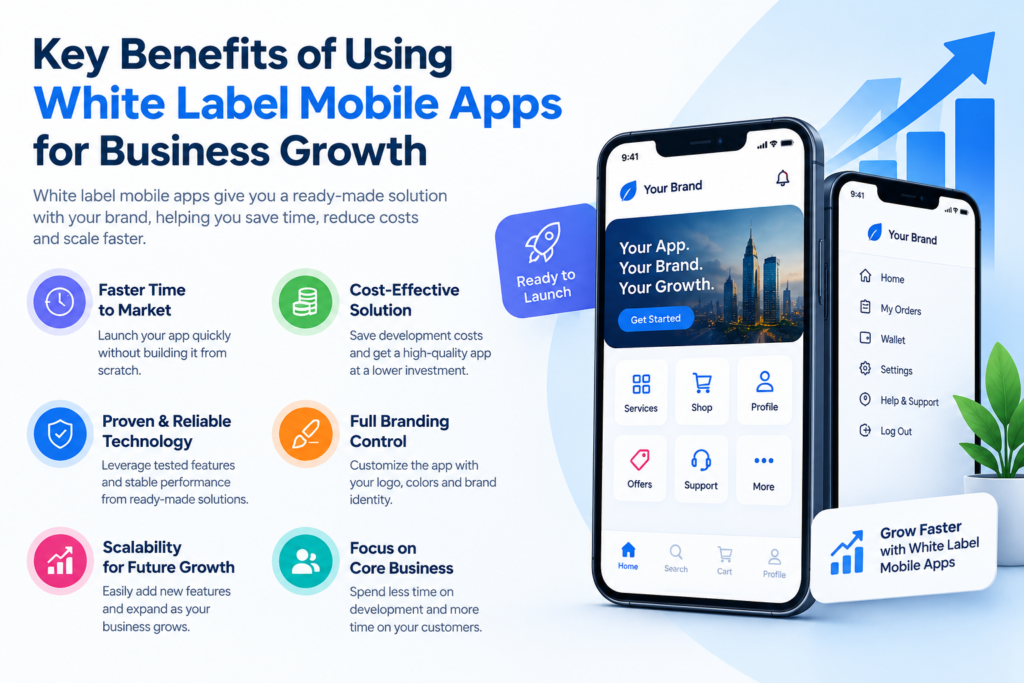
In today’s digital-first marketplace, having a strong mobile presence is no longer optional for businesses that want to stay competitive. Customers increasingly expect brands to provide fast, convenient, and personalized experiences directly from their smartphones. For businesses, however, building a mobile application from scratch can involve significant development time, technical expertise, testing, maintenance, and financial investment.
This is where white label mobile apps offer a practical alternative.
A white label mobile app is a pre-built application developed by a technology provider that can be customized, branded, and launched by another business as its own. Instead of spending months creating an application from the ground up, businesses can adapt an existing solution to match their brand identity, features, and customer requirements.
From startups and retailers to restaurants, financial service providers, healthcare companies, and agencies, organizations across industries can use white label applications to establish a mobile presence faster and with fewer development barriers.
But speed is only one advantage. White label mobile apps can also support customer engagement, brand visibility, operational efficiency, scalability, and revenue growth.
Let’s explore the key benefits of using white label mobile apps for business growth.
1. Faster Time to Market
One of the biggest advantages of a white label mobile application is the ability to launch quickly.
Traditional app development typically involves multiple stages, including planning, UI/UX design, coding, testing, debugging, deployment, and ongoing optimization. Depending on the complexity of the application, this process can take several months.
A white label solution reduces much of this initial development workload because the core application has already been built and tested.
Businesses can focus primarily on customization, branding, configuration, and market preparation. This allows companies to introduce their mobile app to customers considerably faster.
Speed can be particularly valuable when entering a competitive market. A business that launches a useful mobile experience ahead of competitors can begin building customer relationships, collecting feedback, and generating revenue sooner.
Rather than waiting for a lengthy development cycle, companies can move from concept to market with greater efficiency.
2. Lower Development Costs
Building a completely customized mobile application can be expensive. Businesses may need to hire developers, designers, project managers, testers, and other specialists. They also need to account for infrastructure, maintenance, security updates, and future development.
White label apps provide a more cost-effective starting point because the underlying technology has already been developed.
Instead of paying for every component from scratch, a business invests in an existing platform and customizes it according to its requirements.
This can be especially useful for startups and small businesses with limited technology budgets. Money saved on initial development can potentially be redirected toward marketing, customer acquisition, product development, or other growth initiatives.
Lower upfront costs do not necessarily mean compromising on functionality. Many white label platforms offer extensive features that would otherwise require substantial development resources.
3. Stronger Brand Presence
A mobile application provides another direct channel through which customers can interact with a business.
With a white label app, companies can customize important elements such as the logo, color palette, typography, graphics, navigation, and overall visual identity. Customers can therefore experience the application as an extension of the company’s existing brand.
This consistency matters.
When the mobile experience reflects the same identity customers see on a website, social media channels, packaging, and physical locations, the brand becomes easier to recognize and remember.
A branded app can also create a sense of ownership and credibility. Customers are not simply interacting with a generic third-party platform; they are engaging with a digital product associated directly with the business.
Over time, this can strengthen brand recognition and contribute to long-term customer loyalty.
4. Improved Customer Engagement
Modern customers expect businesses to communicate with them in convenient and relevant ways. Mobile applications create opportunities for businesses to maintain ongoing engagement beyond individual transactions.
For example, companies can use features such as push notifications, personalized offers, loyalty programs, reminders, new-product announcements, and in-app promotions.
Unlike many traditional marketing channels, an app provides a direct communication channel with customers who have chosen to install it.
Businesses can use this connection to encourage repeat purchases, announce special promotions, share useful updates, and keep customers informed.
However, effective engagement depends on providing value. Sending excessive or irrelevant notifications can frustrate users. Businesses should therefore focus on timely, personalized communication that improves the customer experience rather than simply increasing message frequency.
5. Access to Ready-Made Features
Another important benefit of White Label App Development Company is access to established functionality.
Depending on the provider and industry, a white label application may include features such as:
-
User registration and secure login
-
Customer profiles
-
Product or service catalogs
-
Online payments
-
Booking and scheduling
-
Push notifications
-
Loyalty and rewards programs
-
In-app messaging
-
Order tracking
-
Analytics dashboards
-
Social media integration
-
Customer support tools
Developing all of these capabilities independently can require significant resources.
With a white label platform, many essential features may already be available and can be configured or customized according to business needs.
This enables companies to focus less on building basic infrastructure and more on delivering a differentiated customer experience.
6. Easier Scalability
Businesses rarely remain the same size. As customer demand increases, digital platforms need to evolve accordingly.
A well-designed white label mobile application can provide a foundation that supports future growth. Businesses can often add features, integrate additional services, introduce new payment options, or expand into new markets without rebuilding the entire application.
This scalability can be particularly valuable for companies experiencing rapid growth.
For example, a small retail business might initially need only product browsing and ordering features. As its customer base grows, it may want to add loyalty rewards, personalized recommendations, subscriptions, delivery tracking, or advanced customer support.
A scalable white label platform can make these additions more manageable.
The key is to choose a provider whose technology architecture and customization options can support the company’s long-term objectives.
7. Reduced Technical Complexity
Not every business has an internal technology team capable of managing a complete mobile application ecosystem.
White label solutions can reduce the technical burden by providing a ready-made technology foundation. Depending on the provider, technical responsibilities such as infrastructure management, updates, bug fixes, security improvements, and platform compatibility may be handled by the technology partner.
This allows business teams to concentrate on their core activities.
Marketing professionals can focus on customer acquisition. Sales teams can focus on revenue generation. Operations teams can improve service delivery. Management can focus on strategic growth.
Technology remains important, but the business does not necessarily need to manage every technical layer independently.
8. Better Customer Retention
Acquiring a new customer is often more expensive than retaining an existing one. Businesses therefore need strategies that encourage customers to return.
A mobile app can become a valuable retention tool by making repeat interactions easier and more convenient.
Customers can quickly reorder products, access loyalty rewards, receive personalized promotions, manage bookings, track orders, or communicate with support teams.
When an app simplifies a customer’s recurring tasks, it can become part of their routine.
White label technology makes it easier for businesses to introduce these retention-focused capabilities without investing in a completely new application architecture.
A thoughtfully designed mobile experience can therefore contribute not only to customer acquisition but also to stronger long-term relationships.
9. Opportunities for Personalization
Personalization has become an important part of modern customer experiences.
A mobile application can provide businesses with opportunities to understand user preferences and deliver more relevant experiences, provided that data is collected and used responsibly.
For example, an e-commerce company may highlight products based on browsing behavior. A restaurant app may promote frequently ordered meals. A fitness platform may recommend content based on a user’s goals and activity.
White label apps can provide the technological foundation for these experiences while allowing businesses to maintain their own branding and customer journey.
Personalization can make an application feel more useful because customers see information and offers that are relevant to their needs rather than receiving the same experience as everyone else.
10. Competitive Advantage
In crowded markets, businesses need ways to differentiate themselves.
A professionally designed mobile app can help a company create a more convenient customer experience than competitors that rely solely on websites, phone calls, or third-party platforms.
Consider a customer choosing between two similar businesses. If one provides easy mobile ordering, personalized rewards, instant notifications, and simple account management while the other offers a less convenient experience, the first business may have a meaningful advantage.
White label applications make this type of digital experience accessible without requiring every company to maintain a large software development department.
The result can be a faster path toward digital competitiveness.
11. Simplified Maintenance and Updates
Launching an app is not the end of the development process. Mobile operating systems change, security requirements evolve, devices are updated, and customers expect new functionality.
Maintaining a completely custom application can therefore become an ongoing responsibility.
With a white label solution, maintenance and platform updates may be managed by the technology provider. This can reduce the internal resources required to keep the application functional and compatible.
Businesses should carefully review a provider’s update policy before choosing a solution. Reliable technical support, regular maintenance, security practices, and clear service-level expectations are important factors in determining the long-term value of a white label platform.
12. Data and Business Insights
Mobile applications can also help businesses understand customer behavior.
Depending on the platform and applicable privacy requirements, companies may be able to analyze metrics such as user engagement, purchases, feature usage, retention, and conversion behavior.
These insights can support better business decisions.
For example, if analytics show that customers frequently abandon a particular step during checkout, the business can investigate and simplify that process. If a loyalty feature generates strong engagement, the company may invest further in that area.
Data transforms the mobile application from simply a customer-facing tool into a potential source of business intelligence.
Businesses should always ensure that data collection, storage, and usage comply with applicable privacy laws and clearly communicated customer expectations.
13. Multiple Revenue Opportunities
A mobile app can create additional opportunities for revenue generation.
Depending on the business model, companies may use their apps for direct product sales, subscriptions, bookings, premium services, loyalty programs, upselling, cross-selling, or digital products.
For example, an online retailer can use personalized recommendations to increase average order value. A service provider can introduce subscription packages. A restaurant can promote add-ons during the ordering process.
Because the application provides a direct customer channel, businesses can experiment with different revenue strategies and measure their effectiveness.
14. A Practical Option for Startups and Growing Businesses
For startups, building a strong digital product while controlling costs is often challenging.
White label mobile apps can provide a middle ground between having no mobile application and investing heavily in completely custom software.
A startup can launch with essential features, test the market, gather customer feedback, and improve its offering over time.
This approach can reduce the risk of spending significant resources on features that customers may not actually use.
Once the business establishes product-market fit and understands customer expectations, it can decide whether further customization or a fully bespoke solution is necessary.
How to Choose the Right White Label Mobile App Provider
Not every white label platform offers the same level of quality or flexibility. Businesses should evaluate providers carefully before making a decision.
Important factors include:
-
Customization: Determine how extensively the application can be branded and modified.
-
Features: Confirm that the platform supports both current and anticipated business requirements.
-
Security: Review authentication, encryption, data protection, and security update practices.
-
Scalability: Ensure the technology can support increasing users and transactions.
-
Integration: Check compatibility with existing payment systems, CRM platforms, websites, and other business tools.
-
Support: Understand what technical assistance and maintenance services are included.
-
Pricing: Look beyond initial costs and evaluate subscription, maintenance, customization, and transaction fees.
-
App store compliance: Verify that the provider supports deployment and ongoing compliance with relevant app marketplace requirements.
-
Analytics: Look for meaningful reporting and insights that can support business decisions.
Choosing the cheapest provider may not always produce the best long-term result. The goal should be to find a platform that balances cost, functionality, reliability, customization, and future growth.
Final Thoughts
White label mobile apps have changed the way businesses can approach mobile technology. Instead of starting every project from a blank screen, companies can leverage an existing technology foundation and adapt it to their brand and business model.
The benefits can extend far beyond faster development. A well-selected white label mobile application can reduce development costs, strengthen brand visibility, improve customer engagement, support retention, provide valuable insights, and create new revenue opportunities.
For startups and established businesses alike, the biggest advantage may be the ability to move faster while keeping technology investments aligned with business goals.
However, the success of a white label app ultimately depends on more than the technology itself. Businesses need a clear customer strategy, useful features, consistent branding, strong security, effective marketing, and ongoing optimization.