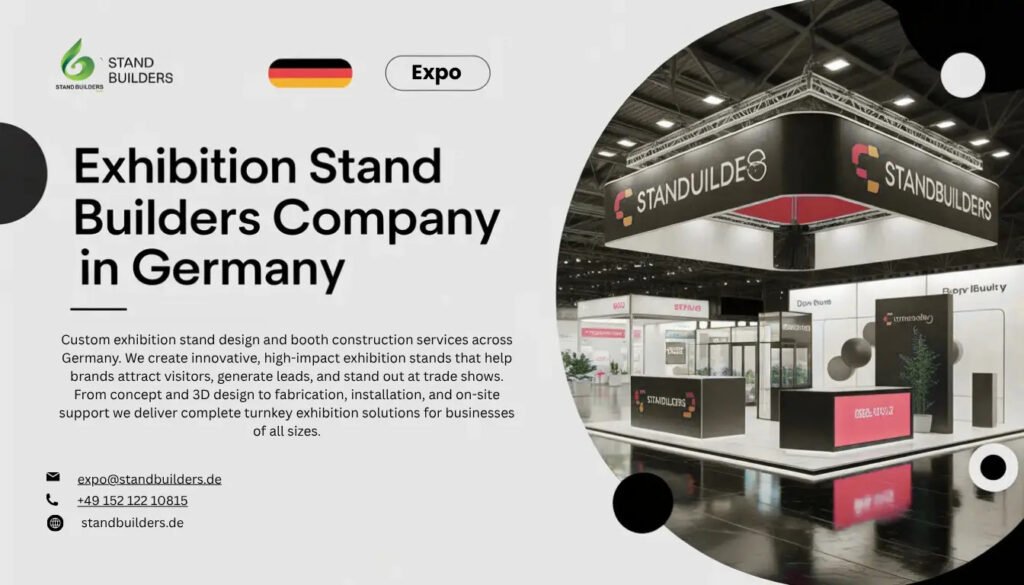
Germany has built up a good reputation as a global centre for trade exhibitions, with professional events drawing in companies and visitors from all sorts of industries. Exhibition centres throughout the country feature representation from the automotive, engineering, healthcare, technology, logistics, energy, construction and consumer sectors.
For any company taking part in such events, the exhibition stand goes beyond being merely a physical setup; it provides the setting in which visitors come across the brand, investigate the products, ask questions, attend demonstrations, and start professional discussions. It is for this reason that planning for an exhibition must blend design creativity with practical decision-making.
A company that builds exhibition stands in Germany can get involved whenever businesses require assistance in translating their exhibition aims into a physical form. Yet effective planning begins a lot earlier on, through conducting audience research, preparing a budget, analysing the venue, and having a clear idea of what the stand should achieve.
Germany’s Trade Fair Environment
Germany has a wide variety of trade fairs, ranging from highly specialised industry events to international exhibitions which have thousands of participants. Frankfurt, Düsseldorf, Munich, Berlin, Cologne and Hannover are among the main cities for exhibitions.
Because of the professional character of many German trade fairs, visitors usually come with particular interests in mind. A few of them are looking for suppliers, others wish to compare different technologies, and some go in order to find new partnerships or to become aware of new developments in the industry.
The way in which it is done has an effect on the design of exhibitions; specifically, a stand must have sufficient visual impact so as to draw attention and at the same time make it easy for visitors who are interested to understand the business and begin a conversation.
Start With the Visitor, Not the Structure
A very useful principle when planning an exhibition is to consider the visitor’s journey prior to considering the construction.
A person usually spots a stand from afar, checks to see if it seems relevant, goes to the area, looks for information, and then decides whether to talk to the staff or to look at a demonstration.
Design can affect every stage.
Large and easy-to-read branding will help shoppers recognise the company from within the aisle. Clear displays of the products can make it evident what the business has to offer. Open entrances can lessen the psychological obstacle to entering the stand, while comfortable seating can lead to longer conversations.
A visitor-centered approach is especially useful for professional audience concept development by exhibition stand builders in Germany.
Important Design Considerations
Brand Visibility
A stand must be able to convey its identity rapidly; too much text can make it hard for people to understand it from a distance, whereas branding that is too discreet will make it difficult for visitors to recognise the exhibitor.
Effective communication usually includes a mix of identifiable branding, clear messaging, images of the product, and well-placed graphics.
Visitor Flow
The way you move through the store should appear natural, with the entry points, the product displays, the counters, the meeting areas, and the hospitality zones all working in unison rather than vying for space.
For smaller stands this is especially important since each square metre has a practical purpose.
Meeting Spaces
Detailed discussions are often a part of business exhibitions, which is why meeting areas must strike a balance between accessibility and privacy.
For brief discussions an informal seating area will do, but companies which are dealing with technical specifications or commercial negotiations will need quieter meeting rooms.
Lighting
The way in which lighting is used can affect the way in which products, graphics, and architectural features are seen; concentrated lighting can emphasize important displays, while general lighting can make the entire area more comfortable.
The goal goes beyond mere brightness to achieve illumination with a specific purpose.
Different Stand Formats for Different Objectives
No single stand format can be suitable for every business.
A modular stand is useful for companies which take part in a number of events and need flexible parts; the systems can in some cases be reconfigured to meet different floor spaces and exhibition requirements.
Since the stands are custom-built, it is possible to have greater control over the architecture, branding, the way the products are presented and the arrangement of the visitor areas. Such stands would be suitable for companies launching significant products or those that need specialized demonstration environments.
A minimalist stand can be equally effective if the brand’s message is strong and the space available is limited.
Exhibition Stand Design in Germany usually combines visual simplicity with functional planning instead of depending completely on elaborate structures.
Exhibition Budget: Where the Money Goes
The cost of the stand is only one element of the overall exhibition budget.
Companies might also have to take into account the cost of venue services, electricity, flooring, furniture, graphics, technology, transportation, installation, dismantling, storage, staffing, travel, accommodation, and promotional materials.
The extent to which a exhibition stand contractor in Germany has to customise a stand and co-ordinate a project can have an effect on the cost.
For instance, a small modular booth with standard graphics will have a different cost structure to a large custom stand which has private meeting rooms, suspended signage, product demonstrations, and integrated digital technology.
A practical budget should therefore be set up before the design is finally determined.
The Importance of Local Exhibition Knowledge
Challenges may arise for international exhibitors even if they are not apparent when planning begins.
The rules applicable to the venue, the time frames for installation, the necessary technical approvals, the procedures for delivery, and the schedules for dismantling may vary from one exhibition centre to another, and it may also be necessary to transport the materials internationally, which makes logistics of particular importance.
It is possible to explain why companies at times choose to work with Expo Stand builders in Germany who are familiar with the local exhibition conditions.
Even though local knowledge doesn’t take the place of strategic planning it can help companies to see how a design idea is turned into a real exhibition installation.
Common Mistakes to Avoid
One of the most preventable errors when exhibiting is to start too late, since design changes, production, shipping, venue approvals, and installation all take a certain amount of time.
A further issue is trying to convey too great a amount of information. A display showing all of the products, services, statistics, and marketing messages can become visually overwhelming.
Failing to provide storage is also a frequent mistake; if there is no special storage space, packaging, brochures, equipment, and staff belongings might end up in areas that are visible to visitors.
Businesses may also fail to prepare their staff. A booth that has been well designed still relies on representatives who understand the main messages, the questions that visitors might ask, the demonstrations, and the procedure for handling leads.
When Professional Stand Support Makes Sense
Certain businesses handle their exhibition projects themselves, but they hire in outside experts when the event is big or involves complex technical requirements.
If a company needs help with concept development, construction, graphics, logistics, or installation, then working with Stand Builders in Germany could be considered.
When it is important to maintain consistency across a number of venues, businesses that are taking part in exhibitions in several European countries might also consider using exhibition stand builders in Europe.
It ought to be based on the complexity of the project, the expertise already available within the organisation, the deadlines, and the resources available rather than just on the size of the stand.
Conclusion
To exhibit in Germany you need a mix of strategic planning, careful design, thorough logistical preparation and sound financial management. A successful stand does not have to be the biggest or most elaborate structure in the exhibition hall; its effectiveness is determined by how well it communicates with the target audience and how effectively it supports the company’s exhibition objectives.
Every choice made in regard to visitor flow and lighting as well as those concerning meeting areas, demonstrations, storage, and technology can have an effect on the overall experience. When preparing a budget it should likewise take into account the total cost of taking part rather than concentrating only on the cost of construction.
For companies which are not familiar with the German system of running exhibitions, it makes sense to choose a Exhibition Stand Builders Company in Germany if technical co-ordination, local knowledge and installation management are required. If adequate preparation is carried out and a visitor-oriented approach is adopted, businesses will be able to set up an exhibition environment which is informative, functional and suitable for their audience.
FAQs
What is the aim of an exhibition stand?
An exhibition stand can serve a number of purposes, such as demonstrating products, holding business meetings, promoting the brand, enabling networking, engaging customers, and communicating new products.
What is the way in which a stand can draw in visitors without having excessive decoration?
Good branding, simple messages, open access, efficient lighting, displays of the right products, and a layout that is easy to understand all have the ability to draw in customers without producing excessive visual clutter.
How does a modular exhibition stand differ from a custom one?
Modular stands usually make use of flexible parts which can be set up for various kinds of spaces, whereas custom stands offer more freedom when it comes to architecture, materials, branding, and functionality.
What kinds of costs should be taken into account when preparing an exhibition budget?
The budget could cover the cost of the stand, the graphics, the furniture, the lighting, the technology, transportation, installation, dismantling, venue services, staffing, travel, accommodation, and promotional materials.
Why might an international exhibitor employ local stand professionals?
Since local experts are likely to be familiar with the venue’s procedures, technical requirements, installation schedules, logistical arrangements, and construction practices, this knowledge can be of use to an international company that is organising an exhibition from a distance.