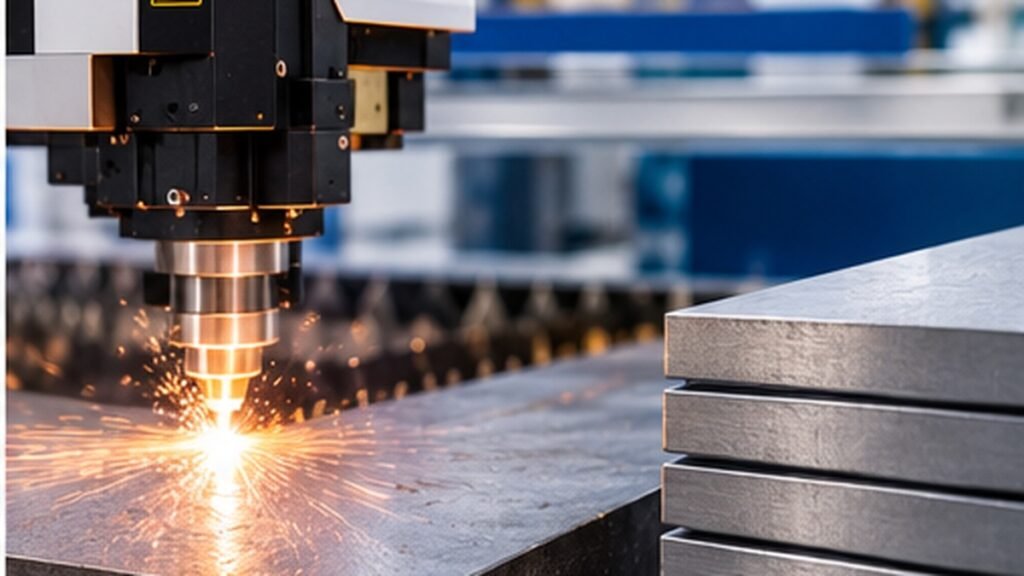
laser beam welding
Most people understand intuitively that welding big structural steel members is hard work. What fewer people appreciate is that welding tiny, delicate components is an entirely different kind of hard, and in many ways a more demanding one.
When your weld zone is smaller than a grain of rice, when the wall thickness of the part is measured in tenths of a millimeter, when the component sitting 2mm from your weld joint cannot tolerate any heat whatsoever, the rules change completely. The tools change. The skills required change. And the consequences of getting it wrong are immediate and unforgiving.
This is exactly the territory where laser beam welding earns its reputation. Precision laser welding of small parts is one of the most technically demanding manufacturing operations in existence, and it is also one of the most enabling. Parts that simply could not be made any other way come out of precision laser welding operations every day, bound for pacemakers, spacecraft, surgical instruments, and defense systems.
Here is a thorough look at how it works, what makes it so challenging, and what separates shops that do it well from those that just claim they can.
Why Small Parts Demand a Completely Different Welding Approach
1. The Problem with Conventional Welding on Miniature Components
Take a TIG torch anywhere near a component with 0.3mm wall thickness and you will understand the problem immediately. The arc produces heat across a zone many times larger than the part itself. The filler rod, even at its smallest diameter, adds mass that overwhelms a miniature joint. The heat-affected zone spreads through the entire component in milliseconds, annealing, distorting, or outright melting features that needed to stay intact.
MIG welding is even less suitable. The arc energy, the wire feed, and the process dynamics all operate at scales that have no business being near precision miniature work. Even the best conventional welders, highly skilled people with decades of experience, cannot overcome the physical limitations of arc-based processes at this scale.
2. What Makes Laser Welding the Natural Fit for Small Parts
The laser beam is a fundamentally different energy delivery tool. It concentrates energy onto a spot that can be smaller than the weld zone itself, deposits that energy in controlled pulses or continuous wave output that can be adjusted in real time, and does all of this without any physical contact with the workpiece. No electrode, no filler rod unless specifically added, no arc plasma spreading heat across unintended areas.
The result is a process that puts heat exactly where you want it, in the quantity you specify, for the duration you control. On a 0.5mm stainless steel tube, that level of control is not just useful. It is the only thing that makes welding that tube a realistic manufacturing operation.
3. The Scale Problem Most Engineers Underestimate
Here is something that catches people off guard when they first encounter precision small part welding. The tolerances that seem forgiving at normal manufacturing scale become enormous challenges at miniature scale. A positional error of 0.2mm means almost nothing on a structural weld. On a 0.8mm diameter weld spot on a medical implant component, 0.2mm of positional error places the beam edge dangerously close to an adjacent feature or completely off the intended joint.
Everything that matters in welding, fixturing accuracy, joint fit-up, beam positioning, thermal management, shielding gas coverage, scales down with the part size but does not become easier. In most cases it becomes significantly harder, and the margin for error at each step shrinks proportionally.
How Precision Laser Welding Actually Works on Small Parts
1. Focused Beam Delivery and Spot Size Control
The starting point for small part laser welding is getting the beam small enough and focused precisely enough to match the joint dimensions. Industrial laser systems used for precision work deliver focused spot sizes ranging from 0.1mm to about 0.5mm at the workpiece surface depending on the optics configuration and laser wavelength.
Shorter wavelength lasers, like green or ultraviolet systems, focus to tighter spots than standard infrared fiber lasers and find application in the smallest-scale work. For most industrial small part welding in the 0.3mm to 3mm thickness range, high beam quality fiber lasers with appropriate focusing optics deliver the spot size control needed without the added complexity of specialized wavelength systems.
The beam delivery system must maintain that focused spot at a consistent standoff distance from the workpiece throughout the weld path. On contoured or three-dimensional small parts, maintaining focal distance requires either precise CNC motion programming or active focus tracking systems that adjust in real time.
2. Pulse Parameters and Energy Management at Micro Scale
Welding with a laser on small parts almost always means pulsed operation rather than continuous wave output. Pulses allow the operator to control exactly how much energy enters the weld zone with each firing, and to allow the part to cool between pulses to prevent heat accumulation that would damage surrounding features or distort the assembly.
Pulse parameters include peak power, pulse duration, pulse frequency, and pulse shape. Each of these affects the weld differently. High peak power with short duration creates rapid, localized energy delivery that minimizes heat spread. Lower peak power with longer duration increases fusion depth but also increases heat input to the surrounding material.
Developing the right pulse recipe for a specific small part application is a process engineering task that requires real weld development work on representative samples. The shop that says it can weld your part immediately without any parameter development is telling you something important about how seriously they take the work.
3. The Role of Fixturing in Small Part Welding Success
If precision laser welding is 50 percent beam control and 50 percent everything else, a significant portion of that everything else is fixturing. A small part must be held in exactly the right position relative to the laser beam, with the joint geometry presented consistently, with enough support to prevent movement during the weld, and without introducing contamination or stress that affects weld quality.
Good fixturing for small part laser welding is often custom-designed for each specific component. It accounts for part loading and unloading speed, thermal expansion during welding, accessibility for shielding gas delivery, and the need for optical access to verify part position before every weld cycle.
Why a 0.1mm Fixture Gap Ruins an Otherwise Perfect Setup
Small part laser welding has essentially zero tolerance for joint gaps. When welding a thin-wall tube to a fitting, or sealing a miniature enclosure, the faces being joined must be in intimate contact. A gap of even 0.1mm allows the weld pool to drop through or bridges poorly, creating a weld that looks acceptable on the outside but has internal voids or incomplete fusion that only shows up under destructive cross-section examination.
This means parts must be machined to mating fits that close up properly under fixture clamping load. It means surface finish on weld faces matters. It means that cleaned, oxide-free joint surfaces are a prerequisite, not an afterthought. Shops that build good fixturing and insist on proper part prep are the ones whose small part welds hold up under examination.
Materials Commonly Welded in Small Part Applications
1. Stainless Steel and Medical-Grade Alloys
Austenitic stainless steels, 304L and 316L in particular, are the most common small part laser welding materials. They respond well to the process, produce consistent welds under controlled conditions, and meet biocompatibility requirements for medical applications. Their moderate thermal conductivity helps contain heat at the weld zone rather than rapidly conducting it into the surrounding part, which is an advantage on thin sections.
Medical-grade variants with controlled sulfur content for improved weldability are specified for implantable devices. These materials are produced to tighter chemical composition ranges than commercial grades and are supplied with full material certifications that trace the chemistry and mechanical properties back to the original heat.
2. Titanium in Miniature Component Welding
Titanium is extensively used in small part laser welding for aerospace, medical, and defense applications. Its combination of high strength-to-weight ratio, excellent corrosion resistance, and biocompatibility makes it the material of choice for implantable housings, aerospace fasteners and brackets, and precision instrument components.
Titanium welds cleanly with laser and achieves excellent joint properties when atmosphere control is properly managed. The challenge, and it is a real one, is that titanium picks up oxygen, nitrogen, and hydrogen contamination from the atmosphere at welding temperatures with extraordinary enthusiasm. Even tiny amounts of contamination produce weld discoloration, porosity, and brittleness that fail inspection. Clean shielding on all surfaces exposed to welding heat is non-negotiable.
3. Precious Metals and Specialty Thin-Wall Applications
Gold, Platinum, and the Jewelry and Sensor Industries
Gold, platinum, and palladium alloys are welded by laser in jewelry manufacturing, dental prosthetics, and precision sensor construction. These materials have specific reflectivity and thermal characteristics that require careful parameter development, but they weld cleanly under the right conditions and the laser’s ability to place energy precisely in a tiny zone without damaging surrounding stones, enamels, or delicate features is simply irreplaceable in jewelry and dental work.
Thin-wall tubing in precious metals and specialty alloys used for temperature sensors, pressure sensing diaphragms, and scientific instrument components represents another category where laser welding is the enabling technology. Wall thicknesses of 0.05mm to 0.2mm that would be destroyed by any conventional process weld cleanly under carefully controlled laser pulse parameters.
Industries That Build Their Products Around Small Part Laser Welding
1. Medical Device and Implantable Component Manufacturing
No industry relies on small part laser welding more fundamentally than medical device manufacturing. Pacemakers, neurostimulators, cochlear implants, drug infusion pumps, and continuous glucose monitors all contain laser-welded components. The housings must be hermetically sealed, the welds must be free of porosity and cracks, and the entire assembly must survive for years inside a human body without degradation.
The standards applied to laser welding in this space are severe. Every weld must be inspectable and traceable. Process validation to FDA and ISO 13485 requirements means that every parameter, every operator qualification, and every deviation is documented. The discipline required to operate in this environment is what separates medical-grade laser welding from general production work.
2. Aerospace Sensors and Miniaturized Assemblies
Aerospace programs generate a continuous demand for miniaturized, precision-welded sensor packages, actuator components, and structural micro-assemblies. Pressure sensors, temperature probes, accelerometers, and attitude control device components all involve small part laser welding at some stage of their production.
AS9100D certification and ITAR registration are baseline requirements for many aerospace small part welding programs. Full material traceability, documented weld procedures, first-article inspection reports, and in many cases customer-approved process qualification are expected before production begins. These requirements exist because the cost of a failed weld on a flight-critical component is measured not just in dollars but in mission and safety outcomes.
3. Electronics, Connectors, and Battery Assembly
Precision connectors, relay contacts, battery terminals, and electronic component leads all use laser welding for joining operations that soldering cannot accomplish reliably at the temperatures or in the materials required. Lithium battery cell tab welding, for example, requires consistent, low-resistance connections in aluminum foil that is 0.1mm thick. Laser welding handles this cleanly at high production rates where mechanical joining and soldering both fall short.
4. Defense and Precision Instrumentation
Defense components including guidance system housings, fuze components, and precision optical mounts require small part welding that meets military specifications for strength, hermeticity, and dimensional stability. Precision scientific instrumentation, mass spectrometers, electron microscopes, and vacuum system components all involve miniature laser-welded assemblies where dimensional accuracy and weld cleanliness directly affect instrument performance.
Key Process Controls That Separate Good Results from Scrap
1. Atmosphere Shielding on Miniature Weld Zones
Shielding on small part laser welding must cover not just the weld pool but all surfaces that reach elevated temperatures during the weld cycle. On a small part, that can mean the entire component. Trailing shields, enclosure boxes flooded with argon, and in demanding cases full glove-box or chamber welding under controlled atmosphere are all employed depending on the material and the weld quality standard required.
Inadequate shielding shows up immediately on reactive materials like titanium as discoloration ranging from light gold through blue to white, each shade representing increasing levels of oxidation and corresponding degradation of weld properties. On stainless steel, poor shielding produces sugaring on the back side of the weld, a rough, granular oxidized surface that indicates heat exposure without shielding coverage.
2. Thermal Management When There Is Almost No Material to Absorb Heat
Heat management on small parts is a genuine engineering challenge. A large weldment absorbs and distributes heat across its mass. A 0.5mm titanium housing has almost no thermal mass. Heat builds up with each weld pulse and has nowhere to go except into the adjacent features you are trying to protect.
Pulse parameters must be developed to balance adequate fusion against heat accumulation. Interpulse cooling time between successive pulses allows heat to dissipate before the next energy delivery. Fixturing that provides thermal contact to a heat sink can pull energy away from sensitive areas. These strategies, applied together, keep small part weld temperatures under control throughout what might be a weld path of dozens of individual pulses around a small seam.
3. Visual Inspection and Quality Verification at the Micro Level
Inspecting small part laser welds requires tools and methods appropriate to the scale. Standard visual inspection is a starting point but reveals only gross defects on tiny weld beads. Stereo microscopes at 10x to 40x magnification are the baseline for surface examination of small part welds. Scanning electron microscopy is used for forensic examination of failures and for process development work.
When Standard Inspection Tools Simply Cannot See What Matters
Internal weld quality on small hermetic seals, the porosity, incomplete fusion, and micro-cracks that might compromise a seal long after external inspection gives a clean result, requires destructive cross-section examination, X-ray, or helium leak testing to detect. Leak testing is the practical standard for hermetic small part welds in medical and aerospace applications, providing a quantitative, traceable result that confirms or denies seal integrity without assumptions about what the surface appearance indicates.
Choosing a Shop That Can Actually Weld Small Parts Well
1. Equipment Capability Requirements for Precision Small Part Work
The equipment required for serious small part laser welding is specialized. The laser system must offer fine pulse parameter control, stable beam quality, and reliable output consistency over time. The motion system or weld stage must position parts with accuracy measured in microns, not millimeters. The fixturing design capability must be in-house, not outsourced. The shielding system must be appropriate for the most reactive materials the shop handles.
Shops that do small part laser welding seriously invest in all of these elements and maintain them rigorously. The machine that runs production parts must be calibrated, documented, and performing to specification. A shop that cannot show you calibration records for their laser system and motion positioning is not operating at the level that precision small part work demands.
2. What Certifications Tell You About a Shop’s Precision Capability
Quality certifications do not guarantee weld quality directly, but they do guarantee that a documented system for controlling process and catching problems is in place. ISO 9001 provides the baseline quality management framework. AS9100D adds the aerospace-specific requirements for traceability, change control, and risk management that precision programs need. ISO 13485 covers medical device manufacturing system requirements.
A shop holding relevant certifications has been audited against those standards by an accredited third party and found conforming. That audit history, along with the ongoing surveillance audits required to maintain certification, provides a level of assurance about process discipline that no uncertified shop can offer regardless of what they claim.
3. Questions to Ask Before Sending Your First Parts
Before committing small parts to any shop, ask directly about their specific experience with your material and feature size. Ask whether they develop and validate weld procedures for new jobs or just set up and run. Ask what inspection methods they apply to small part welds and whether they can provide cross-section data from process development samples. Ask about their shielding approach for reactive materials. Ask who qualifies their weld operators and what that qualification entails.
The answers to these questions reveal whether a shop genuinely understands small part precision welding or is hoping their general laser capability will be close enough to get through your job. For precision work, close enough is not a concept that belongs in the conversation.
Conclusion
Precision laser welding of small parts sits at the demanding edge of what manufacturing can accomplish. It requires the right equipment, the right process development discipline, the right fixturing, the right atmosphere control, and the right inspection capability working together on every single job. When all of those elements align, the process produces results that nothing else in manufacturing can replicate: clean, strong, hermetic welds on components so small that conventional welding would destroy them before the first arc ever struck. Finding a shop that brings all of those elements together reliably is the most important step toward making your small part program successful.
Frequently Asked Questions
- What is the smallest part size that laser welding can handle?
Laser welding handles parts with weld zones under 0.1mm diameter in specialized applications. Medical and electronics components with features in the 0.2mm to 0.5mm range are welded in regular production at qualified shops. - Does laser welding on small parts require filler material?
Most small part laser welding is autogenous, meaning it fuses base metal only without added filler. Filler wire can be added when joint geometry or material combination requires it, but it complicates the process at miniature scales. - How do shops verify hermetic integrity on small welded parts?
Helium leak testing using a mass spectrometer leak detector is the standard method, capable of detecting leak rates far below what any other test method can measure on small hermetic assemblies. - Can dissimilar metals be laser welded on small parts?
Yes, though the combination must be metallurgically compatible. Stainless steel to titanium, kovar to stainless, and certain other pairs are routinely joined by laser welding in medical and aerospace applications with proper procedure development. - How long does weld procedure development take for a new small part?
Development time varies by complexity, but a new small part weld procedure including sample welding, cross-section examination, and process parameter documentation typically takes days to a few weeks before production qualification is complete.