Radon Mitigation St Louis
Quick Answer
Radon is a naturally occurring radioactive gas that seeps into homes from soil beneath the foundation, and it’s the second leading cause of lung cancer in the United States after smoking. It has no smell, taste, or color, so the only way to know your home’s level is through testing. The EPA’s action level is 4.0 pCi/L, and homes testing at or above that number benefit from radon mitigation, a proven, relatively affordable fix that typically takes a single day to install. Scheduling radon testing St Louis appointments is really the only starting point that makes any of this actionable.
What Radon Actually Is
Where It Comes From
Radon forms when uranium in soil and rock naturally breaks down over time. This happens essentially everywhere, since trace uranium exists in soil across most of the country, including throughout the St. Louis region specifically. As that uranium decays through a chain of radioactive elements, it eventually becomes radon gas, which moves upward through soil looking for any path of least resistance, including straight into your home through foundation cracks, gaps around pipes, and sump pits.
Why You Can’t Detect It Yourself
This is the part that catches people off guard. Radon has no smell, no taste, no visible presence at all. Unlike a gas leak or mold, there’s nothing your senses will pick up on to warn you. A home can have dangerously elevated radon for years, even decades, with absolutely no sign anything’s wrong, which is exactly why testing matters more than trusting your gut or your home’s general condition.
Why Radon Matters for Your Health
The Long-Term Lung Cancer Risk
The EPA estimates radon causes approximately 21,000 lung cancer deaths annually in the United States, making it the leading cause of lung cancer among non-smokers specifically and the second leading cause overall. The risk isn’t immediate or acute, it builds cumulatively over years of exposure, which means there’s no dramatic symptom to watch for, just a long-term risk that grows the longer elevated levels go unaddressed.
Why St. Louis Specifically Carries Higher Potential
Much of the St. Louis metro, on both the Missouri and Illinois sides, falls into the EPA’s higher radon potential classification, largely due to regional soil and geological composition. This doesn’t mean every home here has a problem, but it does mean elevated readings are common enough that radon testing St. Louis has become a routine, expected part of homeownership and real estate transactions in this specific market. Anyone new to the area quickly learns that radon testing St. Louis conversations come up far more often here than in many other parts of the country.
How to Find Out If Your Home Has a Problem
Testing Options and What They Involve
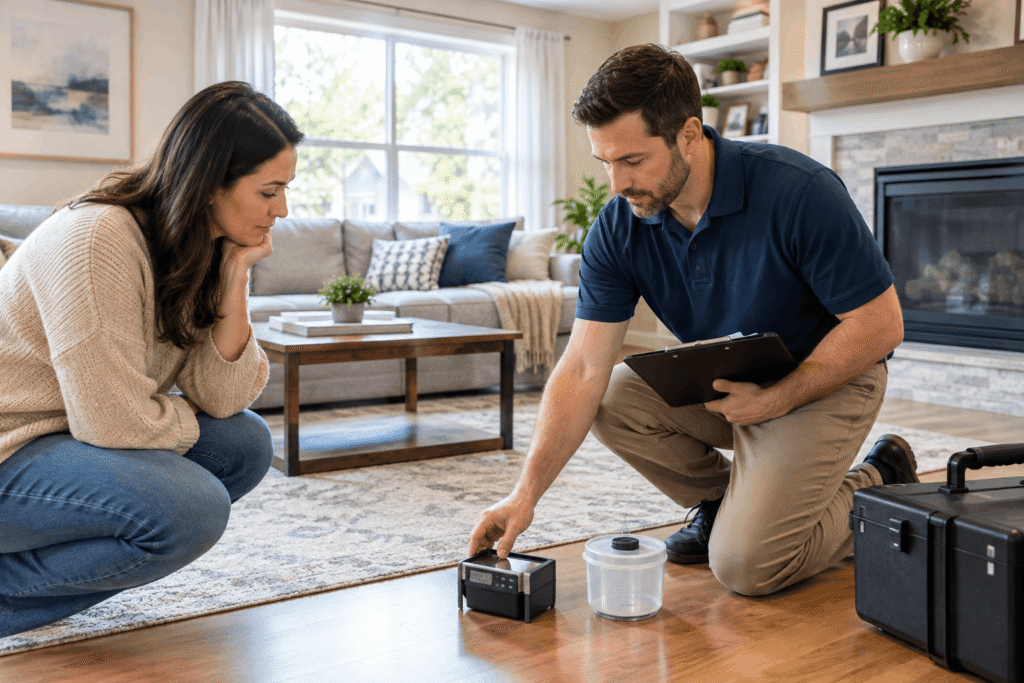
You’ve got a few paths here. Short-term DIY kits run $15 to $30 and take a minimum of 48 hours under closed-house conditions. Long-term kits spanning 90 days to a year give a more complete seasonal average. Professional continuous monitor testing, typically $125 to $250, follows the same 48-hour minimum but delivers same-day certified results, the option most real estate transactions require. Most radon testing St. Louis appointments I run for real estate deals use this professional monitor approach specifically for that reason.
Understanding Your Results
Results below 2.0 pCi/L are generally considered low-concern. Between 2.0 and 3.9 pCi/L sits in a range where some homeowners choose to act and others don’t, it’s a personal call rather than a formal recommendation. At or above 4.0 pCi/L, the EPA recommends mitigation, and most homeowners I work with move forward once they see a number in that range.
What Happens If Your Home Tests High
If your result comes back elevated, radon mitigation St Louis installation is the standard, proven fix. A technician installs a sub-slab depressurization system, typically a single suction point, PVC piping routed to the exterior, and a fan that runs continuously to pull soil gas out from beneath your foundation before it ever enters your living space. This usually reduces radon levels by about 99 percent and takes just a few hours in most homes. A post-installation test confirms the fix actually worked before the job is considered complete.
A Homeowner Who Didn’t Know for Fifteen Years
I tested a home in Florissant a couple years back for a homeowner who’d lived there fifteen years without ever testing, mostly because nobody had ever really explained why it mattered beyond a vague warning she’d half-remembered from somewhere. Her result came back at 11.6 pCi/L, nearly three times the EPA’s action level, and had almost certainly been elevated for the entire time she’d lived there. Nothing about her daily life had ever hinted at a problem, no smell, no symptom, nothing. We installed a mitigation system, and her post-test came back at 0.8 pCi/L. She told me afterward that the thing that actually got her to finally test wasn’t fear, it was just finally understanding what radon actually was and why the invisible part mattered so much. That radon mitigation St Louis installation quietly ended fifteen years of exposure nobody had ever realized was happening. That’s really the whole point of homeowner education on this topic, understanding beats vague worry every time.
Conclusion
Radon is a naturally occurring, invisible gas that poses a genuine long-term health risk, and the St. Louis region’s soil composition means it’s a realistic concern for homes throughout the metro regardless of age or condition. The good news is that finding out where you stand is straightforward and affordable, and fixing a problem once it’s found is equally manageable. Radon mitigation St Louis installation resolves elevated levels quickly and effectively, but that fix only happens once testing reveals the problem exists in the first place. If you’ve never tested your home, or if it’s been years since you did, don’t let the invisible nature of this gas talk you into assuming everything’s fine, or that radon mitigation St Louis work is something other homeowners deal with, not you. Reach out to Air Sense Environmental and I’ll help you find out where your home actually stands.
FAQs
- Can radon levels change over time in the same house? Yes, seasonal weather, foundation settling, and renovation work can all shift levels, which is why periodic radon testing St. Louis check-ins matter even after a clean result.
- Is radon testing expensive? No, DIY kits start around $15, and professional radon testing St. Louis appointments typically run $125 to $250, both modest compared to the health risk being ruled out.
- Does every home need a mitigation system installed regardless of testing? No, mitigation is only recommended for homes testing at or above the EPA’s 4.0 pCi/L action level, not as a universal precaution.
- How long does radon mitigation St Louis installation typically take? Most homes are completed in a single visit, usually two to four hours, with more complex foundations occasionally taking longer.
- Is radon only a concern in older homes? No, radon comes from soil rather than the home itself, so new construction can test just as high as an older house on the same lot.