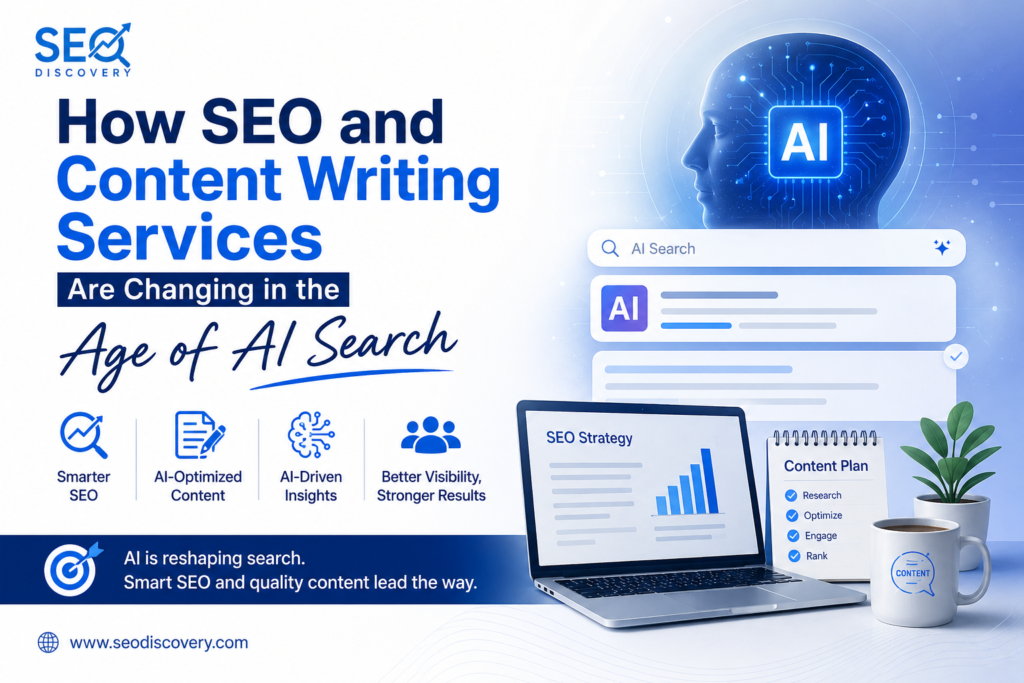
For two decades, ranking well meant one thing: earning a spot in a list of blue links. A user typed a query, ten results appeared, and the job of any SEO and content writing services provider was to get a client’s page into that list, ideally near the top. That world hasn’t disappeared, but it is no longer the whole picture. Today a growing share of queries never produce a list at all. They produce an answer, synthesized on the spot by an AI system that pulls from multiple sources, compresses them into a few paragraphs, and sometimes cites where the information came from, and sometimes doesn’t.
This shift is forcing a genuine rethink of what good SEO content writing services actually deliver. It’s no longer enough to rank. Content now has to be built so that AI systems can find it, trust it, and pull clean, accurate passages from it. That’s a different discipline from classic optimization, and it’s reshaping how a serious content writing company approaches every brief.
Two Systems, One User
The clearest way to understand the change is to recognize that search results pages and AI answer engines are now two separate but related systems. Search Engine Results Pages still rank webpages based on relevance, authority, and technical health. AI answer engines like AI Overviews, Perplexity, and conversational assistants instead retrieve passages, synthesize them into a direct answer, and decide which sources, if any, deserve a citation.
Both systems are ultimately proxies for the same goal: satisfying the person who asked the question. But the mechanics of winning visibility in each are meaningfully different. A page can rank comfortably on page one and still be almost invisible to an AI answer engine because its content isn’t structured for extraction. Equally, a page can be a frequently cited source in AI answers while lacking the backlinks and technical polish needed to rank in classic search. Understanding which gap you’re dealing with, a ranking gap or a citation gap, is now a foundational part of any serious seo content writing company’s diagnostic process.
What Makes Content Citable, Not Just Rankable
Classic SEO rewarded pages that were comprehensive, well-linked, and technically sound. Those fundamentals still matter, but AI systems are evaluating something additional: whether a specific passage can be lifted out of a page and still make sense on its own.
A few qualities determine whether content earns that trust.
Directness matters more than ever. AI systems favor content that states the answer within the first sentence or two of a section, then supports it with detail. The narrative style that once kept readers scrolling, building up to a conclusion, tends to work against extraction. Answer-first writing wins.
Specificity beats generality. Named entities, concrete numbers, dates, and clearly defined terms are far more citable than vague claims. A statement like “conversion rates typically improve with faster load times” is weak. A statement with an actual benchmark, source, and context is strong.
Self-contained paragraphs perform better. Because retrieval systems pull passages rather than entire pages, each section needs to hold up on its own, without depending on context from three paragraphs earlier.
Original data and frameworks carry outsized weight. AI systems default to whichever source said something first or most clearly. Content built entirely from paraphrased consensus rarely earns a citation, while original research, proprietary frameworks, or first-hand case data consistently do.
This is the practical core of what any modern seo and content writing services engagement needs to deliver: content written to be understood by both a human reader and a machine that’s deciding whether to trust and quote it.
Trust Hasn’t Gotten Easier, It’s Gotten More Explicit
Experience, expertise, authoritativeness, and trust were already the backbone of quality content before AI answer engines existed. What’s changed is how visibly that trust needs to be demonstrated. AI systems weigh author and organization identifiability, whether a claim is corroborated by other credible sources, and whether the source has a track record of accuracy. A single unattributed claim on an anonymous page is unlikely to be cited, no matter how well-optimized the page is technically.
This raises the bar for any content writing company producing material at scale. Bylines, credentials, clear sourcing, and consistency across a domain’s published history all now function as ranking and citation signals, not just editorial nice-to-haves. For topics touching health, finance, safety, or civic matters, that bar climbs even higher, since inaccurate answers in those categories carry real consequences.
Structure Is No Longer Optional
Getting content indexed and retrieved by AI crawlers requires more deliberate technical groundwork than classic SEO did. Clear entity definition in the opening lines, logically chunked sections with real headers, and structured data markup like FAQ, HowTo, or Article schema all make claims easier for a retrieval system to parse accurately. Confirming AI crawlers aren’t blocked, where visibility in AI answers is actually a goal, has become a standard technical check.
None of this replaces the fundamentals of technical health that have always mattered: crawlability, mobile usability, page speed, and clean site architecture. It sits on top of them. A page that fails on the basics will struggle in both systems regardless of how well the writing itself is structured.
What This Means for Choosing a Partner
For a business deciding who to trust with content strategy, this shift changes the evaluation criteria. A provider that still measures success purely by keyword rankings and backlink counts is optimizing for half the picture. The stronger seo and content writing services providers are now producing dual-track reports, one line of evidence for how content performs in classic search, another for whether it’s actually being retrieved, trusted, and cited by AI systems, and using the gaps between the two to prioritize what gets fixed first.
This is also where the volume of general seo blogs circulating online becomes a liability rather than an asset for brands that publish without a real framework behind it. Thin, templated posts built purely to hit a word count and a keyword density target are exactly the kind of content both classic search quality raters and AI answer engines are built to filter out. The content that wins now is the content built with genuine expertise, clear structure, and evidence a reader (or a retrieval system) can verify.
Where This Leaves Businesses in 2026 and Beyond
The practical reality is that SEO and content writing are converging into a single discipline rather than splitting into separate silos. Writing for humans and writing for machines used to feel like tension. Increasingly, they demand the same thing: direct, well-sourced, structurally clear content that earns trust on first read. Businesses that treat this as an evolution of existing content discipline, rather than an entirely new skill set bolted on afterward, are the ones positioned to hold visibility across both search engines and AI answer engines as the landscape keeps shifting.
This is the standard SEO Discovery applies across every content engagement, building material that’s rigorous enough to earn trust from a search engine, an AI system, and the person actually reading it. If your current content strategy hasn’t been evaluated against both of these systems yet, that’s the gap worth closing next.
Ranking lists and AI answers aren’t competing formats forever locked in tension, they’re two expressions of the same underlying demand: give people, and the systems that serve them, an answer they can actually trust.