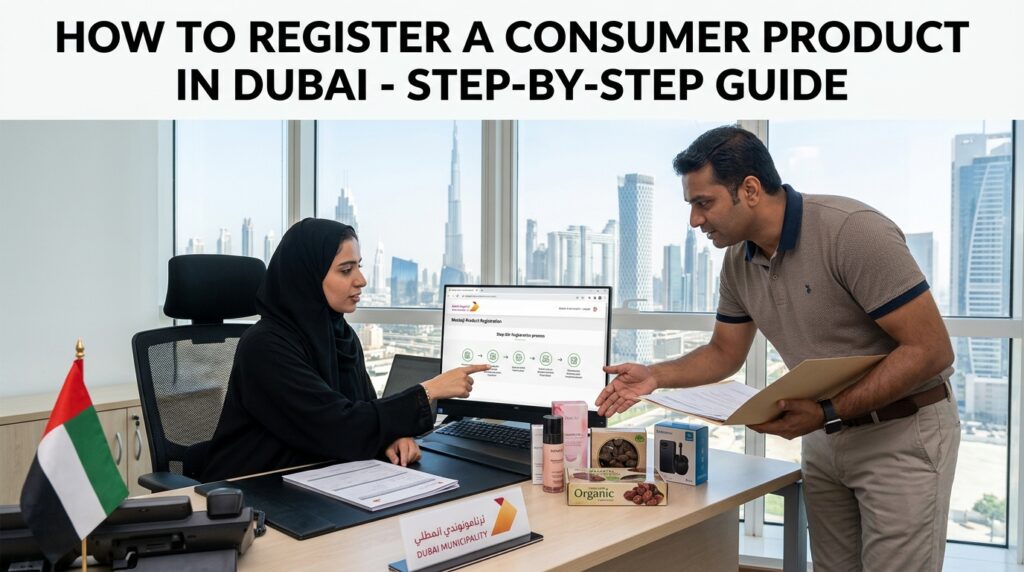
Registering a consumer product in Dubai is a required step before many products can be imported, launched, or sold in the market. The process is designed to protect consumers and make sure products meet local safety, labeling, and compliance standards.
For businesses, this is not just a paperwork task. It is part of market entry. If the registration is done correctly, the product can move through customs, shelf placement, and sales more smoothly. If it is done poorly, the company may face delays, rejection, or extra compliance work.
What it means
Dubai Consumer Product Registration is the official approval process for products sold to the public, such as cosmetics, detergents, disinfectants, and similar regulated items. In Dubai, this is usually handled through Dubai Municipality systems such as Montaji for consumer products, while food products are handled through a separate food registration route.
A registered product typically receives an approval or registration certificate that confirms it has passed the required checks. The certificate is generally valid for a fixed period and must be renewed or updated if product details change.
Why it matters
This process matters because Dubai does not allow harmful or non-compliant consumer products to be launched freely into the market. Registration helps ensure that products are safe, properly labeled, and supported by the right documents before they reach customers.
It also matters commercially because retailers, distributors, and import channels often expect formal product approval before they will work with a brand. A product that is not registered properly can face delays at launch, especially when customs, municipality reviews, or retailer compliance teams request proof of approval.
Who needs it
Any business that wants to sell regulated consumer products in Dubai should expect registration requirements. This is especially relevant for companies in cosmetics, detergents, disinfectants, health supplements, and other non-food consumer categories.
The company usually needs a valid UAE trade licence with the correct activity before applying. That means product registration is not a standalone step; it depends on having a properly licensed business in place first.
Step-by-step process
Step 1: Get the right trade licence
Before anything else, the business must have a valid trade licence with an activity that matches the product category. The authority will check whether the applicant is legally allowed to trade in that product type.
This is important because if the licence activity does not fit the product, the registration process can be delayed or blocked.
Step 2: Choose the correct portal
For consumer products, businesses generally use the Dubai Municipality consumer product registration route, commonly referred to as Montaji. Food products follow a different process, so the category must be identified correctly first.
This distinction matters because the documentation and review rules are not identical across product types. Selecting the wrong route can cause extra remarks or rejection.
Step 3: Prepare the required documents
The documents usually include product artwork, labels, ingredient or composition details, analysis reports, and supporting certificates depending on the product. For some products, a free sale certificate, GMP certificate, MSDS, or Halal certificate may also be required.
The exact list depends on the product type and where it is manufactured. Imported products often need proof that they are freely sold in the country of origin, while locally made products may need manufacturing-related documents.
Step 4: Review the label carefully
Label review is one of the most important parts of the process. Dubai Municipality expects the product label to clearly show the required information, and the wording must match the product details submitted in the application.
For food products, label expectations can include brand name, product name, ingredients, country of origin, manufacturer details, product barcode, batch number, and net weight or volume. Consumer product labels also need to avoid misleading or unapproved claims.
Step 5: Submit the application
Once the documents are ready, the business submits the application through the Dubai Municipality system and pays the required fee.
At this stage, accuracy matters. If the product name, images, label, or ingredient data do not match, the application may be returned for corrections or rejected.
Step 6: Respond to remarks
After submission, the authority reviews the file and may issue remarks. Some remarks are minor and can be corrected by resubmitting the missing details, while major issues such as banned ingredients, unsupported claims, or missing core documents can lead to rejection.
This is where many applications slow down. The faster the business responds to the remarks and the cleaner the revised file is, the smoother the registration process becomes.
Step 7: Receive approval
If the product passes review, the authority issues the registration certificate electronically. This certificate is then used as proof that the product has been approved for the Dubai market.
Once approved, the product can move forward for commercial launch, distribution, or import, depending on the business model. The company should still keep track of product changes, because updates to formula, label, or packaging may require fresh review.
Common real-world checks
Authorities often look closely at ingredient safety, label claims, and consistency between documents. If the product mentions health, cosmetic, or performance claims, the company may need additional proof or technical support for those statements.
For imported products, a free sale certificate from the country of origin is commonly expected, and some product types may also require laboratory analysis or other supporting proof. This is especially common where safety, composition, or specialized ingredients are involved.
Common mistakes
One of the biggest mistakes is starting the process without the right trade licence activity. Another common issue is submitting incomplete documents or using a label that does not match the product description.
Businesses also get delayed when they assume all product types follow the same process. Food products, cosmetics, disinfectants, and supplements can each have different authority expectations, so the category has to be confirmed from the start.
Practical timeline
Approval time varies depending on product type, document quality, and whether remarks are raised. In smooth cases, the process can be completed in a relatively short period, but extra corrections or missing documents can slow it down.
That means businesses should not wait until the last moment before launch. A better approach is to prepare the file early so the product is ready for sale without last-minute compliance pressure.
Conclusion
Registering a consumer product in Dubai is a structured compliance process, not just a formality. The business needs the correct licence, the right portal, complete documents, accurate labels, and clear product information before approval can be granted.
For brands that want to enter Dubai successfully, product registration is a necessary step that protects both the company and the consumer. When the file is prepared properly and the details are consistent, the process becomes much easier and the product can move to market with fewer delays.
FAQs
What is consumer product registration in Dubai?
It is the official approval process required for regulated consumer products before they can be sold or imported.
Which portal is used for consumer products?
Consumer products are typically handled through Dubai Municipality’s Montaji route, while food products follow a different portal.
What documents are usually needed?
Common documents include product artwork, labels, ingredient details, analysis reports, and sometimes free sale, GMP, MSDS, or Halal certificates.
How long does it take?
Approval time varies depending on the product and document quality.
How long is the certificate valid?
The registration certificate is generally valid for a fixed period and must be renewed if required.