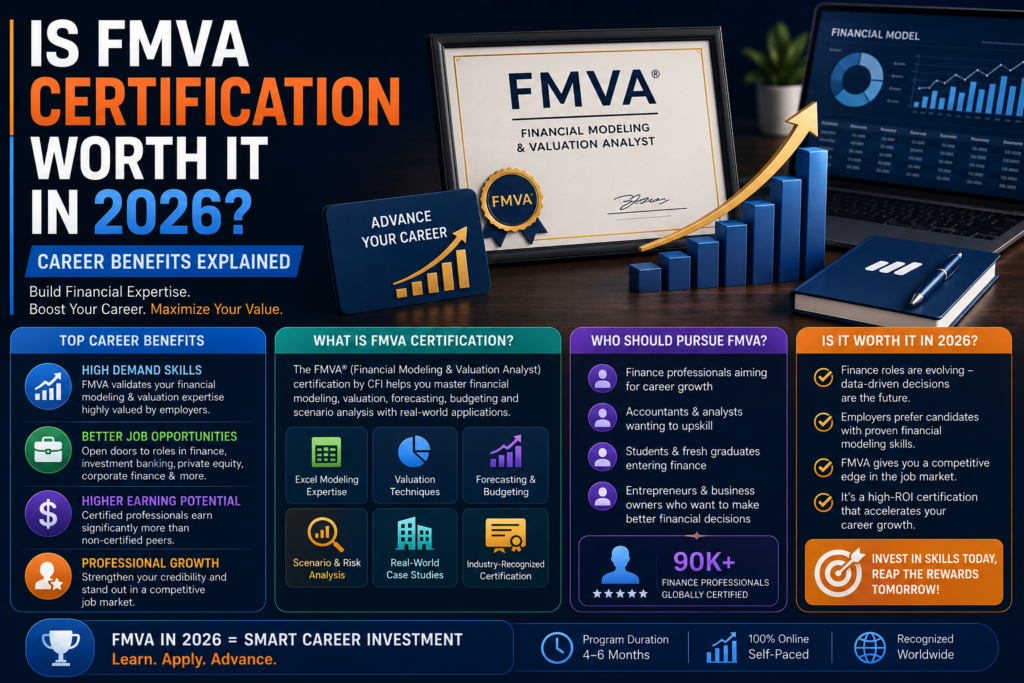
Financial modeling has become one of the most valuable skills in corporate finance, investment banking, equity research, financial planning, and business analysis. Organizations increasingly rely on financial professionals who can build accurate models, analyze business performance, forecast future results, and support strategic decision-making through data-driven insights.
The Financial Modeling & Valuation Analyst (FMVA) certification is designed for professionals who want to strengthen these practical finance skills. Many students and working professionals consider earning the certification to improve their technical expertise and career prospects. However, before investing time and money, a common question arises: Is the FMVA certification worth it in 2026?
The answer depends on your career goals, existing experience, and the type of finance role you want to pursue. This guide explores the certification’s value, career benefits, potential opportunities, and how it can support long-term professional growth.
What Is the FMVA Certification?
The FMVA certification focuses on practical financial modeling, valuation techniques, budgeting, forecasting, financial statement analysis, business analysis, and Excel-based financial decision-making.
Unlike certifications that emphasize theoretical finance concepts, FMVA is designed to develop job-ready skills used by finance professionals in their daily work. Candidates typically learn how to analyze financial data, create forecasting models, evaluate investments, and present financial insights that support business decisions.
Because financial modeling is widely used across industries, these skills remain relevant in banking, consulting, corporate finance, private equity, and many other business environments.
Watch Cert Mage YouTube guide on FMVA Certification.
Why Financial Modeling Skills Matter
Modern organizations generate enormous amounts of financial data.
Business leaders depend on finance professionals who can transform that information into meaningful forecasts, valuation models, investment analysis, and strategic recommendations. Financial modeling helps organizations evaluate acquisitions, prepare budgets, estimate future performance, assess business risks, and support long-term planning.
Professionals with strong modeling skills often become valuable contributors to financial decision-making because they combine analytical thinking with practical business knowledge.
Career Benefits of FMVA Certification
The certification offers several advantages for professionals seeking finance-related careers.
Some of the key benefits include:
- Strengthens financial modeling skills
- Improves valuation knowledge
- Builds practical Excel expertise
- Demonstrates commitment to professional development
- Supports career advancement
- Enhances analytical thinking
- Increases confidence during financial analysis
These benefits are especially valuable for professionals whose daily responsibilities involve financial reporting, investment evaluation, budgeting, or forecasting.
Career Opportunities
FMVA skills can support a wide variety of finance careers.
| Career Role | How FMVA Skills Help |
| Financial Analyst | Build financial models and business forecasts |
| Corporate Finance Analyst | Support budgeting and investment decisions |
| Investment Banking Analyst | Perform valuation and financial analysis |
| Equity Research Analyst | Analyze companies and estimate business value |
| FP&A Analyst | Develop forecasts and financial planning models |
| Business Analyst | Evaluate financial performance and business trends |
While employers consider many factors during hiring, practical financial modeling skills are widely applicable across these roles.
Does FMVA Improve Employability?
Certification alone does not guarantee employment, but it can strengthen your professional profile.
Recruiters often value candidates who demonstrate practical finance skills alongside academic qualifications and work experience. FMVA helps show that you have invested time in learning financial modeling, valuation techniques, and analytical methods commonly used in business environments.
Candidates who combine certification with internships, projects, or relevant work experience generally become more competitive in finance recruitment processes.
Salary Considerations
Many professionals pursue FMVA because they hope it will lead to higher-paying opportunities.
Salary depends on several factors, including:
- Professional experience
- Geographic location
- Industry
- Employer
- Job responsibilities
- Technical expertise
The certification itself does not guarantee a salary increase. However, professionals with strong financial modeling skills may become eligible for positions involving budgeting, valuation, financial planning, investment analysis, and corporate finance, which often offer attractive long-term earning potential.
Developing practical skills remains the most important factor in career progression.
Who Should Consider FMVA Certification?
FMVA Certification is suitable for professionals at different stages of their finance careers.
It may be particularly valuable for:
- Finance students
- Recent graduates
- Financial analysts
- Investment banking professionals
- FP&A specialists
- Accountants expanding into corporate finance
- Business analysts
- Professionals planning a career transition into finance
Before enrolling in the FMVA Certification, candidates should evaluate whether the curriculum aligns with their career goals, current skill level, and long-term professional objectives.
How to Maximize the Value of the Certification
Completing the certification is only the first step.
To gain the greatest career benefit, apply financial modeling techniques through practical projects, internships, case studies, and workplace assignments. Building complete financial models using real business scenarios strengthens both technical ability and professional confidence.
Continuing to improve Excel skills, financial analysis techniques, communication abilities, and business understanding also supports long-term career development.
Many candidates also enhance their preparation using structured study resources, practice exercises, and mock assessments available through Cert Mage alongside their regular learning plan.
Looking Ahead
Demand for professionals who understand financial modeling, valuation, forecasting, and business analysis is expected to remain strong as organizations continue making data-driven financial decisions.
Emerging technologies such as artificial intelligence and automation may change how financial data is processed, but professionals who can interpret results, evaluate investments, and support strategic planning will continue to play an important role in modern finance teams.
Developing practical analytical skills alongside certification will help professionals remain competitive in the years ahead.
Conclusion
The FMVA certification can be a worthwhile investment for professionals pursuing careers in corporate finance, financial analysis, investment banking, equity research, and financial planning. While it does not guarantee employment or higher salaries, it demonstrates practical financial modeling expertise and supports long-term professional development.
By combining certification with hands-on experience, continuous learning, and strong analytical skills, finance professionals can improve their qualifications and prepare for a wide range of career opportunities in 2026 and beyond.
FAQs
Is the FMVA certification suitable for beginners?
Yes. Students, recent graduates, and early-career finance professionals can benefit from learning practical financial modeling and valuation techniques that support future careers in finance and business analysis.
Does FMVA certification guarantee a higher salary?
No. Salary depends on experience, employer, industry, location, and job responsibilities. The certification strengthens your skills and qualifications but does not automatically increase compensation.
Which careers benefit most from FMVA certification?
Financial analysts, investment banking analysts, FP&A professionals, equity research analysts, corporate finance specialists, and business analysts commonly benefit from practical financial modeling and valuation expertise.
Is practical experience more important than certification?
Yes. Employers generally value professionals who combine certification with internships, workplace projects, and real financial modeling experience that demonstrates practical problem-solving and analytical capabilities.
Is FMVA certification worth pursuing in 2026?
For professionals interested in financial analysis, corporate finance, valuation, or investment-related careers, FMVA remains a valuable certification when combined with continuous learning and practical experience.
Read More: https://enkling.com/read-blog/347